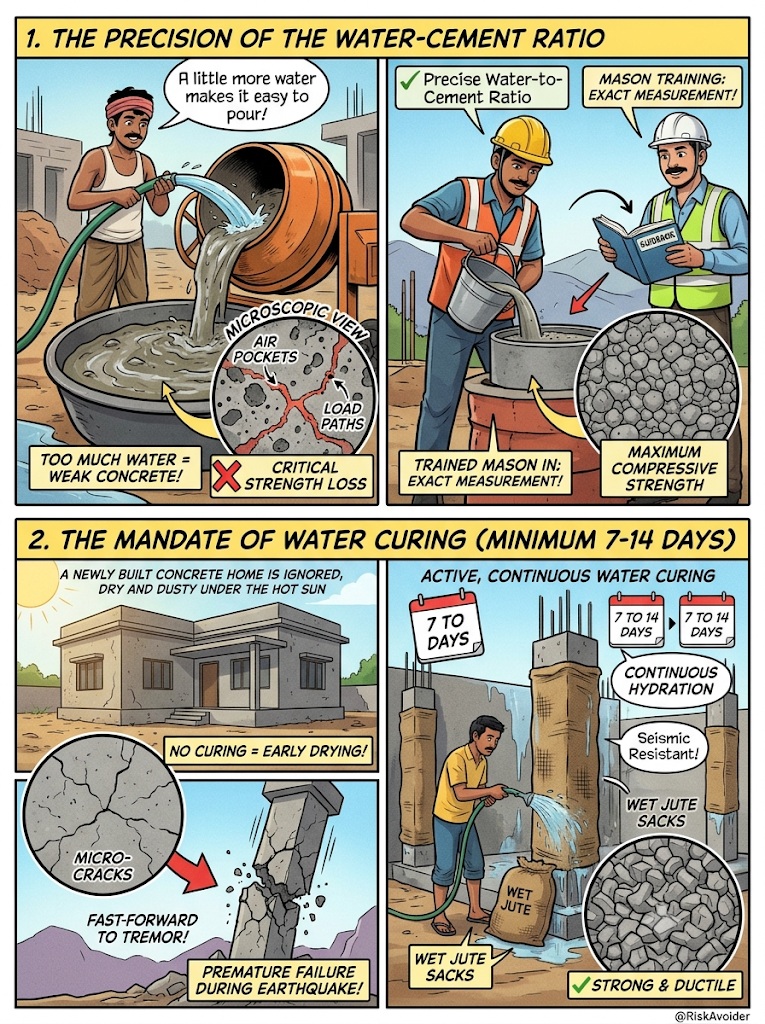
 Santa was standing next to a massive, messy pile of grey concrete mix outside his under-construction highway dhaba in Uttarakhand.
He was holding a large rubber hosepipe in one hand and a bucket of water in the other, happily splashing water into the concrete pile until it looked like a thin, running lentil soup.
Banta walked up the dirt road, carrying a structural engineering manual and a digital moisture meter. He stepped back as a splash of grey, watery muck landed near his boots.
“Oye, Santa-ji!” Banta yelled, holding his nose.
“Are you trying to prepare a light, watery batter for frying pakoras, or do you honestly think this running grey soup has the strength to support a double-story concrete roof?”
Santa laughed, stirring the watery pile with a spade.
“Banta, you are stuck in the mud of old textbooks!”
“This is what I call ‘hydraulic efficiency’!”
“I started thirty years ago as a helper carrying bricks, and I learned on the job.”
“By adding extra water, the concrete becomes smooth and runs into the columns easily without any hard ramming. It saves my boys hours of labour!”
Banta reached down, picked up a dry chunk of concrete from a pillar cast three days ago, and squeezed it.
It crumbled into dry sand and gravel in his hand.
He pointed his moisture meter at the bone-dry pillar.
“Your hydraulic efficiency is a structural crime, Santa! Concrete isn’t clay; it is a chemical reaction that demands a precise Water-Cement ratio.”
“By drowning this mix, you have washed away its compressive strength!”
“But Banta, it dried quickly in the sun!”
“It looks completely solid!” Santa argued.
“Drying is the enemy of curing, Santa!” Banta shouted.
“A concrete structure is unforgiving when executed poorly.”
“It needs continuous water curing for at least 7 to 10 days to allow the cement molecules to chemically bind with the aggregate.”
“If you let the hot mountain sun bake it dry without curing, microscopic cracks will spiderweb through the core.”
“Outside major metros, 80-90% of constructions proceed without any engineering input, relying entirely on untrained masons who learn by trial-and-error.”
“When a seismic wave hits the central gap, your dry, uncured columns won’t flex—they will simply shatter and pancake, bringing your entire parantha business down on your head!”
Santa looked at the dry, crumbling column, then at his watery mix.
“Oye… so my concrete needs to drink water for a week, not just take a bath on day one?”
“Precisely, Santa-ji,” Banta said.
“If you don’t cure the concrete today, it won’t cure your safety tomorrow.”
संता – बंता की इस जुगलबन्दी से आज हमने क्या सीखा:-
- जल-सीमेंट अनुपात की शुद्धता / The Precision of the Water-Cement Ratio:
- कंक्रीट मिश्रण (RCC) में अत्यधिक पानी मिलाने से उसकी मजबूती बेहद कम हो जाती है। भूकंपीय झटके झेलने के लिए राजमिस्त्रियों को पानी और सीमेंट के सटीक अनुपात को बनाए रखने का वैज्ञानिक प्रशिक्षण दिया जाना आवश्यक है / Excess water in Reinforced Cement Concrete (RCC) mixes drastically reduces compressive strength. Masons must be formally trained to maintain precise water-to-cement ratios to ensure structural load paths remain resilient under stress.
- कंक्रीट तराई (Curing) की अनिवार्यता / The Non-Negotiable Mandate of Water Curing:
- कंक्रीट की ढलाई के बाद कम से कम 7 से 14 दिनों तक उसकी लगातार तराई (curing) करना अनिवार्य है। बिना तराई के कंक्रीट सूखकर कमजोर हो जाता है और भूकंप के दौरान ढह जाता है / Structural concrete requires continuous, wet curing for a minimum of 7 to 14 days to complete chemical hydration. Neglecting curing leads to micro-cracking and premature structural failure during seismic events.
संता – बंता की यह जुगलबन्दी आपको कैसी लगी, कृपया हमें जरुर बताये
व
इस जुगलबन्दी को बेहतर बनाने के लिये अपने सुझाव अवश्य दें।
हमें हमेशा की तरह आपके सुझावों, प्रतिक्रियाओं व कटाक्षो का बेसब्री से इंतजार रहता हैं औरसच मानिये इसी के आधार पर हम अपने आप में, अपनी सोच व रचनात्मकता में सुधार करने को प्रेरित होते हैं।
सो अच्छा – बुरा जैसा आपको महसूस हुवा हो, कमेंट जरुर करते रहें।
#MasonTraining #ConcreteCuring #WaterCementRatio#UnengineeredConstruction #SeismicSafety #SantaBanta
Leave a Reply