 Strategic Guide: Post-Thaw Structural Check (PTSC)
The return of the sun is a relief, but for a Himalayan home, the Thaw Phase is often more structurally taxing than the freeze itself. As ice melts, it releases giga-joules of “Latent Energy,” and water—now in its liquid, mobile state—finds its way into the micro-cracks created by the “Great Desiccation” and the recent “Crystalline Grip.”
This guide is designed to help your community systematically audit their homes for damage before the next weather cycle begins.
The Post-Thaw Audit Checklist
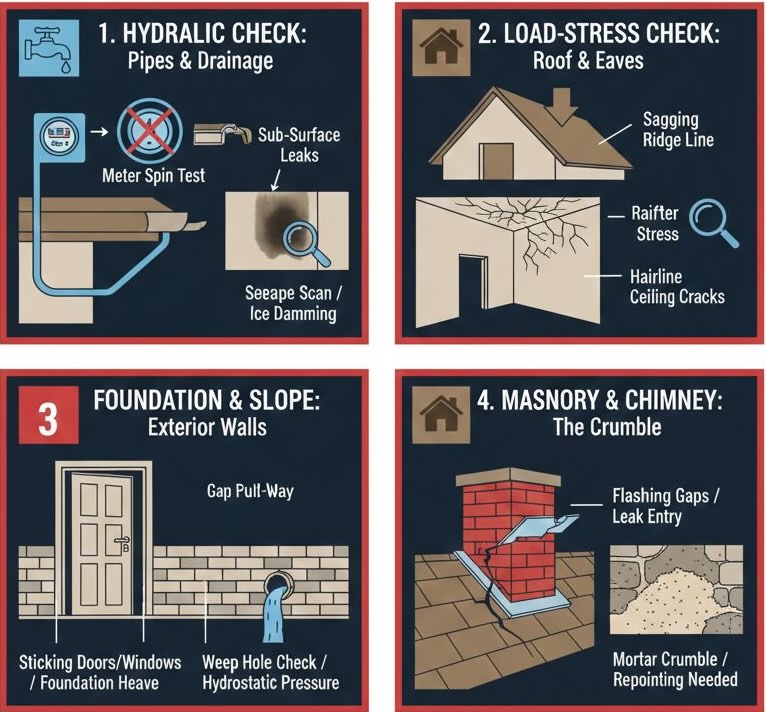
1. The “Hydraulic” Check: Pipes & Drainage
Water expands when it freezes, but it leaks when it thaws.
-
The “Meter Spin” Test: Turn off every tap in the house. Check your water meter or the level in your overhead tank. If it’s dropping, you have a “Sub-Surface Leak” caused by a burst pipe that was previously “plugged” by ice.
-
The Gutter Audit: Check if ice weight has pulled gutters away from the roofline. Ensure downspouts are clear; if they are blocked, the meltwater will “back-flow” under your shingles or into your eaves.
-
The Seepage Scan: Look for “dark blooms” on interior ceilings and walls, especially near corners. This indicates Ice Damming, where meltwater was trapped behind an ice ridge and forced upward into the roof structure.
2. The “Load-Stress” Check: Roof & Eaves
The “Snow-Melt Weight” can be heavier than fresh snow because it becomes saturated with water.
-
The Sag Test: Stand back from your house and look at the “Ridge Line” (the very top of the roof). Does it look perfectly straight, or is there a slight “U-shape” dip? A dip indicates that the Rafters have been stressed by the snow load.
-
The Interior Ceiling Pop: Look for new “Hairline Cracks” in the plaster of your top-floor ceilings. Listen for occasional “popping” sounds; this is the wooden frame adjusting as the weight is lifted.
3. The “Foundation & Slope” Check: Exterior Walls
In the Himalayas, the ground itself moves during the thaw.
-
The “Door-Swing” Audit: Do doors or windows that worked fine last week suddenly stick or “rub” against the frame? This is a primary sign of Foundation Heave, where the freezing/thawing ground has slightly tilted the house.
-
The Retaining Wall Scan: Inspect the stone or concrete walls supporting your terrace. Look for “Weep Holes” (the small holes meant for drainage). If they are dry while the ground is wet, the internal drainage is blocked, creating Hydrostatic Pressure that could lead to a wall collapse.
4. The “Chimney & Masonry” Check
-
The Flashing Gap: Check the area where the chimney meets the roof. The “Thermal Shock” often causes the metal flashing to pull away, creating a direct entry point for the next rain.
-
The Mortar Crumble: Rub your hand over stone walls. If the mortar falls out like sand, the “Freeze-Thaw” has pulverized the binding agent. This needs immediate “re-pointing.”
#PostThawCheck #HimalayanHomeSafety #WinterRecovery #StructureAudit #HimalayanSentinel
आपदा जोखिम न्यूनीकरण सीख: विलम्बित क्षति / DRR Lesson: “The Delayed Collapse”
पहाड़ो में अवसंरचनाओं को होने वाली क्षति का इतिहास बताता है कि अवसंरचनाओं को बर्फ पड़ते समय नुकसान नहीं होता हैं, क्षति प्रायः बर्फ के गल जाने के बाद के हफ्तों में होती हैं। ऐसा पत्थर व लकड़ी की संरचनात्मक यादाश्त बिगड़ जाने के कारण होता हैं। अतः बर्फ न होने का तात्पर्य खतरे का न होना नहीं हैं। सर्दियों के मौसम में प्रतिरोध्यता का मतलब बर्फ गलने के बाद के समय में सावधान व सतर्क रहना हैं / The history of mountain architecture failures tells us that structures rarely collapse during the snow; they fail in the weeks after the thaw. This is because the “Structural Memory” of the wood and stone has been compromised. The “PTSC Protocol” warns us that the absence of snow is not the absence of danger. Vigilance during the thaw is the final step in winter resilience.
Leave a Reply