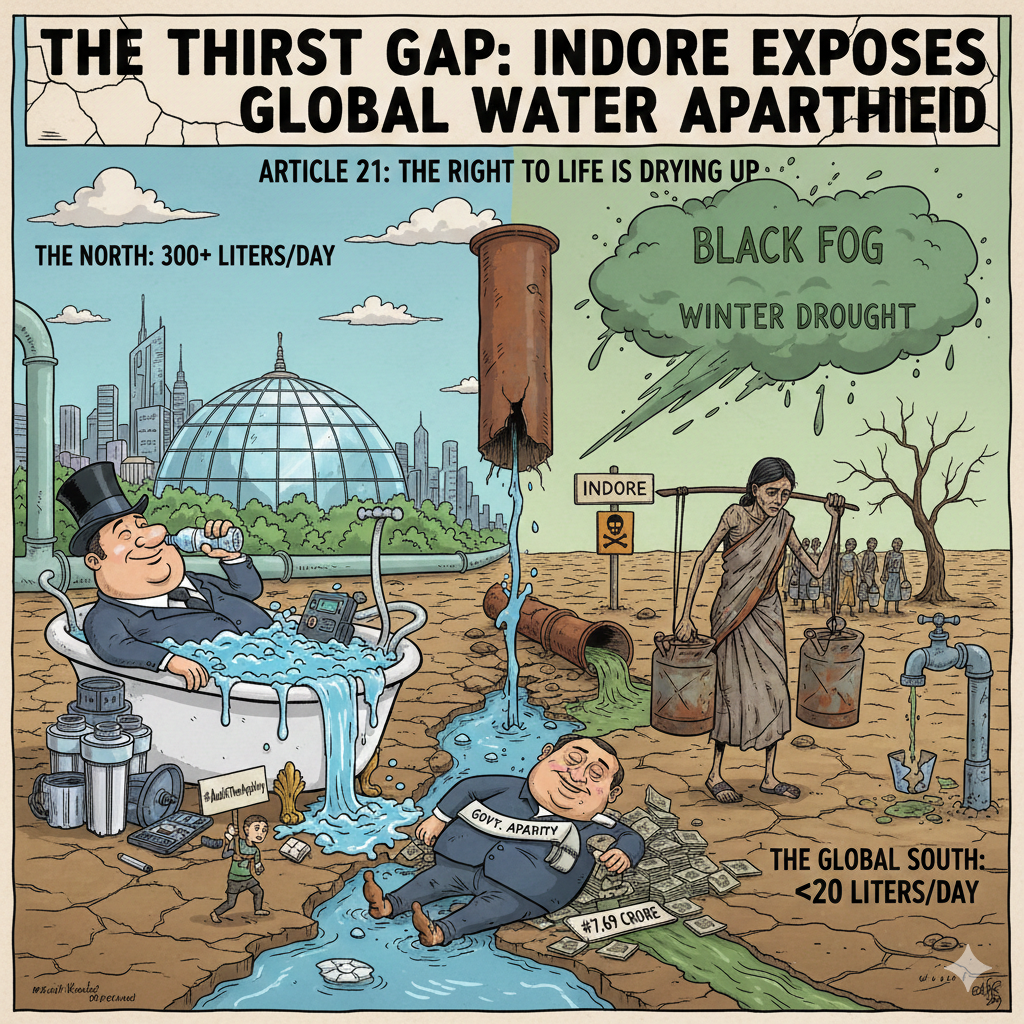
 As Indore’s water tragedy exposes the rot beneath our ‘smart cities,’ we are forced to confront a global hydrological apartheid where clean water is becoming a luxury of the elite rather than a constitutional right. To survive the 2026 winter drought, we must move from surface-level aesthetics to a Mission Mode focused on the ‘Right to Life‘ under Article 21.
1. The Global Scenario: The Great Water Divide
As we enter 2026, the global water landscape is defined by a widening “Hydrological Apartheid.” In developed nations, water is a background utility; in the Global South, it is a daily struggle for survival.
-
The Differential: In high-income countries, average water use per person is 300-500 liters/day. In third-world nations, millions survive on less than 20 liters/day.
-
Growing Disparity: Climate change has accelerated this. The 2026 UN Water Report notes that while the “Global North” invests in multi-billion dollar desalination, sub-Saharan Africa and parts of Asia are seeing a 15% decreasein renewable freshwater availability.
-
The Death Toll: This isn’t just a shortage; it’s a massacre. Globally, water-borne diseases like cholera and typhoid remain the leading killers of children under five. In 2025 alone, contaminated water was linked to over 1.2 million deaths globally—deaths that were entirely preventable.
2. The Indian Subcontinent: A Region on the Edge
South Asia is currently the global “hotspot” for water stress. The year 2026 has begun with a terrifying atmospheric signal: The Winter Drought.
-
Depleted Winter Rains: The Western Disturbances of early 2026 have been historically weak. Without these rains, the “recharge” of Himalayan aquifers and the soil moisture for the Rabi crop are failing.
-
The Pre-Monsoon Fear: If pre-monsoon showers (March-May) fail to arrive, the subcontinent faces a “Heat-Water Nexus” where peak summer demand will hit exactly when reservoirs are at dead-storage levels. We are looking at a potential “Day Zero“ for over 20 major Indian cities.
3. The Indore Tragedy: A Symptom of Apathy
Between January 1 and 3, 2026, the city of Indore—consistently ranked as India’s cleanest city—faced a grim irony. Contaminated water supply in several wards led to a spike in gastrointestinal deaths and hundreds of hospitalizations.
-
The Cause: Preliminary reports suggest a cross-contamination between aging sewage lines and the main water supply pipes, exacerbated by a sudden pressure drop that allowed “back-siphoning” of toxins.
-
Government Apathy: Despite repeated complaints from residents about “yellowish, foul-smelling water” in late December, the municipal response was delayed. The focus on “surface-level” cleanliness (clean roads) masked the “sub-surface” decay of infrastructure.
-
National Implication: Indore proves that Swachh Bharat is a façade if it doesn’t include the invisibility of our water pipes. It reveals a nation that is building smart cities on top of rotting, colonial-era plumbing.
4. The Future Strategy: The New Water Ordinance
To prevent Indore from becoming the national norm, we must shift to a Mission Mode based on constitutional and ecological reality.
-
Right to Clean Water (Article 21): The Indian Judiciary has repeatedly affirmed that the “Right to Life” includes the right to safe drinking water. We must move this from a legal theory to an Actionable Guarantee where local officials are held criminally liable for supply contamination.
-
Water Harvesting as a Mandate: Every new building must be a “Catchment Area.” We need to transition from “Roof-top Harvesting” as a hobby to a National Mission with strict penalties for non-compliance.
-
Sustainable and Equitable Use: We must end the “Water Luxury” of the elite. Zero-waste protocols and the recycling of “Grey Water” for non-potable uses must be mandatory for all industrial and luxury residential zones.
-
Plugging the Loops: Banning reverse osmosis (RO) systems in areas where TDS (Total Dissolved Solids) is within safe limits is essential to stop the 1:3 water-to-waste ratio inherent in RO tech. Furthermore, polluting industries must face Permanent Closure (not just fines) for discharging into aquifers.
Global Examples: The Positive vs. Negative
-
Positive (Israel): 90% of wastewater in Israel is treated and reused for agriculture—the highest in the world. Their “National Water Carrier” system treats water as a sovereign asset.
-
Negative (Cape Town): The “Day Zero” crisis of 2018 remains a warning. It wasn’t caused by a lack of rain alone, but by a failure to diversify water sources and manage demand during “normal” years.
The 2004 Tsunami and the deaths in Indore tell us that nature and infrastructure do not grant holidays to the apathetic. Our ongoing initiatives tell us we have the roadmap for resilience through the National Water Mission, but the rising death tolls from contaminated water and the depleted winter rains warn us that we are running out of time to fix the pipes beneath our feet.
If we do not move from being spectators of water stress to becoming the “Guardians of the Aquifer,” we are not just witnessing a local tragedy in Indore; we are watching the slow dehydration of a nation.
Leave a Reply