 A small community shed was recently built in the village with funds pooled by everyone.
The site chosen was a relatively even patch of ground that was quickly cleared.
However, within a few months, one corner of the shed’s floor has started to sag noticeably, and a crack has appeared in the adjacent wall.
Villagers are gathered, looking worried.
Santa, who was part of the construction committee, says, “I don’t understand!”
“We used good cement, good bricks!”
“Why is this happening?”
“We even had a ‘bhumi puja‘ before starting!”
Banta is quietly observing the ground around the sagging corner.
He notices the soil there is darker, almost black, and feels unusually damp despite no recent rain.
He remembers that old Heera Singh, a very experienced village elder who rarely spoke but observed everything, had muttered something about “murda mitti” when the site was being cleared, but he was dismissed as being overly cautious by the enthusiastic committee.
“Santa,” Banta says gently, “good materials are important, but the ‘neev‘ and the earth beneath it are even more so.”
“Do you recall what Heera Kaka had tried to tell us about this patch of ground?”
“Heera Kaka?”
“He just mumbled something about the soil not being right.”
“But it looked fine to us, easy to work with,” Santa replies defensively.
“Sometimes, Santa,” Banta explains, “what looks ‘fine’ or ‘easy’ to our untrained eyes holds hidden warnings for those who know how to read the earth.”
“Our traditional site selectors, the truly experienced ones, knew how to identify ‘murda mitti‘ – soil that lacks bearing capacity, perhaps because it’s too silty, or it’s from an old waterlogged area, or it has too much organic matter that will decay and cause settling.”
“They would assess the ‘kasawat‘ and ‘samhalne ki shakti‘ of the soil.”
He points to the damp, dark soil.
“This patch here feels different from the ground just a few feet away.”
“It smells a bit stagnant.”
“An expert traditional builder would have likely dug a few test pits, felt the soil at different depths, observed how it behaved when wetted and dried.”
“They would have looked for signs that this land was perhaps an old pond or a marshy spot that was filled in long ago.”
“Such ground is notorious for causing foundations to sink, just like our shed’s corner is doing.”
“So, Heera Kaka’s ‘mumbling‘ was actually a vital geotechnical assessment?” Santa asks, chagrined.
“It was likely an assessment based on a lifetime of observing how different soils behave under load and through seasons,” Banta affirms.
“He wasn’t just being negative; he was sharing an objective observation based on a traditional ‘algorithm‘ of soil indicators.”
“Modern geotechnical engineers do extensive tests with instruments to find these things out.”
“Our ancestors, and experts like Heera Kaka, developed similar acumen through direct, sensory engagement with the earth.”
“They knew that the stability of a structure begins with the ‘prana‘ of the soil beneath it.”
Santa looks at the sagging shed with regret.
“We were in such a hurry to build, so focused on the structure itself, that we ignored the wisdom about the earth it stands on.”
“We should have listened to Heera Kaka.”
“His eyes and hands knew more than our modern haste.”
Banta nods.
“It’s a lesson for us, Santa.”
“This traditional knowledge of reading the land isn’t just folklore; it’s a practical, cost-effective science for ensuring safety and durability, especially for our smaller, everyday structures.”
“We must learn to respect it and integrate it with our modern efforts, not dismiss it.”
संता – बंता की इस जुगलबन्दी से आज हमने क्या सीखा:-
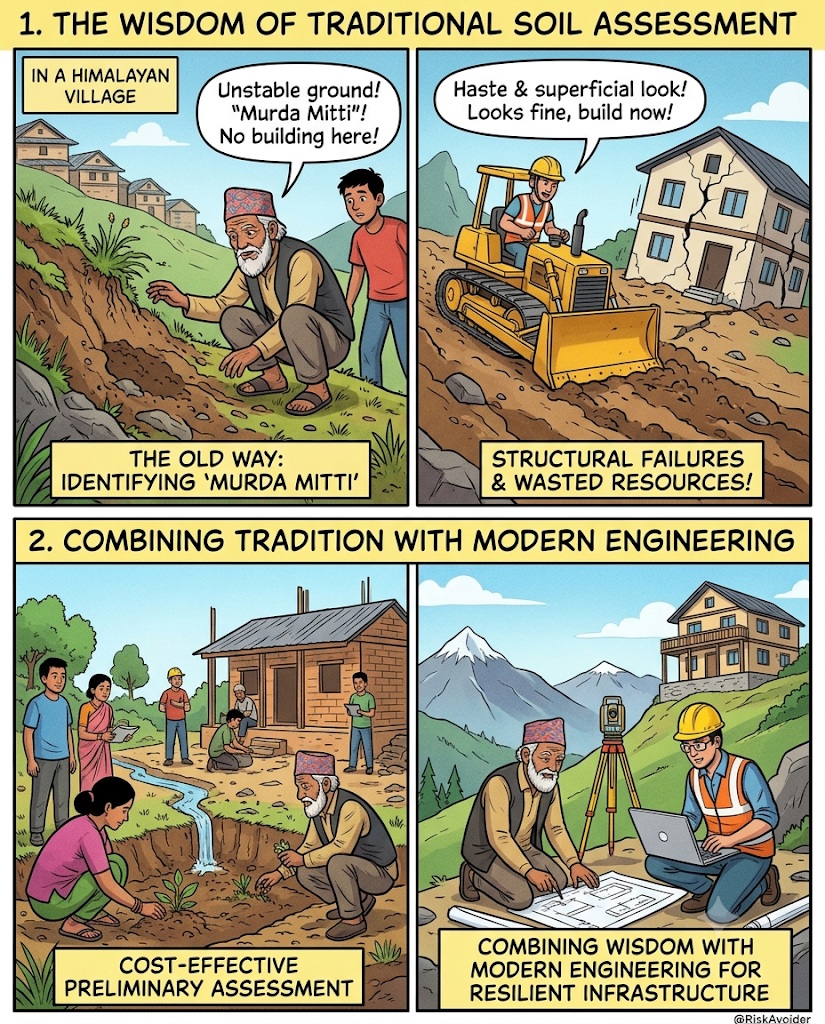
- “मुर्दा मिट्टी” की पहचान: असुरक्षित जमीन पर निर्माण से बचाव:- हमारे पारंपरिक जानकार मिट्टी के रंग, गंध, वनस्पति और जल-रिसाव जैसे कई संकेतों को बारीकी से देखकर अनुपयुक्त या धंसने वाली जमीन (“मुर्दा मिट्टी”) को तुरंत पहचान लेते थे, जिससे कमजोर और अस्थिर ढलानों पर निर्माण से बचा जा सकता था / Traditional experts could identify unsuitable soil conditions (“murda mitti“) through careful observation of multiple indicators, preventing construction on unstable ground.
- पारंपरिक समझ की अनदेखी: भारी बर्बादी और संरचनात्मक विफलता:- जल्दबाजी या जमीन की केवल ऊपरी चमक-दमक पर भरोसा करके पुरखों के इस व्यावहारिक ज्ञान को नजरअंदाज करना घातक साबित होता है; इससे घर और इमारतें धंसती हैं और जान-माल का भारी नुकसान होता है / Ignoring this wisdom, often due to haste or over-reliance on superficial site appearance, can lead to structural failures and resource wastage.
- किफायती प्रारंभिक परीक्षण का सबसे बेहतर जरिया:- खासकर ग्रामीण, सामुदायिक और छोटे स्तर के निर्माण कार्यों में महंगे तकनीकी परीक्षणों से पहले पारंपरिक तरीकों से जमीन की स्थिरता का आकलन करना एक बेहद आसान, व्यावहारिक और कम लागत वाला विकल्प है / Traditional site assessment offers a cost-effective preliminary method for evaluating ground stability, particularly relevant for community-level and smaller constructions.
- पारंपरिक अनुभव और आधुनिक तकनीक का तालमेल ही असली सुरक्षा:- बुजुर्गों और स्थानीय कारीगरों के सदियों पुराने जमीनी ज्ञान को जब आधुनिक सिविल इंजीनियरिंग और भू-वैज्ञानिक तकनीकों के साथ जोड़ा जाता है, तभी हम पहाड़ों में वास्तव में सुरक्षित, टिकाऊ और आपदा-रोधी निर्माण सुनिश्चित कर सकते हैं / Combining traditional knowledge with modern engineering practices can lead to more resilient and sustainable infrastructure.
संता – बंता की यह जुगलबन्दी आपको कैसी लगी, कृपया हमें जरुर बताये
व
इस जुगलबन्दी को बेहतर बनाने के लिये अपने सुझाव अवश्य दें।
हमें हमेशा की तरह आप के सुझावों, प्रतिक्रियाओं व कटाक्षो का बेसब्री से इंतजार रहता हैं और सच मानिये इसी के आधार पर हम अपने आप में, अपनी सोच व रचनात्मकता में सुधार करने को प्रेरित होते हैं।
सो अच्छा – बुरा जैसा आपको महसूस हुवा हो, कमेंट जरुर करते रहें।
Leave a Reply