 Strategic Brief: Turning Laundry into a Lifeline
In a water-stressed Himalayan winter, the “Zero-Waste” goal is to ensure that the water leaving your washing machine can go directly into your garden or be used for “Thermal Mulching” without poisoning the soil or the mountain’s fragile micro-flora.
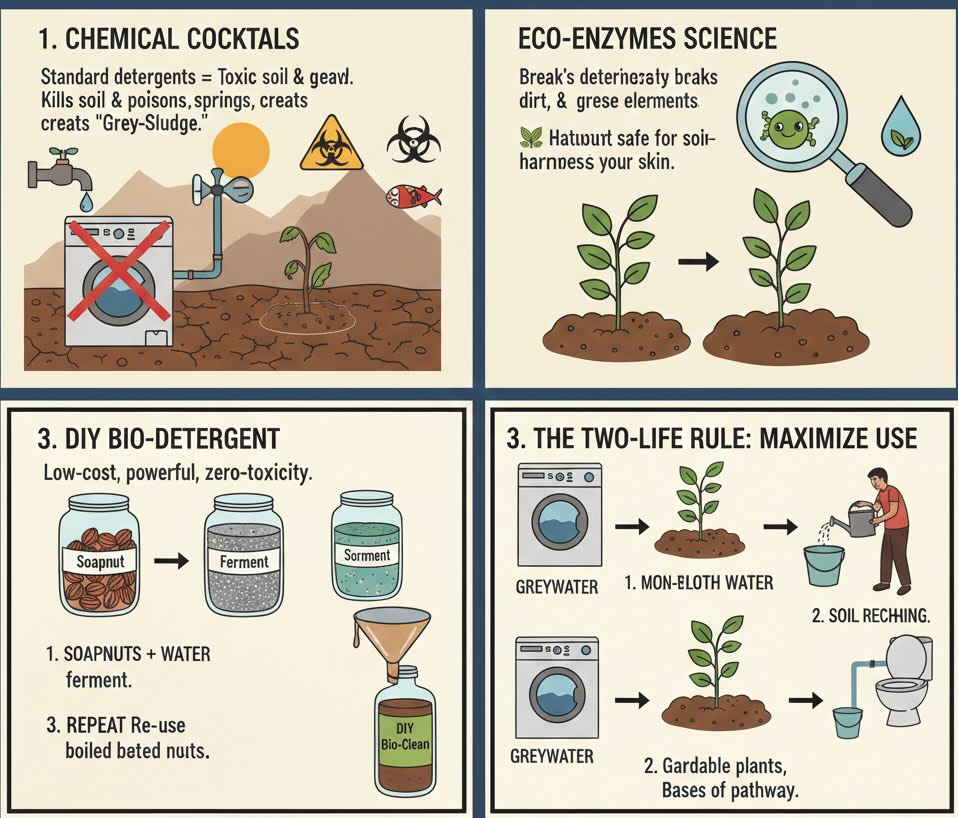
Standard detergents are “Chemical Cockpits” that can turn a healthy slope into a sterile, toxic zone.
The “Safe-Stream” Guide: Choosing Garden-Safe Cleaning Products
-
The “Toxic Three” to Avoid
When reading labels for your Shimla, Mussoorie or Gangtok household, immediately reject any product containing these ingredients if you plan to reuse the water:
- Phosphates: While they clean well, they cause “Algal Blooms” in mountain streams and can “salt” the soil, killing the beneficial fungi your plants need to survive the dry spell.
- Sodium (Salt) Fillers: Powdered detergents often use sodium as a bulking agent. Excess salt destroys soil structure and prevents roots from absorbing the little moisture available during this snowless winter.
- Chlorine Bleach: This is a broad-spectrum biocide. It kills the soil bacteria that break down organic matter, effectively “mummifying” your garden soil.
-
Identifying “Greywater-Friendly” Alternatives
Look for these specific indicators to ensure your greywater is an asset, not a liability:
- Plant-Based Surfactants: Look for ingredients like alkyl polyglucosides (derived from sugar/corn) or coconut-based cleaners. These break down quickly in the soil.
- Liquid over Powder: Liquid detergents generally contain significantly less sodium than powders, making them much safer for long-term irrigation.
- Bio-Enzymatic Cleaners: These use “good bacteria” to break down stains. When this water hits your garden, the enzymes actually help accelerate the decomposition of leaf litter into compost.
-
The Himalayan “Ancient-Tech” Alternatives
For the ultimate in “Hydro-Sovereignty,” consider returning to indigenous solutions that have protected Himalayan watersheds for centuries:
- Soapnuts (Reetha): These are native to the Himalayan foothills. They contain Saponin, a natural surfactant. Boiling soapnuts creates a liquid that is 100% biodegradable and acts as a mild natural pesticide for your garden.
- Ash-Based Cleaning: For utensils, traditional wood ash is a powerful abrasive and disinfectant that actually adds potassium to the soil—a critical nutrient for mountain orchards.
-
Application Tips for the “Horticultural Loop”
- The Dilution Rule: Even with biodegradable soap, try to dilute your greywater with 25% “clear” water (from vegetable washing) before applying it to sensitive plants.
- Rotate Your Zones: Don’t dump your laundry water in the same spot every day. Spread it across different parts of the slope to prevent a localized buildup of even “safe” minerals.
- Avoid the “Edible Leaf”: Never pour soapy water directly onto the leaves of spinach, lettuce, or herbs. Apply it to the mulch at the base.
आज का सबक : रासायनिक प्रतिरोध्यता / DRR Lesson: “Chemical Resilience”
भू-जल के प्रदूषण का इतिहास हमें चेतावनी देता है कि विशेष रूप से घने बसे पहाड़ी शहरों में ऊपरी ढाल पर बने घरो से अनजाने में किया जाने वाला दूषित जल का निस्तारण अंततः ढाल के निचले स्तर पर अवस्थित नौलो, धारो व अन्य जल स्त्रोतों को प्रदूषित करता है। अतः प्राकृतिक रूप से विघटित हो सकने वाले साबुन के इस्तेमाल से आप अपने बगीचे या पौंधो को बचाने के साथ ही सूखे की स्थिति में पूरे समुदाय का भरण-पोषण करने वाले भू-जल की शुद्धता भी सुनिश्चित कर रहे हैं / The history of groundwater contamination in dense mountain settlements warns us that what we pour on our “backyard” eventually ends up in our neighbour’s “downslope spring.” By switching to biodegradable detergents, you are not just saving your garden; you are protecting the “Arterial Integrity” of the groundwater that sustains the entire community during a drought.
The contamination of Himalayan springs and the soil degradation seen in over-fertilized plains warn us that chemistry is a permanent footprint on the land. These past events tell us that once we salt the soil or poison the ‘weep holes’ of our ridges, the mountain’s ability to heal itself is compromised for generations. Our ongoing initiatives in ‘Eco-Chemistry’ prove that we can clean our clothes without killing our environment, but history warns us that if we do not choose ‘Garden-Safe’ products now, our recycled water will become a slow-acting toxin rather than a life-saving resource. Today tells us the soil is parched and the water is precious; it warns us that a clean shirt is not worth a dead mountain.
Leave a Reply