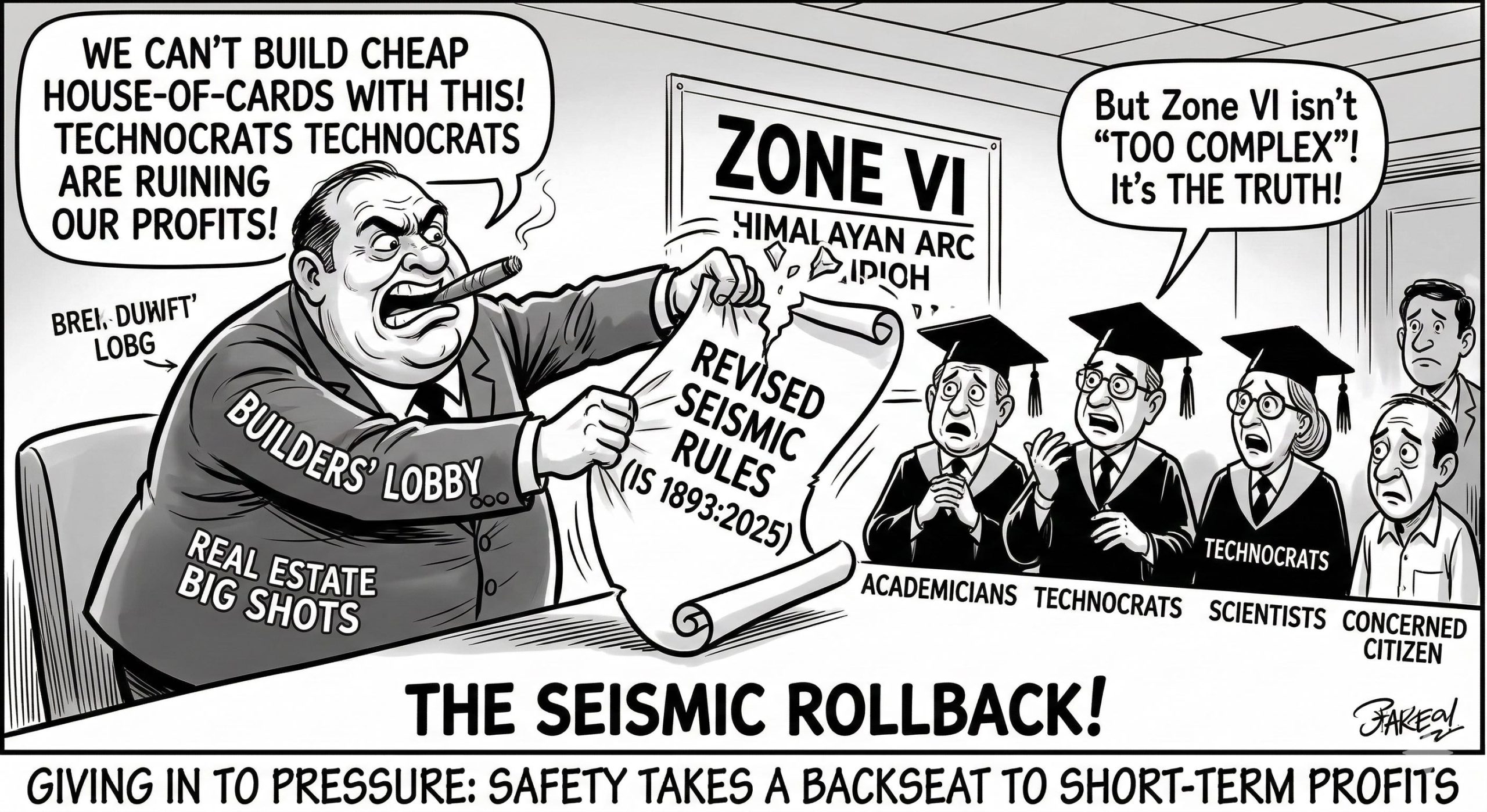
 The sudden withdrawal of IS 1893 (Part 1): 2025 on March 3, 2026, has sent shockwaves through the structural engineering fraternity.
By reverting to the 2016 standards under pressure from real estate lobbies, the state has effectively asked engineers to ignore a decade of seismic research and the newly identified Zone VI reality of the Himalayan arc.
For a professional body like the Consulting Engineers Association of India (CEAI), staying silent is no longer an option.
Our primary duty is to the safety of the public—not the profit margins of developers.
If an engineer designs a building today using an “officially sanctioned” but scientifically obsolete code, who bears the liability when the inevitable “Big One” strikes?
The “Knowledge Gap” vs. The “Ethics Gap”
The rollback was reportedly justified by “technical complexity.”
This is an insult to the Indian engineering community.
We have the capability to design for the world; to say we cannot implement a more rigorous code at home is a self-inflicted wound.
More importantly, the 10-30% increase in base shear mandated by the 2025 code was not a “suggestion”—it was a reflection of the actual crustal stress recorded along our plate boundaries.
To formalize this dissent, we propose the following Model Resolution for adoption by professional engineering associations across the country.
MODEL RESOLUTION: Reinstatement of Seismic Safety Standards
ADOPTED BY:
DATE:
SUBJECT: Formal Objection to the Withdrawal of IS 1893 (Part 1): 2025
WHEREAS, the Bureau of Indian Standards (BIS) released the revised IS 1893 (Part 1): 2025 after extensive peer review by India’s leading seismologists and structural engineers to address increased seismic risk; and
WHEREAS, the introduction of Zone VI and enhanced design spectra represent a critical advancement in safeguarding the lives of millions living in high-hazard regions; and
WHEREAS, the sudden withdrawal of this code on March 3, 2026, was predicated on “financial concerns” rather than scientific evidence, thereby compromising the professional integrity of the engineering community;
NOW, THEREFORE, BE IT RESOLVED THAT THIS BODY:
- REJECTS the notion that financial constraints can override the scientific necessity of seismic safety.
- DEMANDS the immediate reinstatement of IS 1893:2025 as the mandatory standard for all public-utility and high-occupancy structures.
- CALLS UPON the Ministry of Housing and Urban Affairs (MoHUA) to provide a transparent, science-based justification for the rollback.
- ADVISES its members to adopt the 2025 standards as “Best Practice” in their designs, regardless of the official rollback, to mitigate future professional liability.
- COMMITS to launching a nationwide technical training program to bridge the “complexity gap” cited by the Ministry.
The Legal and Moral Imperative
If we continue to build using the 2016 code, we are knowingly constructing “Planned Failures.”
In a court of law, “I followed a defunct code” is a poor defense against “I knew the risk and ignored it.”
Professional bodies must act now.
We must move beyond the drawing board and into the halls of policy.
We aren’t just defending a code; we are defending our right to build a resilient India.
#EngineeringEthics #SeismicResilience #IS1893 #SafeBuilding #HimalayanSentinel #PolicyChallenge #PublicSafety
The collapse of ‘code-compliant’ buildings in the 2001 Bhuj Earthquake and the catastrophic failure of non-ductile frames in Nepal 2015 warn us that a code is only as good as the honesty of its authors.
These past events tell us that political convenience is the primary ingredient in structural failure.
Our ongoing initiatives in ‘Performance-Based Engineering’ prove we have the tools to survive the Zone VI reality, but history warns us that if we do not sign this ‘Model Resolution’ today, we will be forced to sign the death certificates of thousands tomorrow.
Today tells us the plate is moving; it warns us that a code rollback is a countdown to catastrophe.
Leave a Reply