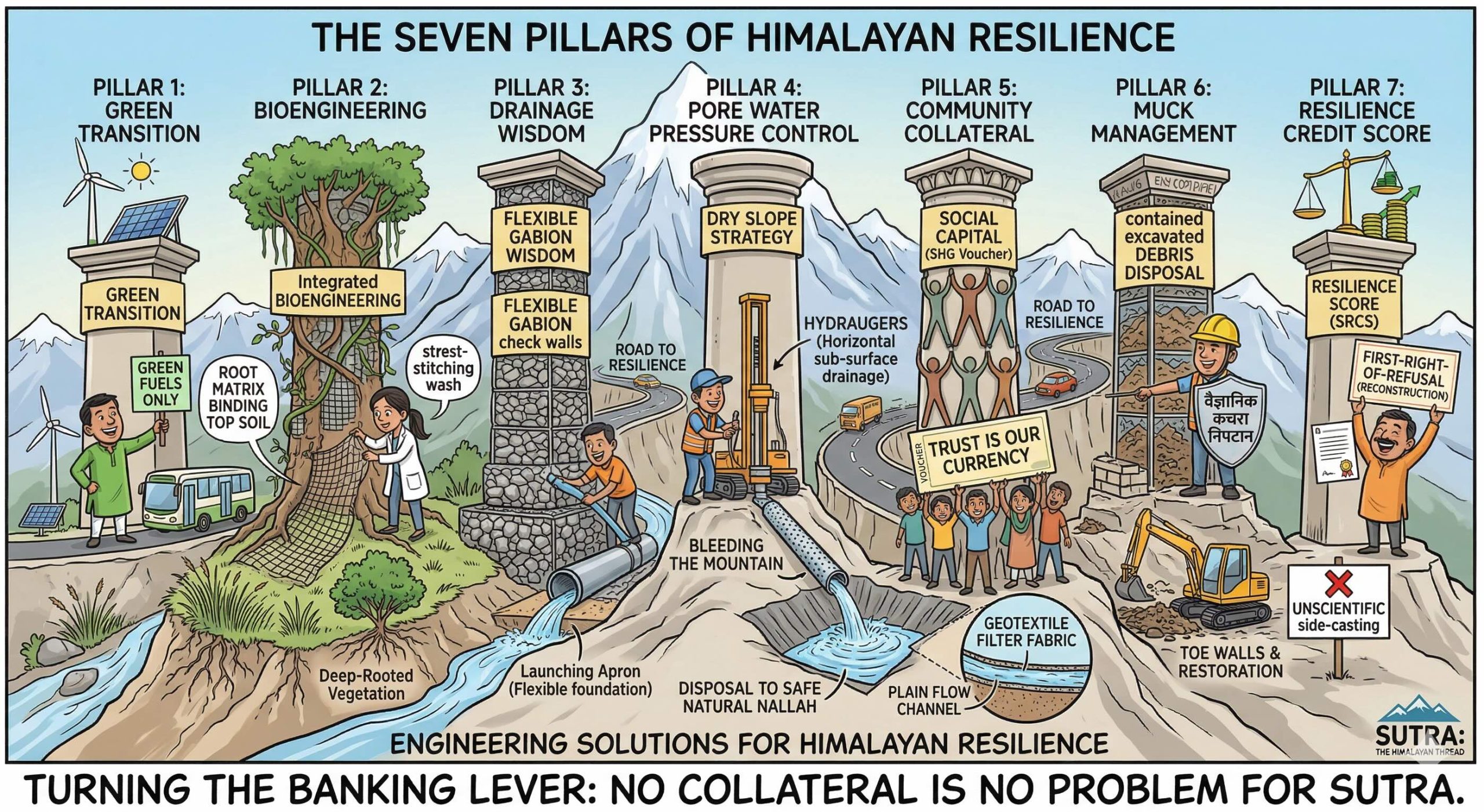
 We are currently building the Himalayas to fail. By applying plains-based engineering to a vertical landscape, we have created a “Kinematic Conflict” that costs lives and billions in losses. This Policy Memorandum proposes a Seven-Pillar shift—from “Hard Construction” to “Hydraulic Wisdom.”
It’s time for the State Planning Commissions to lead the mountain, not just dig into it.
The Crisis of the “Kinematic Conflict“
The Himalayas are the youngest and most tectonically active mountains on Earth.
For centuries, their slopes achieved a delicate equilibrium. However, the modern “Developmental Footprint”—characterized by massive road widening, intensive agro-horticulture, and unregulated urban loading—has introduced a Kinematic Conflict.
We are essentially “unlocking” stabilised debris and inviting gravity to take its course.
When extreme precipitation events—now a staple of our changing climate—hit these disturbed slopes, the result is not just a landslide, but a systemic collapse of infrastructure.
To bridge this gap, we propose a transition to a New Developmental Paradigm built on seven non-negotiable pillars.
The Seven Pillars: A Blueprint for Survival
Pillar 1: Climate Mitigation & The “Green Transition”
- The Goal: Retard the pace of glacial recession and extreme weather triggers.
- Policy Action: Mandatory transition to green fuels in mountain transport and construction; expansion of “Carbon-Sink” green spaces.
- Global Example: The Alpine Convention (Europe), where member states have integrated strict GHG emission targets specifically tailored to protect fragile mountain permafrost.
Pillar 2: Arresting Erosion through Biogeotechnical Measures
- The Goal: Move away from “Brittle” engineering (RCC) toward “Flexible” stabilisation.
- Policy Action: Deploying Bioengineering (root-matrix binding) and Gabion check walls that can adapt to ground movement and creep without cracking.
Pillar 3: The “Dry Slope” Strategy (Pore Water Pressure Control)
- The Goal: Maintain internal slope pressure below threshold limits.
- Policy Action: Institutionalising the use of Hydraugers (horizontal subsurface drains) in all high-risk road sections and orchards to bleed excess water.
Pillar 4: Scientific Debris (Muck) Disposal
- The Goal: End the devastating practice of valley-side “side-casting.”
- Policy Action: Identification of “Geo-Technical Safe Zones” for muck disposal, protected by robust toe-walls to prevent downstream siltation and flash floods.
Pillar 5: Crown-Loading Restrictions
- The Goal: Prevent the “Surcharge Loading” that triggers rotational slides.
- Policy Action: Immediate construction bans on the “heads” (crowns) of active or dormant sliding slopes.
Pillar 6: Geotechnical Integrity over Speed
- The Goal: Ensure every road-cut is scientifically validated.
- Policy Action: Mandatory detailed geotechnical investigations prior to excavation, ensuring stabilization measures (soil nailing/shotcreting) happen concurrently with the cut.
Pillar 7: Hydraulic Reform (Debris-Pass Design)
- The Goal: Designing for “The Mountain’s Delivery,” not just water.
- Policy Action: Re-engineering culverts and bridges to account for Peak Sediment Load and boulders, preventing the “Choke-and-Burst” cycle of flash floods.
Projected Gains: The Dividends of Resilience
|
Duration |
Economic & Social Gains |
|
Short-Term |
Immediate reduction in road closure days; protection of downstream hydropower assets from siltation; reduction in emergency ex-gratia relief expenditure. |
|
Long-Term |
Increased lifespan of infrastructure (30+ years); stabilisation of the mountain economy (Apple/Tourism); reversal of “Climate-Induced Migration” by creating safe habitations. |
The “7 Pillars Manifesto” tells us that administrative convenience is no match for geological force. This warns us that when a Policy Memorandum focuses on “Speed of Construction” rather than the “Pore Water Pressure” of the slope, it is signing a death warrant for the very infrastructure it seeks to build.
Our ongoing initiative in 2026 is to move this manifesto from paper to the Planning Commission halls. By ensuring that every rupee spent is a rupee spent on “Informed Resilience,” we move the global community from the era of “Fragile Growth” toward a future of “Mountain-Strong Stability.”
#MountainPolicy #HimalayanResilience #EngineeringReform #PolicyManifesto #ClimateAdaptation #LandslidePrevention #SUTRA #TheRiskAvoider #InfrastructureSafety
Leave a Reply