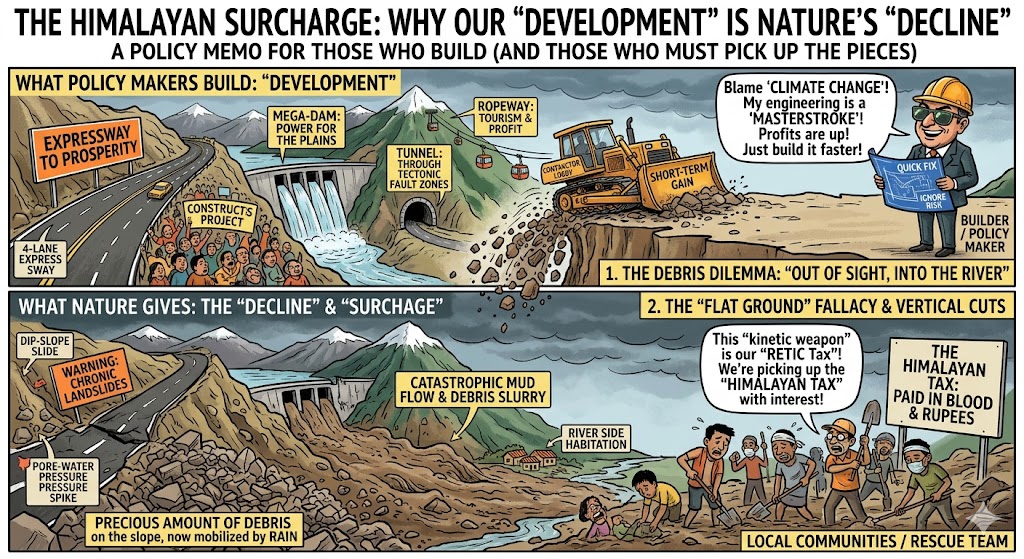
 It is a grand irony of the 21st century that in our quest to “conquer” the Himalayas with four-lane expressways, mega–dams, and gravity–defying ropeways, we are essentially paying billions to sabotage the ground we stand on.
We blame “Climate Change” for every disaster as if the clouds have a personal vendetta against us. But while the climate provides the spark, our engineering “innovations” are providing the gunpowder.
Let’s be clear: Mass wasting is the Mother of the Himalayas. It’s what gave us soil to farm and aquifers to drink from. But there is a difference between a natural geological process and a man-made “Gravity Assisted Demolition.”
1. The Debris Dilemma: “Out of Sight, Into the River“
In the plains, if you leave a pile of trash, it’s an eyesore. In the mountains, if you dump excavated debris down a slope, it’s a kinetic weapon.
-
The Physics: Debris dumped on a slope doesn’t just sit there; it waits. It waits for the first monsoon rain to turn it into a high-density mudflow.
-
The Global Echo: Look at the 2023 Derna Dam collapse in Libya or the Petrópolis mudslides in Brazil. While different terrains, the lesson is the same: unmanaged loose material + water = catastrophe.
-
Policy Fix: We need a “Debris Birth Certificate.” Every cubic meter of earth moved must have a documented, budgeted, and scientifically sound “retirement home” (disposal site) built into the project cost. Dumping should be treated as structural arson.
2. The “Flat Ground” Fallacy
Engineers love flat surfaces. But in the mountains, a flat road or a building terrace is essentially a “Water Infiltration Funnel.”
-
The Science: Water collects on these flats, seeps into the soil, and spikes pore-water pressure. It’s like greasing a slide. Suddenly, the friction holding the mountain together vanishes.
-
Policy Fix: “Drainage or Death.” We must mandate high-velocity rainwater disposal systems that ensure water leaves the flat surface faster than it can say “geological instability.” If the water can’t get out, the mountain will.
3. Vertigo: The Sin of the Vertical Cut
To save money, we often cut mountains vertically. This is the engineering equivalent of pulling the bottom card out of a house of cards.
-
The Geometry of Doom: When we cut a slope, we disturb the Angle of Repose. If the rock layers (foliation or bedding) dip toward the road at an angle shallower than our cut, we haven’t built a road; we’ve built a “Dip-Slope Slide.”
-
The Global Lesson: The Vaiont Dam disaster in Italy remains the gold standard for ignoring “dip-slope” geometry. A massive forest slid into the reservoir because the rock layers were tilted toward the water.
-
Policy Fix: Ban vertical cuts in “High-Dip” zones. Use breast walls and tiered slopes. It’s better to spend on a wall now than on a search-and-rescue team later.
4. Tectonic Blindness
The Himalayas are not a static painting; they are a slow-motion car crash between India and Eurasia.
-
The Reality: We are tunnelling through “Main Central Thrust” (MCT) zones as if they were stable granite. Building a dam or a tunnel without a 3D tectonic map is like playing Russian Roulette with a fully loaded chamber.
-
Policy Fix: No Mapping, No Digging. Comprehensive land-use zonation must be the “Green Signal” for any project. If the rocks are weak, the project must move—or we must accept the eventual “Tectonic Tax.”
The Common Sense Manifesto
Mitigation isn’t rocket science; it’s mountain-sense. The Himalayas are fragile. If you treat them like a flat construction site in Noida, they will treat your infrastructure like a temporary obstacle.
-
मलबा निस्तारण हेतु बजट व्यवस्था / Budget for Debris: मलबे का सुरक्षित निस्तारण विकास कार्यो का अभिन्न अंग / Safe disposal is a cost of development, not an afterthought.
-
जलीय अनुशासन / Hydraulic Discipline: पानी का दबाव नियत सीमा के अन्तर्गत / Control the pore-water pressure or lose the slope.
-
चट्टानों की कमजोर परतों का आदर / Respect the Dip: व्यर्थ ही चट्टानों को सरकने का मौका न दें / If the rock wants to slide, don’t give it a reason.
-
वर्गीकरण का कानून / Zonation is Law: संवेदनशील स्थानों में मानवीय हस्तक्षेप पर प्रतिबन्ध / Stop building in “red zones” and wondering why they turn red with blood.
#HimalayanSentinel #PolicyOverPathology #SustainableDevelopment #MountainEngineering #DebrisManagement #GeologicalCommonSense #SafeHimalayas #ClimateResilience #InfrastructureEthics
The devastating 2021 Rishiganga surge and the chronic landslide blockades on the NH-5 and NH-58 warn us that the Himalayas do not negotiate with poor engineering. These past events tell us that ‘excavated debris‘ is a man-made tectonic force.
Our ongoing initiatives in ‘Disaster Risk Reduction‘ prove we have the knowledge, but history warns us that if we do not institutionalise ‘Stringent Debris Disposal’ and ‘Tectonic Sensitivity‘ today, our grandest highways will become the burial grounds of tomorrow.
Today tells us the slopes are saturated; it warns us that the mountain is watching.
Leave a Reply