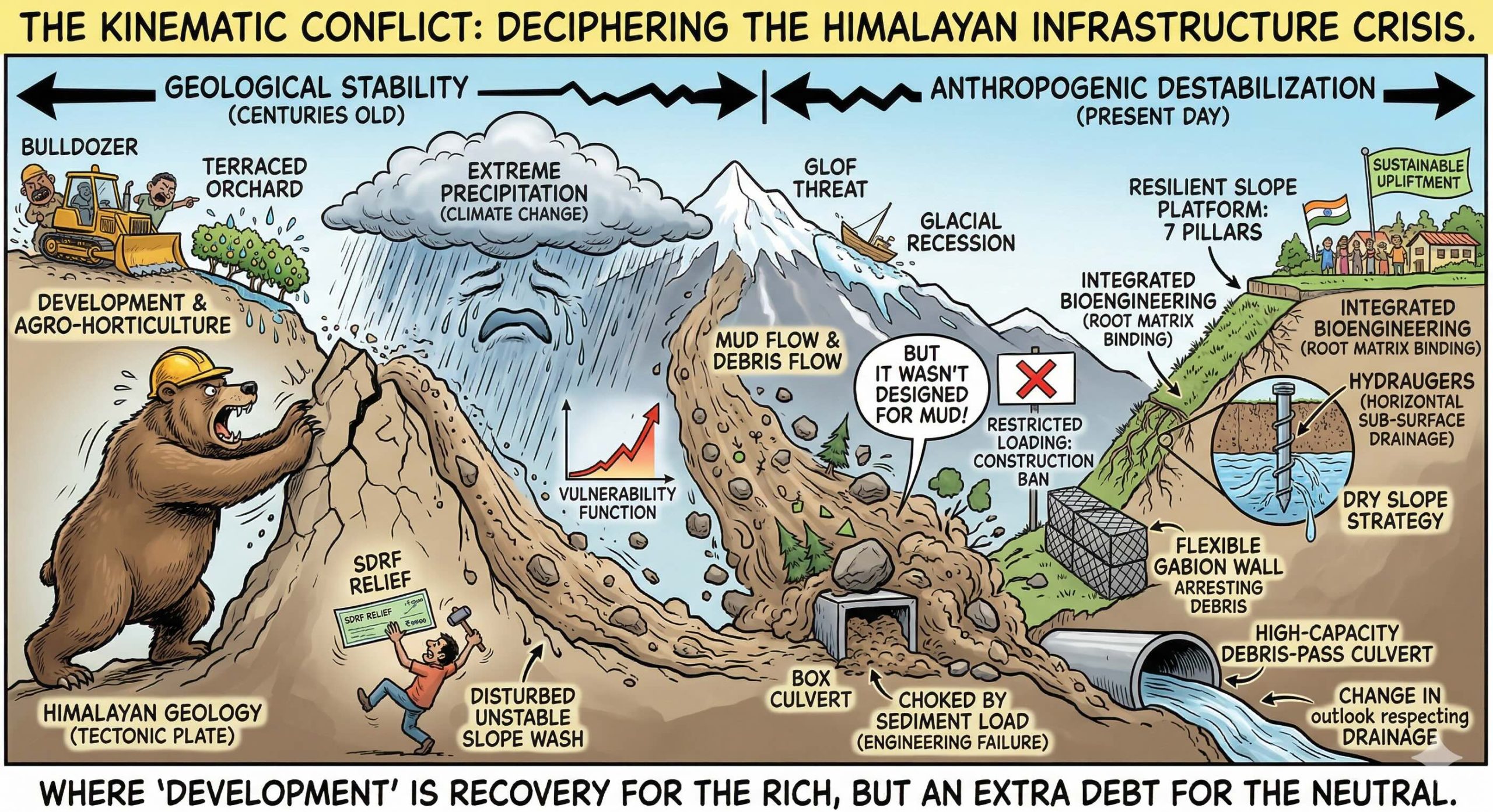
 The Himalayas are in a state of civil war—not between nations, but between a fragile landscape and a heavy-handed developmental model. From the creeping slopes of Shimla and Joshimath to the flash floods of Mandi and Teesta, the signs are clear: our infrastructure is being overwhelmed by a “Kinematic Conflict.”
It is time to stop building against the mountain and start building with it.
1. The War Between Geology and Development
For millennia, the Himalayan slopes achieved a delicate, “force-balanced” stability through natural compaction and vegetative binding. Today, that balance is being shattered.
We are witnessing a Kinematic Conflict: a collision between the slow, steady movement of tectonic plates and the rapid, invasive slicing of slopes for highways, hydro-projects, and intensive agro–horticulture.
When we cut into a mountain to widen a road or terrace a slope for orchards, we disturb the “Angle of Repose.” In places like Jubbal or Auli or Arki, what was once a stabilised debris mass is now a ticking time bomb of creep and solifluction.
2. The Saturated Slope: Creep, Solifluction, and Mudflows
Climate change has altered the “delivery mechanism” of water. We are seeing a shift from slow-melting snow to high-intensity, “vertical” rainfall.
- The Physics of Failure: This water doesn’t just run off; it infiltrates. It increases Pore Water Pressure, effectively “lifting” the soil particles and reducing the friction that holds the mountain
- Global Parallel: This is not unique to India. In the Italian Alps (Dolomites) and the Andes of Peru, “High-Altitude Mudflows” are becoming a seasonal reality as permafrost melts and extreme rain saturates the lithology, turning solid ground into a viscous liquid.
3. The “Debris-Pass” Failure: Choked Veins of the Mountain
A critical flaw in our current engineering is the underestimation of Sediment Load. We design culverts for water, but the mountains are delivering a “slurry” of boulders, silt, and uprooted trees.
- The Choke Point: When a culvert is too small to pass this debris (as observed in the Khorage-Bhalan road), it acts as a dam. The resulting back-pressure eventually overwhelms the road, leading to a catastrophic washout.
- The GLOF Threat: Combined with Glacial Recession, we are facing the looming shadow of Glacial Lake Outburst Floods (GLOFs), where the volume of water and debris can erase entire downstream valleys in minutes, as seen in the 2023 Sikkim (Lhonak Lake) disaster.
4. A New Paradigm: The Seven Pillars of Resilient Engineering
To survive this conflict, we must move from “Hard Engineering” (Rigid RCC) to “Bio-geotechnical Resilience.”
|
Pillar |
Strategic Action |
Technical Justification |
| GHG Reduction | Transition to Greener Fuel | Arresting the temperature rise that triggers glacial melt. |
| Arresting Erosion | Bioengineering & Gabions | Using “Flexible” structures that adapt to creep rather than cracking. |
| Pressure Control | Hydraugers | Horizontal subsurface drains to bleed the mountain of excess water. |
| Muck Management | Scientific Debris Disposal | Ending the “side-casting” that kills downstream vegetation and siltates dams. |
| Loading Limits | Crown-Construction Ban | Prohibiting heavy structures at the “head” of active slides. |
| Geotech Rigor | Investigation-First Design | No cutting without a deep understanding of the underlying dip and joint sets. |
| Hydraulic Reform | Peak-Discharge Design | Incorporating sediment load into culvert and bridge waterway calculations. |
The “Kinematic Conflict” tells us that nature does not negotiate its physical laws. It warns us that when we ignore the sediment load of a stream or the pore water pressure of a slope, we are not building “development“—we are building a delayed–onset disaster.
Our ongoing initiatives advocate for a “Top-Down Moratorium and Bottom-Up Resilience.”
By ensuring that every road-cut is accompanied by a drainage-plan, we move the global community from the era of “Destructive Development” toward a future of “Ecological Equilibrium.”
खेती – बागवानी के लिये ढाल का समतलीकरण एवं जल संचय हो या फिर सड़क निर्माण के नाम पर ढाल का कटान – दोनों ही स्थितियों में हम ढाल पर स्थित मलबे को अस्थिर कर रहे हैं और आपदाओं को निमंत्रण दे रहे हैं ।
सच कहें तो आपदा बारिश नहीं हमारे द्वारा विकास के नाम पर किये जा रहे प्रपंच हैं – ये हमारी करनी का प्रतिफल हैं।
आज जरूरत हैं विकास की एक नयी परिकल्पना की – जहाँ हम हिमालय की संरचनात्मक सीमा का सम्मान करने के साथ ही पानी के दबाव व नदी – नालों के द्वारा बहा कर लाये जाने वाले मलबे का ठीक से आंकलन करें।
#KinematicConflict #HimalayanResilience #CivilEngineering #DisasterRiskReduction #ClimateChange #LandslideMitigation #SustainableDevelopment #MountainPolicy #SUTRA #TheRiskAvoider
Leave a Reply