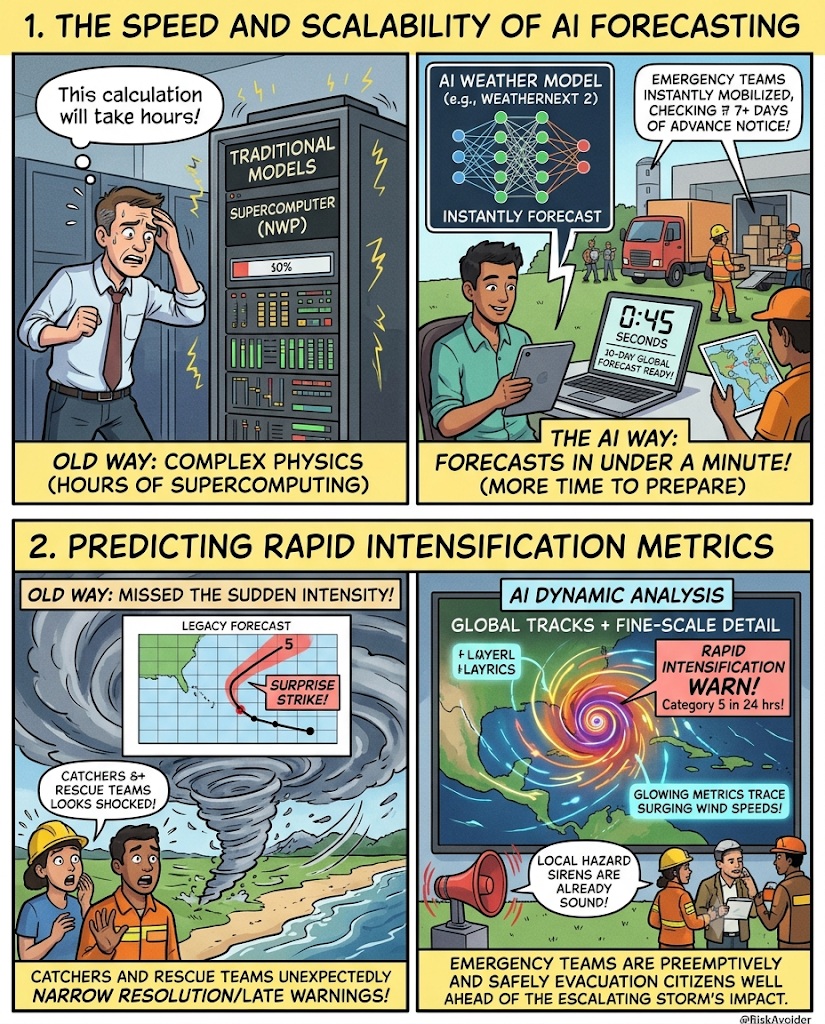
 Santa was acting as the chief meteorological director for a coastal district corridor, sitting inside a room filled with massive mainframe computers that were roaring loudly, trying to solve complex partial differential equations of classical fluid physics to project the path of an incoming tropical cyclone.
“Oye Banta, look at the sheer muscle of my classical computing setup!” Santa shouted over the noise of the cooling fans, pointing to a slow-loading progress bar on his terminal screen.
“These supercomputers have been processing numerical weather predictions (NWP) for the last six hours.”
“By tomorrow morning, it will finish solving the equations and give us a tracking map for this cyclone!”
“Physics is non-negotiable!”
Banta walked into the server room, carrying a compact, silent workstation terminal connected to Google DeepMind’s WeatherNext 2 AI infrastructure framework.
He clicked a single button, and in less than sixty seconds, a complete, highly detailed 10-day global probabilistic ensemble forecast flashed onto his screen, showing the exact wind speeds, pressure changes, and precipitation gradients of the storm.
“Santa-ji, turn off those noisy heaters before they melt your administrative budget!” Banta laughed, pointing to his instant forecast.
“While your supercomputers are still trying to calculate step-one equations from scratch, this machine learning model has already run a complete 10-day global atmospheric projection in under one minute!”
Santa’s jaw dropped as he compared the slow-moving progress bar with Banta’s completed, ultra-high-resolution cyclone path.
“But Banta!”
“This is a dangerous Category 5 storm!”
“How can an AI model skip the fundamental equations of physics and predict a storm path using just a statistical shortcut?”
“Because it doesn’t solve equations from scratch—it learns patterns directly from forty years of global atmospheric history, Santa!” Banta explained.
“Historically, traditional physics models faced a severe trade-off: they could predict a storm’s global path or its fine-scale rapid intensification, but rarely both at high speeds.”
“DeepMind’s WeatherNext framework changed the game during recent extreme cyclonic cycles.”
“By training on decades of ERA5 historical data, it out-performs flagship classical models across 90% of verification targets!”
“It generates highly detailed hourly forecasts for wind speed, precipitation, and geopotential height in less than a minute on a single TPU chip!”
“This incredible lead time allows national disaster management cells to mobilize emergency relief teams, secure marine assets, and execute precision evacuations days in advance with high confidence.”
“Human ingenuity amplified by intelligent machines is how we turn the tide against climate tragedies!”
Santa watched the WeatherNext model accurately highlight the cyclone’s rapid intensification curve, his trust shifting from slow mainframes to deep neural networks.
He turned off the roaring server stack.
“Oye Banta… so your machine looks at forty years of sky memory to protect our coast in sixty seconds?”
“Precisely, Santa-ji,” Banta smiled.
“When the climate accelerates the hazard velocity, our data models must run faster than the wind.”
संता – बंता की इस जुगलबन्दी से आज हमने क्या सीखा:-
- एआई (AI) मौसम पूर्वानुमान की गति व सटीकता / The Speed and Scalability of AI Weather Forecasting:
- पारंपरिक भौतिकी-आधारित सुपरकंप्यूटर मॉडल को चक्रवात या तूफान का रास्ता बताने में कई घंटे लगते हैं। इसके विपरीत, आधुनिक एआई मॉडल (जैसे डीपमाइंड का वेदरनेक्स्ट 2) पिछले 40 वर्षों के मौसमी डेटा का विश्लेषण करके एक मिनट से भी कम समय में सटीक पूर्वानुमान जारी कर सकते हैं, जिससे राहत कार्यों के लिए बहुमूल्य समय मिल जाता है / Traditional Numerical Weather Prediction (NWP) models require hours of high-compute supercomputing to execute physics equations. Advanced machine learning models (like DeepMind‘s WeatherNext 2) generate comprehensive 10-day global ensemble forecasts in under one minute, dramatically extending the lead time for emergency asset mobilization.
- तीव्र मौसमी बदलावों का सटीक आकलन / Predicting Rapid Intensification Metrics:
- एआई मौसम मॉडल वैश्विक वायुमंडलीय पैटर्न और स्थानीय स्तर के छोटे तूफानों, दोनों का एक साथ विश्लेषण करने में सक्षम हैं। यह तकनीक चक्रवातों के अचानक तीव्र होने (rapid intensification) का सटीक आकलन कर सकती है, जो पहले की प्रणालियों के लिये एक बड़ी चुनौती था / AI weather architectures successfully merge global track prediction with fine-scale resolution, allowing for superior forecasting of “rapid intensification” metrics in tropical cyclones that historically compromised legacy early warning configurations.
संता – बंता की यह जुगलबन्दी आपको कैसी लगी, कृपया हमें जरुर बताये
व
इस जुगलबन्दी को बेहतर बनाने के लिये अपने सुझाव अवश्य दें।
हमें हमेशा की तरह आपके सुझावों, प्रतिक्रियाओं व कटाक्षो का बेसब्री से इंतजार रहता हैं औरसच मानिये इसी के आधार पर हम अपने आप में, अपनी सोच व रचनात्मकता में सुधार करने कोप्रेरित होते हैं।
सो अच्छा – बुरा जैसा आपको महसूस हुवा हो, कमेंट जरुर करते रहें।
#WeatherNext2 #DeepMindScience #MachineLearningWeather #CycloneTracking#PredictiveLeadTime #SantaBantaStories
Leave a Reply