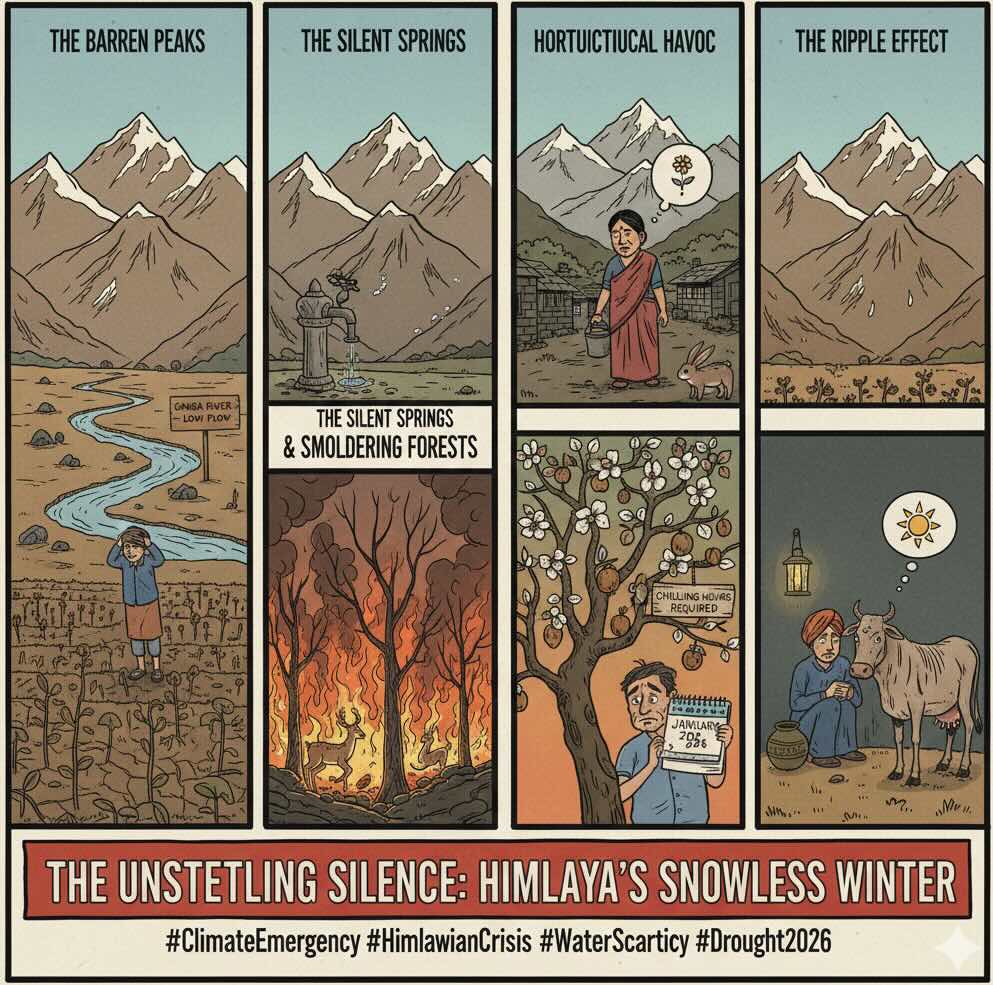
 Edition: 22 Jan 2026 | 2100 hrs IST
I. The Mountain Pulse: Pan-Himalayan Analysis 🏔️
The Himalayan arc is currently witnessing a phenomenon known as “Atmospheric Desiccation Stagnation.” The jet stream remains positioned too far north, leaving the region without the traditional “moisture shield” provided by Western Disturbances.
-
The Movement: For the 14th consecutive day, a “Zero-Precipitation Dome” is centered over the Upper Sutlej and Alaknanda basins. This has resulted in a “Thermal Leap” where daytime surface temperatures on south-facing slopes are –° C above the decadal mean, accelerating the “Sublimation Loss” of the high-altitude permafrost.
-
The Status: “Fuel-Load Criticality.” The forest floor across the mid-hills (1,500m to 2,500m) is now a continuous carpet of bone-dry pine needles. The “Vapor Pressure Deficit“ (VPD) is so high that any spark will result in an immediate “crown fire” behaviour, even in mid-winter.
II. Global Echoes 🌏
The global climate architecture is showing signs of “Synchronized Instability,” with high-altitude regions bearing the brunt.
-
The European Alps: Like the Himalayas, the Alps are reporting a “Green Winter.” Major ski resorts in Switzerland and France are closing lower slopes, not due to lack of cold, but due to a total lack of humidity—proving that the “Global Snow-Drought” is a hemispheric crisis.
-
The High Andes (Bolivia): A massive “Dust-on-Glacier” event has been recorded. Dust from the drying lowlands is settling on the ice, lowering its albedo (reflectivity) and causing “dark-melting” even in sub-zero temperatures.
-
Southwest China: They are battling “Flash Droughts” where water levels in mountain reservoirs have dropped by 30% in just three weeks, mirroring the crisis in our own pumped-water schemes.
III. The Laboratory: The “Micro-Vibration” Effect 🔬
The Topic: “Structural Brittleness of Un-Hydrated Slopes.”
-
The Science: Soil requires a specific moisture content to maintain “shear strength.” In this extreme dry spell, the mountainside is losing its “Cohesive Tension.” Without water to act as a lubricant and a binder, the slope becomes a “granular pile.”
-
The Citizen’s Impact: Even low-intensity vibrations from heavy traffic or nearby construction can now trigger “Dry-Rock Avalanches.” The Fix: If you live below a steep, terraced slope, monitor the “angle of repose” of loose stones. If small stones are frequently “trickling” down without wind or rain, the slope is reaching a Mechanical Tipping Point.
IV. The Time Machine ⏳
Historical Evidence: 22 January
-
1899 – The “Great Arctic Outbreak“: A historic period where extreme dry-cold led to massive infrastructure failure across continents.
-
The Lesson: It taught us that “Dry-Cold” is more damaging to buildings than “Wet-Cold.” The lack of humidity causes wood to shrink so rapidly that structural joints fail. This is the “Kiln-Effect” we are currently fighting in our heritage homes.
-
-
2014 – The “Snow-Mageddon” (USA): A reminder of how quickly “Jet Stream Meanders” can shift.
-
The Lesson: It proved that “Weather Whiplash”—the sudden transition from record dry to record wet—is the most dangerous phase for human response systems. We must prepare for the “Whiplash” when the moisture finally returns to the Himalayas.
-
V. The Daily Ordinance: The “Ember-Path” Audit 📜
Your 60-second safety hack for preventing a winter forest fire disaster.
-
The Hack: Walk the perimeter of your house and look for “Air-Eddies.”
-
The Observation: Notice where dry leaves and dust naturally accumulate (corners of porches, under wooden stairs, or in gutters).
-
The Danger: These are the exact spots where wind-blown embers will settle during a forest fire. In this dry air, these “fuel pockets” will ignite your home in seconds.
-
-
The Action: Clear these accumulation points daily. A “Clean Perimeter” is the only firewall that works in a Himalayan winter drought. #EmberAudit #HimalayanSentinel
The ‘Green Winters’ of the European Alps and the structural collapses of the 1899 Dry-Out warn us that nature’s stability is built on the presence of water. These past events tell us that once the ‘cohesive tension’ of the earth is lost, the landscape becomes a house of cards. Our ongoing initiatives in ‘Ember-Path Audits’ and ‘Structural Monitoring’ prove that we are the mountain’s first responders, but history warns us that if we do not utilize this ‘Brittle Silence’ to harden our perimeters, we will be helpless when the ‘Weather Whiplash’ finally arrives. Today tells us the air is parched and the slopes are fluid; it warns us that a mountain that cannot hold its moisture cannot hold its ground.
Leave a Reply