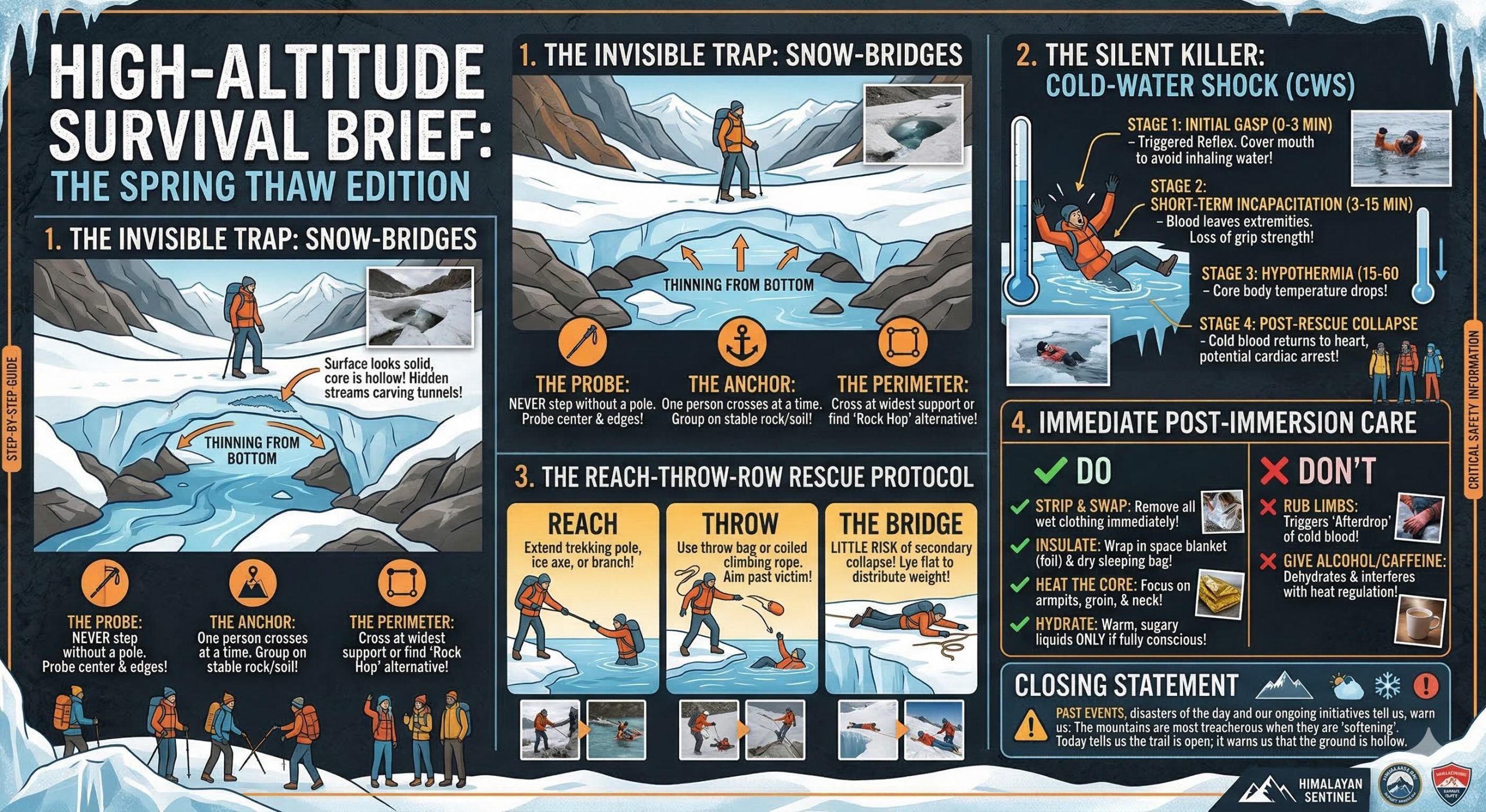
 As the spring equinox approaches, the inner-Himalayan ranges (above 3,500m) undergo a “Hydraulic Shift.”
High-altitude streams that were frozen solid in January are now carving tunnels beneath the snow, creating “Snow Bridges.”
For a trekking group, these are the most deceptive hazards of the season.
1. The Invisible Trap: Snow-Bridges
A snow bridge is a layer of snow and ice that spans a crevasse or a stream.
During the thaw, these bridges thin from the bottom due to running water or rising ground heat, making the surface look solid while the core is hollow.
The “Rule of Three” for Crossing:
-
The Probe: Never step onto a bridge without a trekking pole. Probe the center and the edges. If the pole sinks with “hollow” resistance, the bridge is a trap.
-
The Anchor: Only one person crosses at a time. The rest of the group must stay on “Terra Firma” (solid rock or grounded soil), ideally with a safety line attached to the person crossing.
-
The Perimeter: Cross at the widest point of the support (where the snow meets the rock) or find a “Rock Hop” alternative.
2. The Silent Killer: Cold-Water Shock
If a snow bridge collapses, the primary threat is not drowning, but Cold-Water Shock (CWS). Falling into glacial meltwater (0oC to 4oC) triggers an involuntary physiological response.
The Four Stages of CWS:
-
Stage 1: Initial Gasp (0-3 Minutes): The sudden cold triggers a “Gasp Reflex.” If your head is underwater, you will inhale water into your lungs.
-
Survival Tip: Hold your breath or cover your mouth before you hit the water.
-
Stage 2: Short-Term Incapacitation (3-15 Minutes): Blood leaves the extremities to protect the core. Your fingers will go numb; you will lose the “grip strength” needed to climb out.
-
Stage 3: Hypothermia (15-60 Minutes): The core body temperature drops.
-
Stage 4: Post-Rescue Collapse: The “Afterdrop” where cold blood from the limbs returns to the heart, potentially causing cardiac arrest.
3. The “Reach-Throw-Row” Rescue Protocol
If a teammate falls through a snow bridge into a stream:
-
Do Not Jump In: The rescuer is of no use if they also succumb to Cold-Water Shock.
-
The Reach: Extend a trekking pole, an ice axe, or a sturdy branch.
-
The Throw: Use a “Throw Bag” or a coiled climbing rope. Aim past the victim so the rope settles across their chest.
-
The “Bridge” Support: If you must get close to the edge of the hole, lie flat on your stomach to distribute your weight. This prevents a secondary collapse of the surrounding snow.
4. Immediate Post-Immersion Care
Once the victim is out, the clock is ticking against hypothermia.
-
Strip and Swap: Remove all wet clothing immediately. This is non-negotiable.
-
Insulate: Wrap them in a space blanket (foil) followed by a dry sleeping bag.
-
Heat the “Core”: Focus heat on the armpits, groin, and neck. Do not rub their arms or legs (this triggers the “Afterdrop” of cold blood).
-
Hydrate: Provide warm, sugary liquids only if they are fully conscious. Avoid caffeine or alcohol.
The tragic 2022 Draupadi ka Danda avalanche and numerous unreported snow-bridge fatalities in the Zanskar and Garhwal ranges warn us that the mountains are most treacherous when they are “softening.”
These past events tell us that a single “gasp” in glacial water is the difference between a story and a statistic.
Our ongoing initiatives in ‘Glacial Stream Mapping’ prove we are identifying the arteries of the mountain, but history warns us that if we do not probe every bridge and respect every ‘Initial Gasp‘ today, the hidden torrents of the spring thaw will claim the unwary tomorrow.
Today tells us the trail is open; it warns us that the ground is hollow.
Leave a Reply