 मजबूत घर, सुरक्षित परिवार
In Zone VI, the earth doesn’t just shake; it jumps. These rules are the only thing that will keep a roof over your head when the mountain moves.
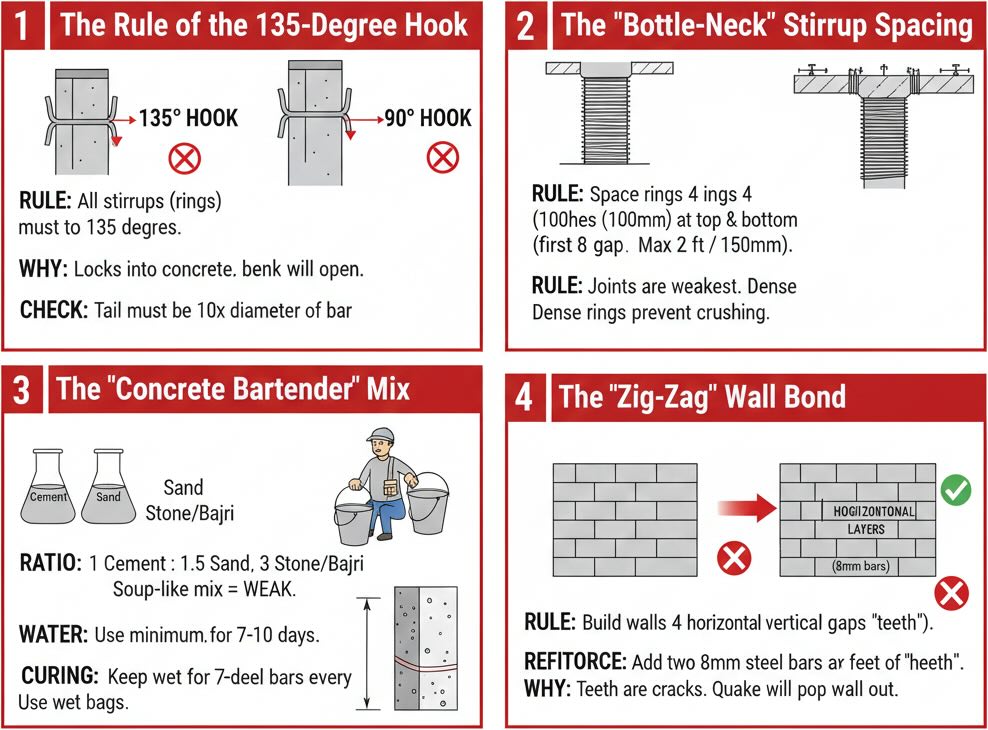
1. The Rule of the 135-Degree Hook (The “S” Hook)
In lower zones, 90-degree hooks were enough. In Zone VI, they will slip and the column will burst.
-
The Rule: All stirrups (rings) must be bent to 135 degrees.
-
Why: A 90-degree hook opens up when the building shakes. A 135-degree hook “locks” into the concrete core and refuses to let go.
-
The Check: The “tail” of the hook must be at least 10 times the diameter of the bar (e.g., for an 8 mm ring, the tail should be 80 mm long).
2. The “Bottle-Neck” Stirrup Spacing
The most dangerous part of a column is where it meets the beam.
-
The Rule: For the first 2 feet (600 mm) from any joint (beam–column junction), space your rings no more than 4 inches (100 mm) apart.
-
The Rule: In the middle of the column, you can increase the gap, but never more than 6 inches (150 mm).
-
Why: Most buildings fail at the joints. Dense rings act like a “cage” that prevents the concrete from crushing.
3. The “Concrete Bartender” Mix
Concrete is a chemical reaction, not just “wet mud.”
-
The Rule: Use the 1:1.5:3 ratio (1 part Cement, 1.5 parts Sand, 3 parts Stone/Bajri).
-
The Water Rule: Use as little water as possible to make it workable. Too much water = Weak stone. If the mix flows like soup, it will crack like a biscuit.
-
The Curing Rule: Concrete needs a “drink” for 7 to 10 days. Keep it wet under burlap bags (jute bags).
4. The “Zig-Zag” Wall Bond (Toothing is Forbidden)
-
The Rule: Never leave “teeth” (vertical gaps) in a wall to be filled later.
-
The Action: Build walls in horizontal layers. Use “Longitudinal Reinforcement“ (placing two 8 mm bars every 2 feet of height) to tie the bricks to the columns.
-
Why: A “toothed” joint is a pre-made crack. In a quake, the wall will simply pop out of the frame.
5. The “L” and “T” Junction Anchorage
Where two beams meet, the steel must “marry.”
-
The Rule: The top and bottom bars of a beam must continue into the column and bend into a “L” shape.
-
Length: This “L” bend must be at least 50 times the diameter of the bar.
-
Why: If the bars aren’t anchored, the beam will simply pull out of the column during the “shakedown.”
Mason’s Final Checklist (The “Daily Five”)
-
Is every ring bent to 135 degrees?
-
Are the rings closer together at the joints?
-
Is the steel clean (no loose rust or oil)?
-
Is the concrete vibrated (no “honeycombs” or air pockets)?
-
Is the “L” bend tucked deep into the column?
#MazbootGhar #ZoneVI #HimalayanSentinel #SeismicLiteracy #DRRIndia #MasonSafety
The tragic rubble of the 2005 Kashmir quake and the 2023 Turkish collapses warn us that “saving money” on a few inches of steel is a death sentence. These past events tell us that a building dies where the rings are wide and the hooks are weak.
The initiatives in ‘Mason Certification’ and ‘Earthquake Safety Literacy’ prove that the builder’s hand is the ultimate shield, but history warns us that if we do not tie these 135-degree hooks today, the mountain will untie our homes tomorrow.
Today tells us the code has changed; it warns us that the strength of the Himalayas must be matched by the strength of our stirrups.
Leave a Reply