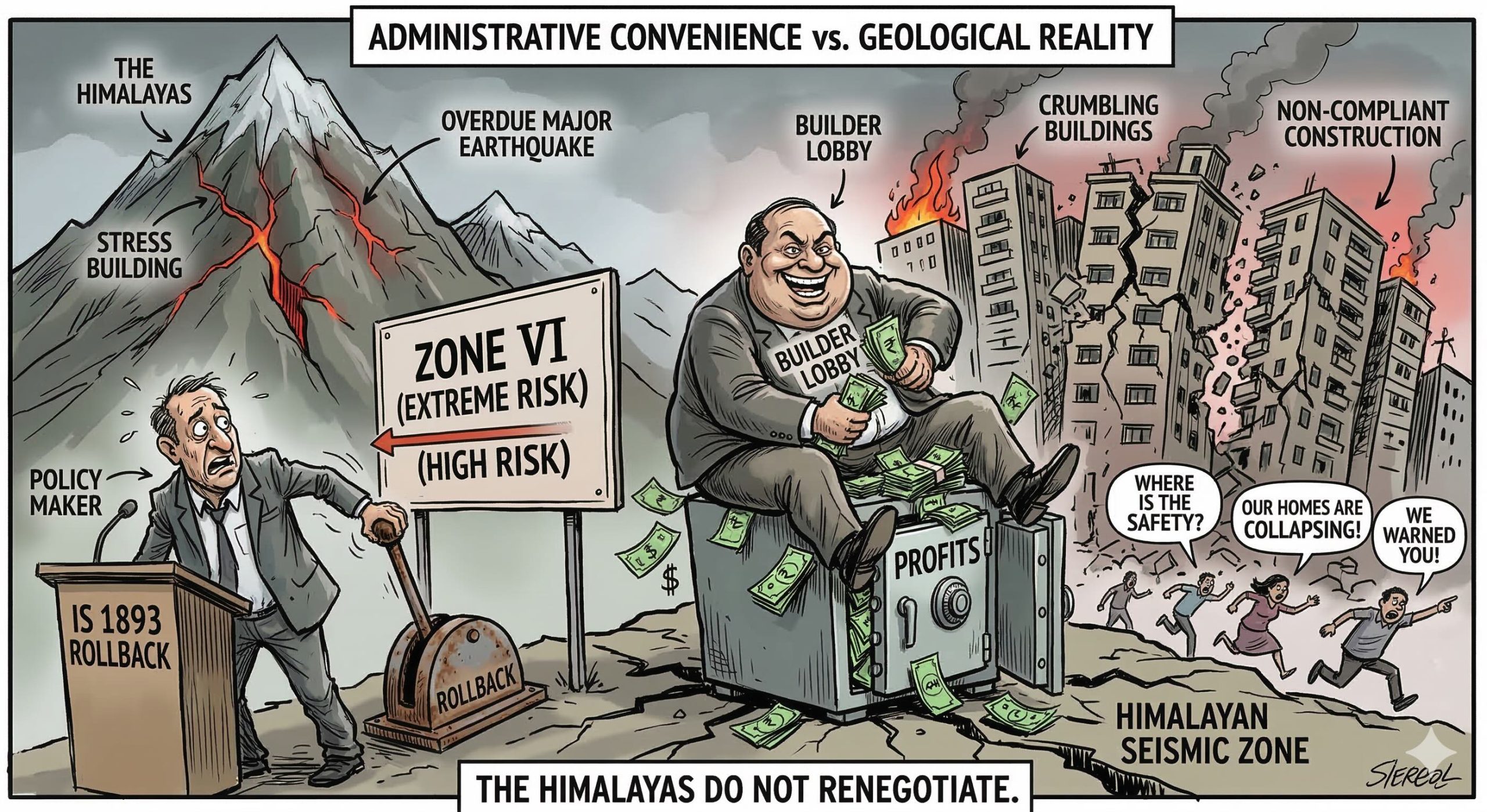
 In early 2025, the Bureau of Indian Standards (BIS) briefly took a historic step by proposing the inclusion of Zone VI in the seismic zoning map. This was an admission that the existing Zone V (the “Highest” risk) failed to capture the potential ground acceleration of a Great Himalayan Earthquake ().
However, the recent rollback to the 2016 standards—reverting the Himalayas to Zones IV and V—is more than a technical revision; it is an act of institutional apathy that disregards decades of seismological research.
The Science of the “Extreme”: Why Zone VI Was Necessary
The Himalayan arc is the world’s most active continental collision zone.
-
The “Seismic Gap” Reality: Large sections of the Himalayas have not experienced a major earthquake in centuries. Seismologists warn that the accumulated strain is sufficient to trigger shocks that far exceed the “Design Basis Earthquake” (DBE) parameters of Zone V.
-
Ground Acceleration: Zone V assumes a Peak Ground Acceleration (PGA) that current research suggests is a vast underestimation for the Himalayan front. By reverting to Zone V, the Code effectively tells engineers to design buildings that are “under-muscled” for the fight they are destined to face.
The Builder Lobby vs. Public Safety
The rollback undeniably favours the “Builder Lobby” and short-term infrastructure costs.
-
The Cost Factor: Designing for the higher ductility and lateral strength required by Zone VI adds roughly 15–20% to construction costs.
-
The Regulatory Bypass: By keeping the Himalayas in Zone V, high-rise projects that would have been prohibited or strictly regulated under Zone VI can now proceed with lighter, less expensive seismic reinforcement. This is a gamble where the stakes are human lives and the “house” is the mountain itself.
The Silence of the Academicians: A Crisis of Dissent
Perhaps the most troubling aspect is the lack of public dissent from technocrats and academic institutions. When science is subordinated to policy, the role of the expert is to provide “Informed Dissent.”
The current silence suggests a chilling effect where the pressure for “Ease of Doing Business” has outweighed the professional oath of the engineer to “hold paramount the safety, health, and welfare of the public.”
Legal Liability: From Negligence to Culpable Homicide?
When a major earthquake inevitably strikes, the litigation will be unprecedented.
-
Culpable Homicide: If it can be proven that authorities wilfully ignored superior scientific evidence (the 2025 amendments) to appease economic interests, the argument for “Culpable Homicide” becomes legally tenable. To knowingly authorize inferior building standards in a known extreme-risk zone is not an error of judgment; it is a deliberate endangerment.
-
Strict Liability: Builders and approving authorities may face “Strict Liability” for the structural failure of buildings that followed a compromised code.
A Call for Himalayan Unity
The Himalayan states — Jammu and Kashmir, Ladakh, Uttarakhand, Himachal Pradesh, Sikkim, and the North-Eastern states—must act as a unified bloc.
-
State-Specific Codes: If the National Code (BIS) fails them, these states have the constitutional right to implement stricter State Building Bye-Laws that exceed the national minimum.
-
Demanding the “Extreme” Classification: They must demand a return to the 2025 standards, insisting that their citizens’ lives are worth more than a 15% saving in rebar and concrete.
The 54,000-foot ash column at Mount Semeru and the 80-fold acceleration of the Palos Verdes landslide tell us that planetary energy is currently outstripping our institutional agility. These warn us that when we choose to “downgrade” seismic risks on paper to favour economic convenience while the geological strain remains “Extreme,” we are not managing a disaster—we are participating in the creation of one.
Our commitment to uncompromising structural integrity and localised awareness is the only viable vanguard for survival in 2026. By prioritising scientific reality over administrative apathy, we ensure that the global community moves from the era of “convenient codes” toward a future where our infrastructure is built to survive the earth’s restlessness rather than simply document our displacement.
#SeismicSafety #HimalayanEarthquake #IS1893 #ZoneVI #BuildingCodes #DisasterResilience #Uttarakhand #HimachalPradesh #EngineeringEthics #TheDelhiPlatform
Leave a Reply