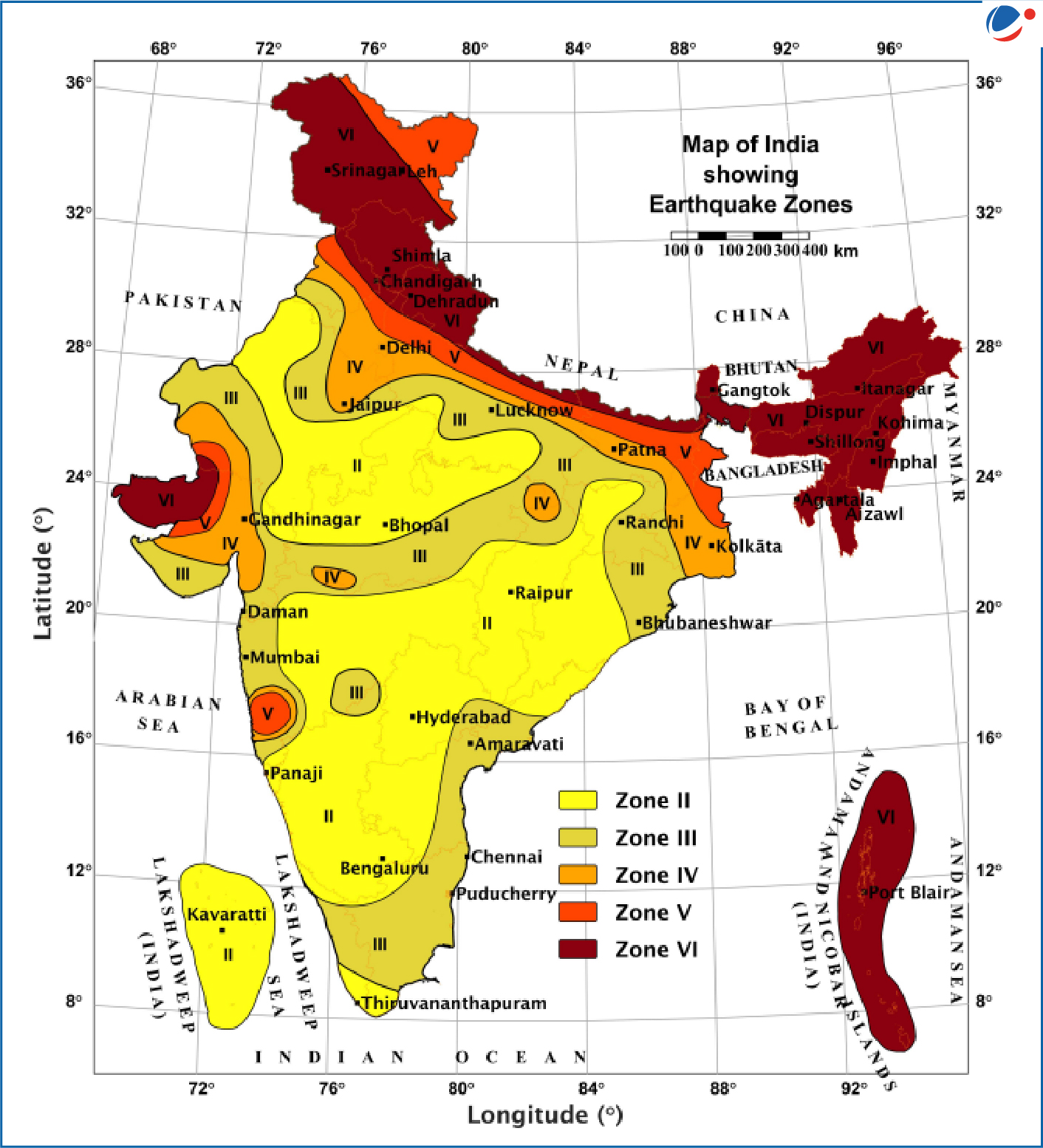
 India has just rewritten its tectonic contract. With the 2025 revision of IS 1893 (Part 1), the map of our risks has been coloured with a new, urgent hue: Zone VI. For the first time, the entire Himalayan arc—the world’s most restless mountain chain—has its own “Extreme Risk” category.
While the scientists celebrate a code that finally respects the crushing power of a Magnitude 8+ event, the streets of Dehradun, Shimla, and Gangtok are asking a harder question: How do we build for a future we can barely afford?
I. The Scientific “Pros”: A Code that Refuses to Blink
The jump from Zone V to Zone VI isn’t just a number; it’s a radical shift in the Zone Factor (). Moving from to effectively doubles the force a building must be designed to withstand.
-
Science over Sentiment: By adopting Probabilistic Seismic Hazard Analysis (PSHA), the code moves away from “what happened in the past” to “what is mathematically inevitable.” It accounts for the 200-year seismic gap in the Himalayas—a silence that is, in geological terms, a scream.
-
The “Ductile” Mandate: Zone VI forces engineers to look beyond mere strength. In a environment, you cannot build “rigid” structures; they will shatter. This necessitates Ductile Detailing—the art of making buildings bend like bamboo rather than snapping like glass.
-
Global Parallels: This move aligns India with Japan’s Shindo scales and California’s NEHRP standards. When Tokyo upgraded its codes, the initial outcry over cost was silenced when the 2011 Tohoku quake saw high-rises sway but remain standing.
II. The Grassroots “Cons”: The Mason and the Bar-Bender
This is where the scientific “Joy” meets the site-level “Jolt.” The biggest threat to Zone VI isn’t the earthquake; it’s non-compliance.
-
The Skill Chasm: In the Himalayas, the “Engineer” is often a ghost. The true builders are the masons and bar-benders.
-
The Bar-Bender’s Burden: Zone VI requires complex “135-degree hooks” and dense stirrup spacing. To a worker paid by the day, these are “unnecessary headaches.” Without intensive vocational training, these critical safety features will be ignored.
-
The Mason’s Mix: High-hazard zones require precise water-cement ratios. On a remote slope in Pauri, Kinnaur or Tawang, “eyeballing” the mix remains the norm.
-
-
The Economic “Squeeze”: Stricter codes translate to roughly 20-30% higher material costs. In a region where a house is often a lifetime’s savings, this cost hike might drive the poor toward “Informal Construction”—effectively building outside the code to stay within budget, creating a more dangerous urban landscape.
-
The Retrofitting Nightmare: Zone VI renders millions of existing buildings “technically obsolete.” How do we tell a retired teacher in Mussoorie that their home needs a retrofit costing half its value?
III. The People’s Perspective: Between Panic and Pragmatism
The digital streets are divided. On LinkedIn, the engineering elite talk of Base Isolation and Tuned Mass Dampers. On X (Twitter), the residents of Himalayan towns talk about fragile slopes and landslide-seismic synergy.
“Most hill cities are built on debris slopes. Now you tell us the quake risk is double? Does the government have a plan to stop the overcrowding, or just a new book of rules?” — A common sentiment across social media.
The fear of Property Devaluation is real. However, there is a burgeoning “Safety Pragmatism” among the youth, who see the map not as a reason to panic, but as a roadmap for Microzonation—knowing exactly which patch of soil in their city is safe to build on.
IV. The “Real” DRR: Turning Code into Culture
If we want Zone VI to be more than a piece of paper, we must address the Human Factor:
-
Mason Certification: We need a “License to Build.” If a mason isn’t trained in seismic detailing, they shouldn’t be on a Zone VI site.
-
Subsidized Safety: The government must provide tax breaks or subsidies for TMT bars and cement for those adhering to the new code.
-
The “Bartender” of Concrete: Just as a bartender knows the exact mix for a drink, our site supervisors need to be “Concrete Bartenders,” obsessed with the chemistry and reinforcement of the pour.
Conclusion: The Constitutional Shield
The implementation of Zone VI is a literal application of Article 21 (Right to Life). It acknowledges that while earthquakes are natural, the “disaster” is man-made.
The Himalayan Sentinel warns us: The mountains are moving. Our science has finally caught up to the threat. Now, our craftsmanship must catch up to the science. Successful DRR in Zone VI won’t happen in the BIS offices in Delhi; it will happen on the steep slopes of the mountains, one 135-degree hook at a time.
Leave a Reply