 Santa is looking despondently at the silent, rusting solar-powered water pump that was installed with great fanfare near their village a few years back by a big NGO.
“Banta, this was supposed to be our 24/7 paani ka ATM!”
“So many speeches, so many photographs when they put it in.”
“And now?”
“Not a drop!”
“A part broke last year, they say the spare part has to come from Mumbai, and no one here knows how to fix this ‘high-tech‘ marvel.”
“Our old, simple naula nearby, which our grandfathers built, still gives us a few buckets, though it’s struggling.”
Banta nods, examining the complex pump.
“Ah, Santa, this is the sad tale of the imported dulha who looked very dashing on the wedding day but didn’t know how to live in the village house or eat the local food!”
Santa, despite his worry, chuckles.
“Imported dulha?”
“What do you mean?”
“This pump, Santa,” Banta explains, “was likely a very good idea in a laboratory or a city with readily available technicians and spare parts.”
“It was a capital-intensive solution, meaning it cost a lot of money, probably from some big project fund.”
“The experts who designed it and installed it were no doubt highly educated and well-meaning.”
“But did they truly understand our remote village’s reality?”
He continues, “Did they think about who would maintain it after the project inputs – the initial money and their visits – stopped?”
“Did they train our village youth properly to handle its complex mechanics, or ensure spare parts were easily available in our nearest town?”
“Was its design suited to our fluctuating mountain electricity, or in this case, the sometimes-cloudy skies for its solar panels?”
“Often, these project-driven solutions, parachuted in by outside experts who may have impressive documents and degrees but little pahad ka anubhav, have no deep roots in our local soil – our traditions, our skills, our actual needs.”
“So, it was like a fancy flower planted in the wrong pot?” Santa asks.
“Exactly!”
“It withers as soon as the special gardener stops visiting,” Banta affirms.
“Now, think about our traditional naulas and dharas or our community-managed guls.”
“They were built using local materials, local skills, and a deep understanding of where water could be found and how it behaved.”
“They were simple to maintain, and everyone in the community felt a sense of ownership.”
“They were cost-effective, sustainable, and environment-friendly, perfectly aligned with our cultural ethos, as the wise men say.”
Santa looks at the rusting pump, then at the small, trickling traditional spring.
“So, that expensive pump is a lesson that ‘howsoever educated, decorated and experienced an expert be, his advice is likely to not yield desired results unless he has lived and imbibed the Himalayas‘?”
He quotes, remembering Banta saying something similar before.
Banta smiles approvingly.
“You have a good memory for wisdom, Santa!”
“The solution to our problems, be it water, waste, or reckless construction, often lies in a respectful partnership – blending the best of modern science and engineering with the invaluable, time-tested traditional knowledge and active participation of our own people.”
“We need solutions that are homegrown or at least suited to the home, not just flashy imports that die when the project funding ends.”
Santa nods.
“Perhaps we should focus our energy on reviving and strengthening our old ‘naula‘ using some simple, sensible modern improvements that we can manage, rather than waiting for another imported dulha to arrive with more empty promises.”
संता – बंता की इस जुगलबन्दी से आज हमने क्या सीखा:-
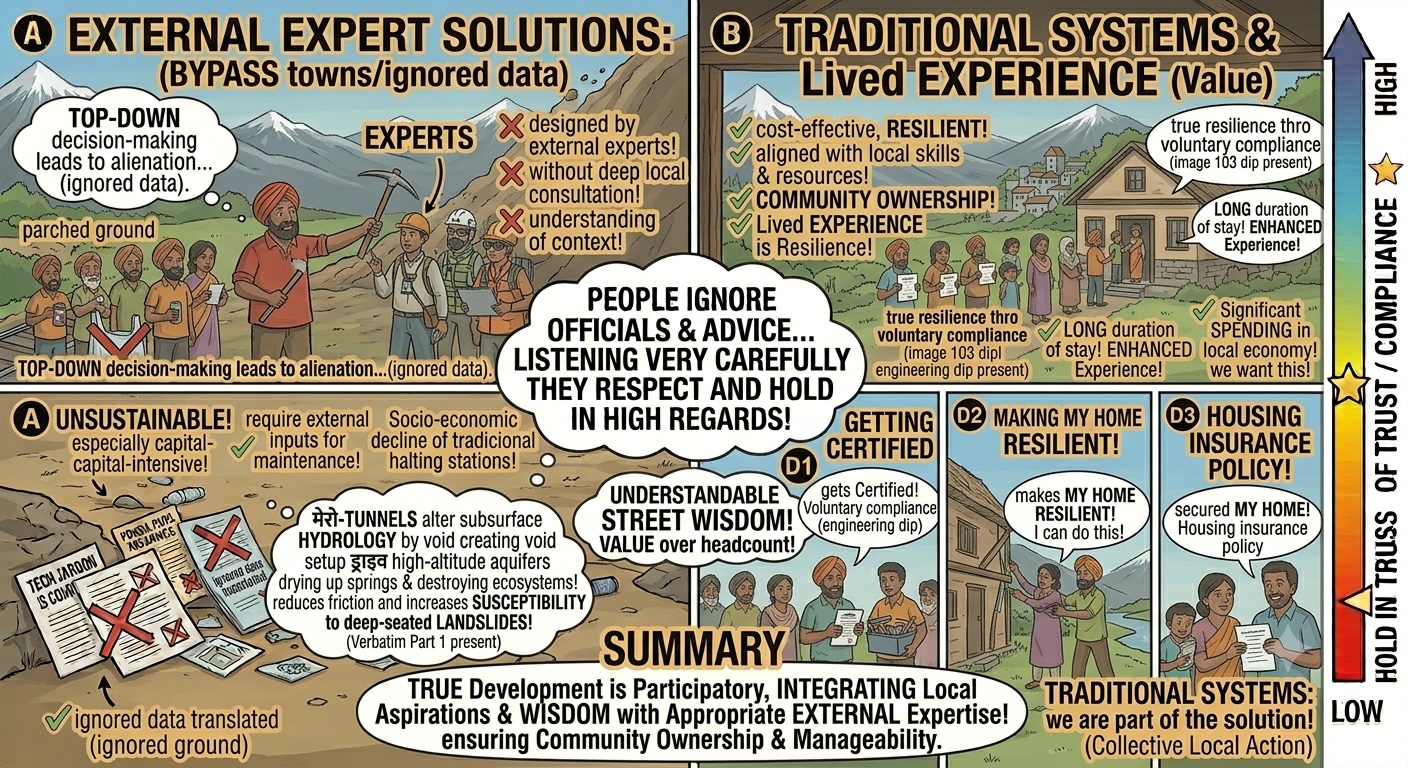
- स्थानीय परिस्थितियों की समझ और लोगो से परामर्श किये बिना बाहरी परामर्शदाताओं द्वारा सुझाये गये उपाय व बनायीं गयी योजनायें प्रायः सफल नहीं हो पति है, विशेष रूप से जब इनकी लागत बहुत ज्यादा हो तथा इनको चलाने या इनके रख रखाव के लिये बाहरी संसाधनों की आवश्यकता हो / Solutions designed by external experts without deep local consultation and understanding of context often prove unsustainable, especially if they are capital-intensive and require external inputs for maintenance.
- पीढ़ियों के संचित अनुभवों व ज्ञान के आधार पर विकसित परम्परागत विधाये, तकनीकें व उपाय प्रायः कम खर्चीले, स्थानीय परिस्थितियों के अनुरूप, स्थानीय स्तर पर रख रखाव लायक व लोगो को स्वीकार्य होती है / Traditional systems, developed over generations, are often more cost-effective, resilient, and aligned with local skills, resources, and cultural practices.
- सतत विकास के लिये समाज की सहभागिता के साथ-साथ स्थानीय व परम्परागत ज्ञान तथा लोगो की आकांशाओ का समावेश करते हुवे उचित तकनीक का उपयोग किया जाना चाहिए और साथ ही किये जा रहे उपाय समाज को स्वीकार्य, व समाज के स्तर पर पोषण योग्य होने चाहिये / Sustainable development requires a participatory approach, integrating local knowledge and aspirations with appropriate modern technologies, ensuring community ownership and manageability.
- हिमालय को आत्मसात किये बिना और क्षेत्र के सामाजिक – परिस्थितीय ढांचे को समझे बिना, इस क्षेत्र के लिये प्रभावी तथा स्थायी समाधान विकसित कर पाना सम्भव नहीं है / “Lived experience” and an understanding of the local socio-ecological fabric are crucial for designing effective and lasting solutions in the Himalayas.
संता – बंता की यह जुगलबन्दी आपको कैसी लगी, कृपया हमें जरुर बताये
व
इस जुगलबन्दी को बेहतर बनाने के लिये अपने सुझाव अवश्य दें।
हमें हमेशा की तरह आपके सुझावों, प्रतिक्रियाओं व कटाक्षो का बेसब्री से इंतजार रहता हैं औरसच मानिये इसी के आधार पर हम अपने आप में, अपनी सोच व रचनात्मकता में सुधार करने कोप्रेरित होते है।
सो अच्छा – बुरा जैसा आपको महसूस हुवा हो, कमेंट जरुर करते रहें।
Leave a Reply