 Edition: 20 Jan 2026 | 2100 hrs IST
I. The Mountain Pulse: Pan-Himalayan Analysis 🏔️
The Himalayan region is currently locked in an “Atmospheric Dead-Zone.” The anticipated mid-January Western Disturbance has completely dissipated over the Hindu Kush, leaving the Indian Himalayas in a state of “Absolute Humidity Deficit.”
-
The Movement: A high-pressure ridge is sitting directly over the Joshimath-Niti Valley axis. This is compressing the air in the valleys, causing “Adiabatic Warming”—where air heats up simply by being pushed down. This is why ridges are feeling unseasonably warm while the valley floors are choked with stagnant, cold smog.
-
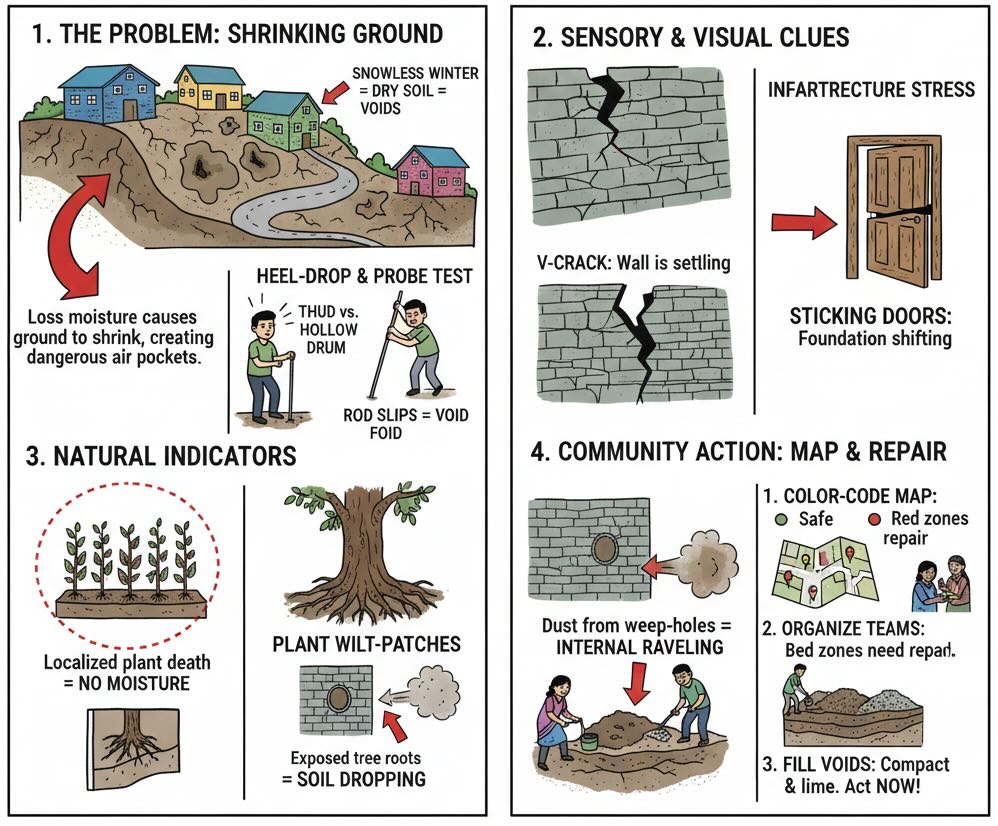
The Status: “Sub-Surface Kinetic Alert.” The total lack of moisture in the soil is causing deep Desiccation Cracking in the slopes of the Bhagirathi and Alaknanda valleys. This is not just a drought; it is a structural weakening of the mountain’s “skin.”
II. Global Echoes 🌏
The “Great Desiccation” is echoing across the world’s most sensitive high-altitude biomes.
-
The Sierra Nevada (USA): They are reporting a “Snow-Water Equivalent” of zero in many sectors. This has triggered an early “Wildfire Alert” in January—a terrifying precursor to our own upcoming spring in the Himalayas.
-
The Tibetan Plateau: New data shows that the “Third Pole” is warming at three times the global average. The permafrost melt is releasing “Legacy Methane,” which is further trapped by the current atmospheric stagnation, creating a localized greenhouse effect.
-
The Australian Alps: Massive storms are hitting the southern hemisphere, proving that while we are “water-starved,” the moisture has simply moved elsewhere, reinforcing the “Global Hydrological Imbalance.”
III. The Laboratory: The “Frost-Heave” Paradox 🔬
The Topic: “Dry-Frost Pulverization.”
-
The Science: Usually, ice binds the Himalayan soil. But in this dry winter, we are seeing “Dry-Frost.” Overnight temperatures still plummet, causing the remaining microscopic moisture in the rocks to freeze and expand. Without a snow blanket to insulate the ground, this “ice-wedging” is happening at an accelerated rate, turning solid rock into fine “rock-flour” or dust.
-
The Citizen’s Impact: This makes the mountain slopes incredibly “fluid.” Even a minor tremor or a heavy vehicle’s vibration could trigger a “Dry-Slide.” The Fix: Avoid heavy construction or drilling near steep, un-retained slopes during this dry spell. The mountain’s “internal glue” is currently brittle.
IV. The Time Machine ⏳
Historical Evidence: 20 January
-
1934 – The Bihar-Nepal Earthquake (Context): One of the most devastating quakes in history occurred in this season.
-
The Lesson: It reminds us that Tectonic Stress doesn’t care about the weather. While we focus on the drought, the Indian Plate continues its relentless push into the Eurasian Plate. A dry, brittle mountain structure may actually transmit seismic waves differently than a saturated one.
-
-
1981 – The “Great Frost” of the UK: One of the coldest nights on record.
-
The Lesson: It taught the world about “Infrastructure Brittleness.” Water mains across the country burst not when they froze, but when they thawed. This is a warning for us: when the first rains finally hit our parched pipes, the “Thermal Shock” could cause a mass-failure of our aging water grids.
-
V. The Daily Ordinance: The “Hollow-Stomp” Walk 📜
Your 60-second safety hack for identifying ground failure.
-
The Hack: When walking on unpaved paths or near boundary walls today, perform the “Hollow-Stomp.”
-
The Observation: Stomp firmly with your heel.
-
The Danger: If you hear a “drum-like” or hollow reverberation, it indicates a “Desiccation Void” beneath the surface.
-
The Action: Mark these spots with lime or a stone. These are the exact points where sinkholes will form during the first spring rain. Alert your neighbors and refer to our “Void-Filling Guide.”
#HollowStomp #HimalayanSentinel
The devastating thaw-bursts of 1981 and the tectonic warnings of the 1934 Bihar-Nepal quake warn us that nature’s silence is often its most dangerous weapon. These past events tell us that structural failure doesn’t always need water; sometimes, it only needs the absence of it. Our ongoing initiatives in ‘Dry-Slide Monitoring’ and ‘Void-Mapping’ prove that we are reading the mountain’s cracks, but history warns us that if we do not reinforce our ‘Brittle Infrastructure’ before the first rain, we are merely waiting for the mountain to exhale. Today tells us the air is still and the ground is hollow; it warns us that the dry earth is a fragile earth.
Leave a Reply