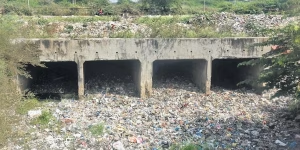
When “Progress” Creates the Next Landslide: Santa is celebrating a routine new development project until Banta points out that the new drainage channel is aimed directly at an unstable slope like a water cannon. Discover why DRR must be integrated into normal developmental budgets, not just emergency funds.
Santa Banta
Santa’s “Nail-It-Quick” Fix vs. Banta’s “Interlocking Embrace”
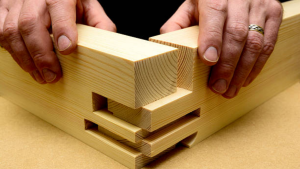
Traditional wooden joinery in the Himalayan region involved intricate housed joints in addition to nailing creating stronger, more rigid connections that distributed forces effectively, enhancing the structure’s ability to resist earthquake shaking without easily loosening or pulling apart.
The Groundhog Day Retaining Wall
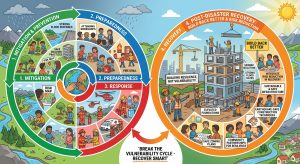
The Merry-Go-Round of Rebuilding: Santa is proud of his new concrete wall, built with “extra cement” after the floods. Banta reveals why rebuilding a mistake is still a mistake, and how ignoring DRR during the reconstruction phase guarantees future failures.
The Danger of the “Silent” Slope: The Map with the Blind Spot
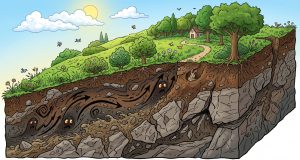
Generic hazard maps often fail to account for recent human-induced changes. Site-specific risk assessment is therefore mandatory for major infrastructure projects in the Himalayas as reactivation of old, dormant landslides is a major threat to human settlements that requires detailed geological mapping.
Santa’s Green Electricity Dream vs Banta’s Cracked Pot Warning

The label “green energy” can be misleading if the associated geological and environmental risks to local communities are not fully assessed and mitigated. Comprehensive and transparent environmental and geological impact assessments are non-negotiable before approving large-scale hydropower projects in the Himalayas.
The “Drunken” Trees and the Hidden Leak
Landslides are multi-parametric. Improper drainage and domestic water disposal can trigger instability in otherwise stable terrains. Subtle signs like “creeping” soil or tilting trees are early warnings of slope failure that require professional risk assessment.
The “Lazy” Hill and the Big Surprise

A slope that has been quiet for decades isn’t necessarily safe; it may just be dormant. The first initiation of a landslide after a long period of silence is often the most catastrophic, catching communities entirely off guard. Discover how aggressive human interventions, such as reckless hill-cutting and heavy construction, can “infuse” instability into ancestral slopes, turning a peaceful mountain into an active hazard zone.
Santa’s “Pakka Cement Dream” vs. Banta’s “Wall of Worry”

Blanket condemnation of traditional structures after an earthquake often masks the real culprit: structural incompatibility. Across mountain regions, the rapid, status-driven adoption of cement-concrete has created dangerous structural hybrids, such as placing heavy concrete slabs on top of old stone walls. Discover why true resilience depends on strict engineering compatibility and localized technical guidance, rather than the blind pursuit of a “modern” aesthetic.
The Map That Missed the Mess

Is your hazard map a “Beautiful Lie”? 🗺️🤥 Santa is ready to trust the colors, but Banta reveals why mapping the “Skeleton” of the mountain while ignoring the “Debris” is a recipe for disaster.
The Lazy Mountain and Newton’s Grudge
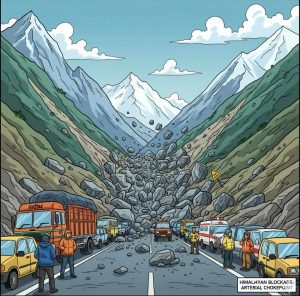
Does the mountain obey Newton? Santa thinks the hills are lazy, but Banta explains the “Law of Inertia” behind landslides. Discover why the “External Trigger” of rain and earthquakes is the only thing standing between a peaceful slope and a deadly disaster.