 Edition: 15 Jan 2026 | 0900 hrs IST
Critical Briefing: The Single-Artery Syndrome
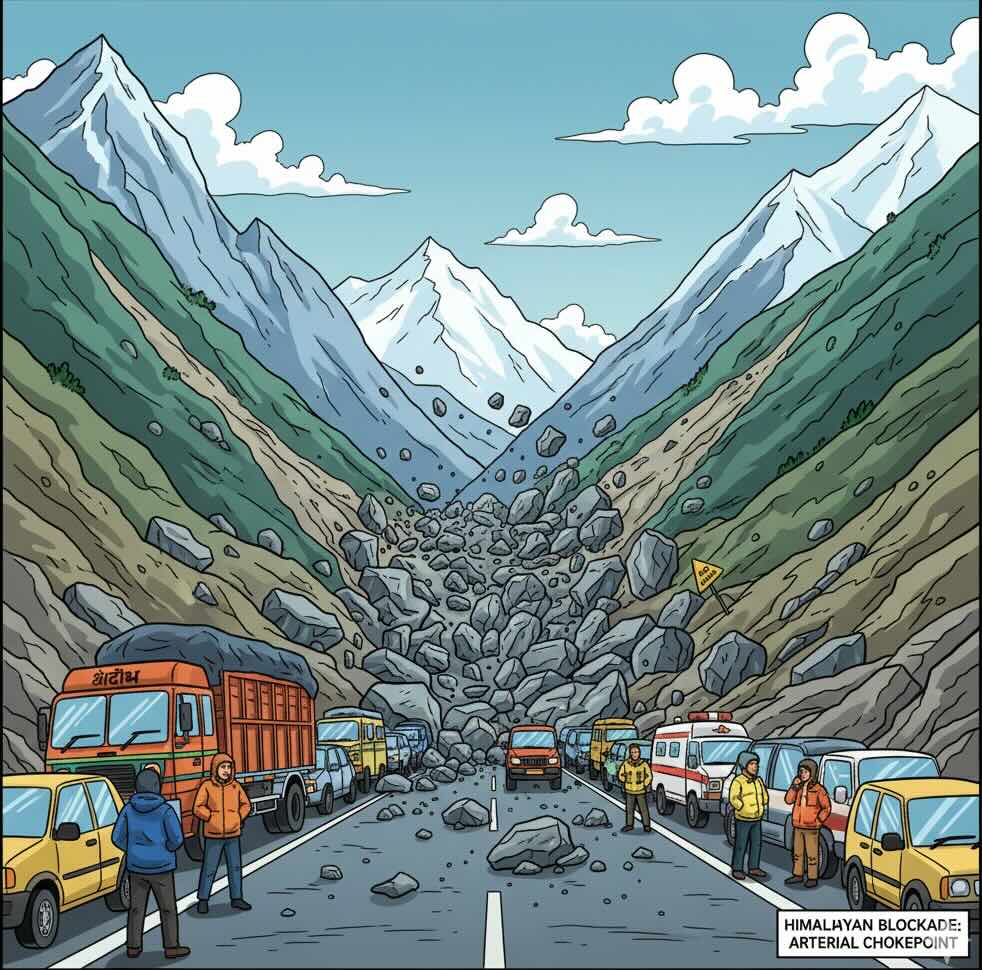
As the Himalayan arc enters the peak of its “Thermal Compression” cycle, we are witnessing a heightened threat to the lifelines of the heights. The extreme temperature variance between sun-exposed rock faces and deep-frozen internal fissures creates a “wedging” effect, making “Spontaneous Rockfall“ on high-altitude highways a primary hazard for mid-winter transit.
The Science of “Arterial Choke Points”
In low-land geography, road networks are “meshed,” providing multiple detours. In the Himalayas, however, we deal with “Zero-Redundancy” Topology. These roads are often “singularities”—if a single bridge or a 50-meter section of a cliff-side highway collapses, the entire downstream or upstream urban center is effectively severed from the world.
This creates a “Logistical Black Hole,” where the inward flow of life-saving oxygen, fuel, and food stops instantly, and the outward flow of emergency medical cases is paralyzed.
The Himalayan Implication: A Systemic Crisis
- Resource Scarcity & Economic Shock: Historical data from the 2023 Beas Floods and the 2021 Rishiganga disaster show that within just 48 hours of a road closure, essential commodity prices in cities like Shimla, Gangtok, Almora, or Leh can spike by 40–60%. This is driven by “Panic Hoarding” and the sheer physical inability to restock.
- Medical Fragility: We must recognise the “Time-Distance” trap. Patients requiring specialized cardiac or neurological care in “base” hospitals in the plains (like Chandigarh, Haldwani, or Siliguri) become “Geographically Trapped.” In a mountain isolation event, a 4-hour journey can turn into a terminal 48-hour wait.
The Mountain Pulse: Pan-Himalayan Analysis 🏔️
- The Movement: Satellite and ground observations across the Indo-Gangetic-Himalayan transition zone indicate a surge in “debris shedding.” The mechanical vibration of heavy winter freight—carrying the very fuel and food meant to prevent scarcity—acts as a catalyst. When combined with “Frost-Heave“ (where moisture under the asphalt freezes and expands), it creates micro-fissures that allow the road to literally pull apart under its own weight.
- The Status: A state of “Flow-Risk” has been declared for several sectors of the National Highways in Himachal, Uttarakhand, and Sikkim. In these zones, the infrastructure is no longer just a victim of the mountain; it is a catalyst. The road-cuts have removed the “toe” of the slope, and the added weight of saturated infrastructure is pushing the hillside toward a failure point.
The Laboratory: Network Resilience 🔬
- The Science: Topology Optimization. Researchers are now using AI to map “Alternative Goat-Trails” and historical mule tracks—paths forgotten since the British era. The initiative involves pre-staging Modular Geotextiles and lightweight aluminium bridging sections that can turn a 2-meter wide track into a 4-meter wide emergency supply route in hours.
- The Citizen’s Impact: Resilience is not just a government duty; it is a household inventory. The “72-Hour Buffer” is the gold standard. This must include:
- Chronic Medication: A 10-day surplus (roads rarely open in 24 hours).
- Energy Redundancy: Solar lamps or power banks, as road failures often take out roadside power lines.
- Water Autonomy: Portable filters, as landslides often break the gravity-fed water pipes supplying Himalayan towns.
The Daily Ordinance: The “Reverse-Commute Awareness” 📜
- The Hack: Shift your gaze. While driving, don’t just look at the road; look at the “Uphill Retaining Walls.”
- The Indicator: If you see “Fresh Scars“—bright, un-weathered rock surfaces—or a ditch filled with crisp, sharp-edged stones, the slope is currently breathing.
- The Rule: Do not stop for “scenic photos” or breaks in these zones. Maintain a steady, cautious pace. If you see water gushing from a crack in a wall that was dry yesterday, that is a pressure-release warning. Move through quickly.
#ArterialIntegrity #HimalayanSentinel #ShimlaToLeh
The total isolation of Leh during the 2010 floods and the recent blocking of the NH-5 remind us that a city with one road is a city with a countdown. These past events warn us that our current ‘Normal’ is held together by a thin ribbon of asphalt that the mountain never agreed to host. Our ongoing initiatives in ‘Topology Optimisation‘ prove we can build a second chance, but history warns us that technology cannot outrun poor planning. Today tells us the road-cuts are shedding and the ‘Frost-Heave‘ is active; it warns us that if we do not move from the ‘Single-Artery’ dependency to a decentralised ‘Survival Buffer,’ we aren’t just residents of the majestic heights—we are prisoners of our own connectivity.
Leave a Reply