 Edition: 19 Jan 2026 | 2130 hrs IST
The Great Himalayan Paradox: From Corbett’s Chronicles to the Migration Crisis
Uttarakhand is currently gripped by a complex socio–ecological dilemma: the “Great Himalayan Paradox.”
While wildlife conservation remains a global priority, the unintended consequences—man-animal conflict, the abandonment of ancestral farmlands, and a surge in forced migration—are hollowed-out rural communities.
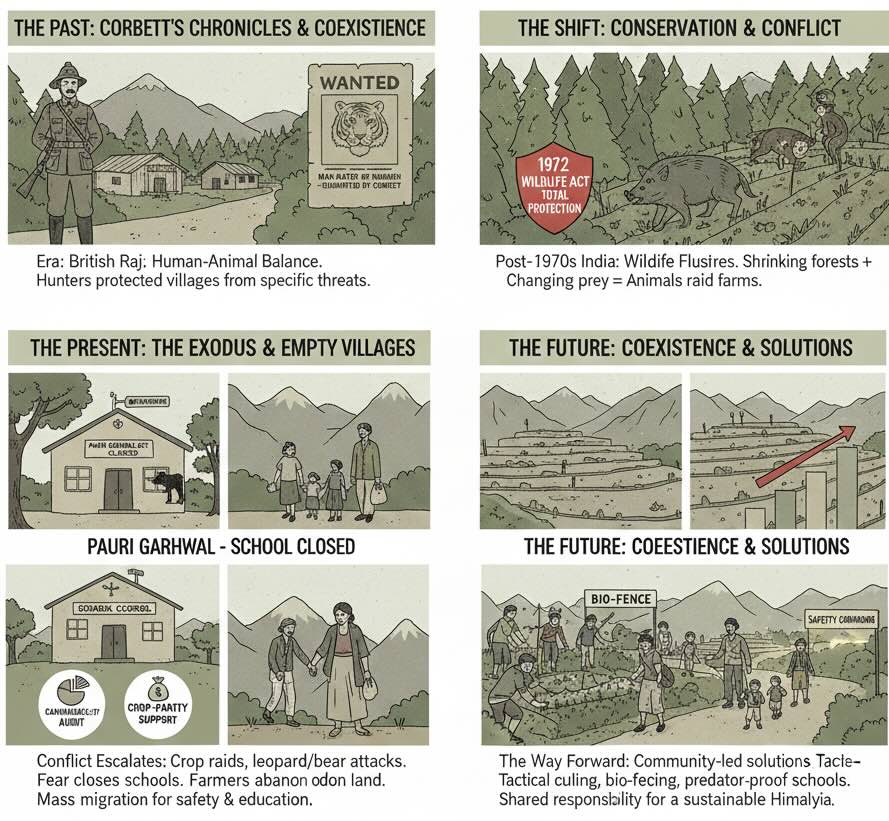
This article explores the evolution of this conflict, from the “Hunter–Protectors” of the British Raj to the present-day crisis of “Barren Terraces” and “Ghost Schools,” seeking a middle path for a region on the brink.
I. The Historical Pendulum: From Bounty to Bondage; The British Era:
The Age of the “Himalayan Hunter”
During the late 19th and early 20th centuries, the relationship between humans and the “Big Cats” was one of survival and elimination. Legendary figures like Jim Corbett were cherished as “Saviours of the Hills.” In those days, a man-eater was a clear and present threat that justified an immediate and often officially sanctioned bounty.
The forest was seen as a resource to be managed and a danger to be tamed.
Independent India: The Conservation Swing
The 1972 Wildlife Protection Act marked a radical shift. The focus turned to preservation, the creation of National Parks, and the total protection of species like the Tiger and Leopard.
While this saved the Indian Tiger from extinction, it created a new dynamics: as forest buffers shrank and prey bases fluctuated due to climate change, predators began to view human settlements not as boundaries, but as hunting grounds.
II. The Present Crisis: The “Barren Terrace” Syndrome
The modern conflict is no longer just about the occasional attack; it is about the total disruption of mountain life.
- The Agricultural Surrender: Wild boars and monkeys have made the traditional cultivation of Mandua (Finger Millet) and Jhingora (Barnyard Millet) nearly impossible. When the cost of protection (fencing/guards) exceeds the market value of the crop—especially compared to subsidised fine grains from the plains—the farmer chooses the city over the soil.
- The “Ghost Schools” of Pauri Garhwal: The fear of the Guldar (Leopard) and the Black Bear is so pervasive that parents are keeping children home. When schools close due to wildlife threats, the “Last Pillar of the Village” falls, accelerating migration for the sake of education.
- Hibernation Hijacked: Climate change is disrupting the hibernation cycles of Himalayan Black Bears. Instead of dormant winters, bears are active and hungry throughout the year, venturing into villages for fruit and livestock, leading to fatal encounters.
III. Global Best Practices: The Way Forward for Coexistence
How do other mountain nations manage the “Apex Predator” problem without depopulating the landscape?
1. The “Human-Wildlife Conflict Offset” (Europe / Sweden)
In Sweden, farmers are not just compensated for lost livestock; they are paid a “Conservation Performance Payment” based on the number of predators successfully living in their vicinity without conflict. This turns the predator from a liability into a community asset.
2. Tactical “Culling” and Harvest Management (USA / Canada)
In North America, species like the Black Bear and Wild Boar are managed through “Sustainable Harvest.” State agencies issue limited hunting licenses to keep populations within the Social Carrying Capacity—the number of animals the human community can tolerate.
The Uttarakhand Context: We must discuss the legal framework for “Controlled Elimination” of vermin (Boars / Monkeys) to restore agricultural viability.
3. Smart Buffers and Bio-Fencing (Bhutan/Africa)
Instead of physical walls, Bhutan uses Bio-Fencing (planting non-edible, thorny, or pungent crops like lemon or chili) to deter animals. In Africa, “Bee-hive fences” stop elephants while providing honey income—a model that could be adapted for Himalayan bears.
IV. Solutions: The Himalayan Middle Path
1. Carrying Capacity Audits:
We must scientifically determine the number of leopards and bears a forest fragment can sustain. If the population exceeds this, relocation or ethical culling must be on the table.
2. Crop-Parity Support:
The government must bridge the price gap between hill millets and plain grains, ensuring that hill farming remains economically resilient despite wildlife pressure.
3. School “Safety Corridors”:
Providing protected transport for children in high-conflict zones like Pauri Garhwal to prevent school closures and halt migration.
The legends of Corbett’s man-eaters and the present-day silent corridors of Pauri Garhwal warn us that when the balance between human security and wildlife protection is lost, the landscape itself begins to hollow out. These past events tell us that conservation cannot succeed in a graveyard of abandoned villages. Our ongoing initiatives in ‘Bio-Fencing’ and ‘Conflict-Offset’ prove that we can coexist, but history warns us that if we do not manage the carrying capacity of our forests and the economic dignity of our farmers, we are not just protecting animals—we are presiding over the migration of a civilization. Today tells us the bear is awake and the school is closed; it warns us that a mountain without its people is a mountain that has lost its soul.
Leave a Reply