 Edition: 16 Jan 2026 | 0900 hrs IST
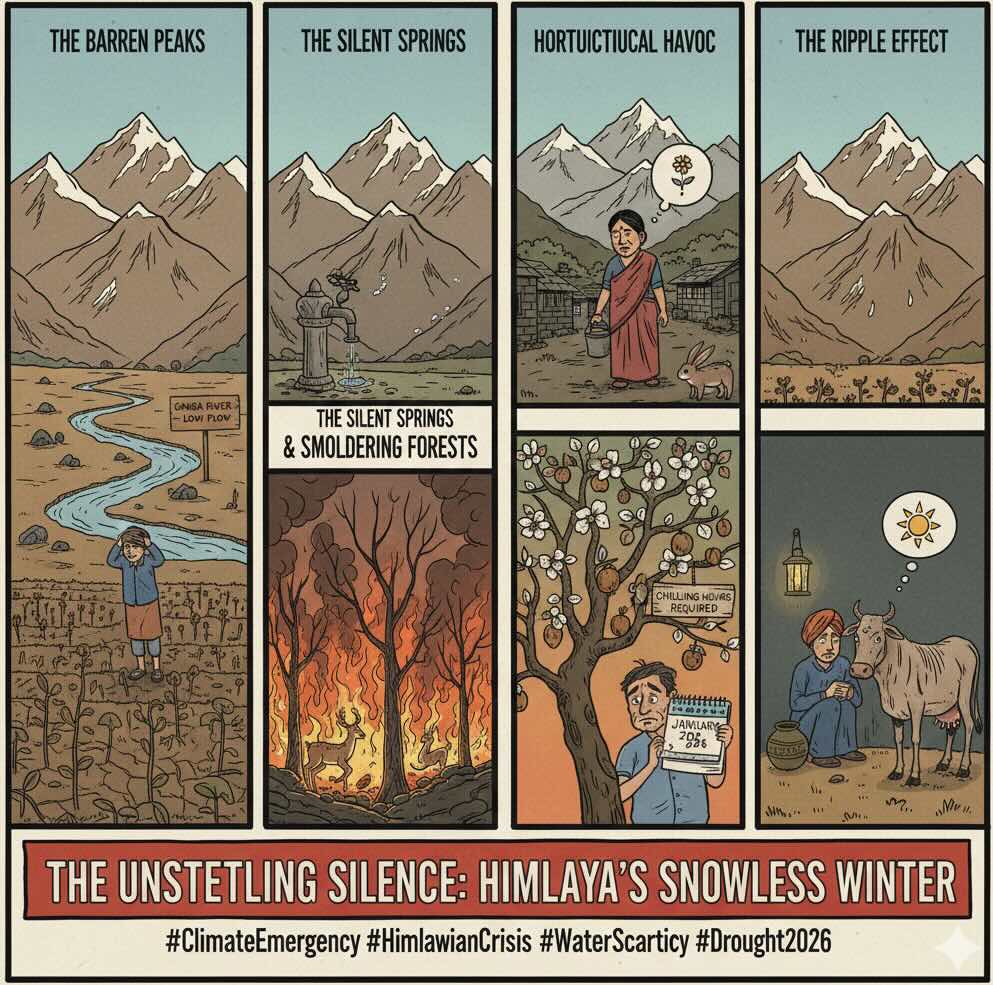
The Himalayan winter of 2026 is etched not by snow, but by its eerie absence. Half of January has passed, and the customary blanket of white remains elusive across vast stretches of these majestic mountains. Temperatures have soared, turning what should be a season of dormancy into a disconcerting prelude to an early spring. The once snow-clad peaks stand bare, stark witnesses to a climatic anomaly. Even if late snowfall graces us now, the prevailing warmth suggests it will be a fleeting guest, melting rapidly and offering little respite to the accumulating crises. This isn’t just a weather report; it’s an urgent dispatch from the front lines of climate change, demanding our immediate attention.
The Unraveling of a Critical Cycle: Beyond the Bare Peaks
This profound shift in winter patterns isn’t merely a scenic disappointment; it’s a systemic shock with devastating implications for an entire ecosystem and civilisation.
1. The Looming Water Crisis: Thirsty Basins, Silent Springs
The Himalayas are the “Water Towers of Asia,” feeding an intricate network of rivers that sustain nearly a quarter of the world’s population. A snowless winter directly translates to a depleted “cryospheric reservoir.”
-
Impact on River Systems: Glacial-fed rivers like the Ganga, Yamuna, Indus, and Brahmaputra, which are the lifeblood of the Indo-Gangetic plains, will experience significantly lower discharge. This isn’t just a reduction; it’s a potential “Hydro-Famine.”
-
Agriculture: Reduced river flow means parched farmlands, jeopardising the crucial Rabi crop season and impacting food security for millions. Imagine the breadbaskets of Punjab and Uttar Pradesh facing unprecedented drought conditions, mirroring the California droughts of 2012-2016, where snowpack deficits led to billions of dollars in agricultural losses and severe water rationing.
-
Hydropower Generation: The vast network of hydroelectric projects, from Himachal‘s Satluj Basin to Uttarakhand‘s Bhagirathi, relies on consistent meltwater. Lower discharge means reduced power generation, leading to energy crises and economic strain, akin to the power shortages experienced in Chile during dry years when its hydro-dependent grid struggled.
-
Sanitation & Urban Supply: Major metropolitan areas depend on these rivers for potable water and waste management. Diminished flow will exacerbate water quality issues and strain already overloaded urban water supply systems, potentially triggering public health emergencies.
-
-
Drying Springs and Seepages: Beyond the rivers, the mountain communities rely heavily on local springs and seepages. These vital water sources are directly replenished by winter snowmelt percolating through the soil. Without sufficient snow, these “silent aquifers“ will dry out, forcing uphill communities to face acute water scarcity, reminiscent of the “Day Zero” crisis in Cape Town, South Africa, where prolonged drought pushed the city to the brink of running out of water.
2. The Threat of Premature Forest Fires: A Smouldering Future
The absence of snow and unusual warmth create a tinderbox scenario.
-
Early Onset & Intensity: The dry undergrowth and leaf litter, typically compressed and moistened by snow, are now exposed and brittle. This creates prime conditions for forest fires to ignite even before the onset of summer. We saw a similar pattern in Australia’s “Black Summer” of 2019-2020, where an exceptionally dry and warm winter fuelled devastating bushfires that started unusually early.
-
Ecological Devastation: These fires are not just destructive; they are transformative. They obliterate biodiversity, impact air quality across vast regions, and contribute to further warming by releasing stored carbon. The loss of forest cover exacerbates soil erosion, particularly on steep Himalayan slopes, increasing the risk of landslides in subsequent monsoon seasons.
3. Horticultural Havoc: The Chilling Requirement Gap
Horticultural crops, especially temperate fruits like apples, peaches, and cherries, are the economic backbone of many Himalayan regions.
-
Chilling Hours Deficit: These crops have a critical “chilling hour requirement”— a minimum duration of cold temperatures needed for proper dormancy and subsequent flowering and fruit set. Abnormally high winter temperatures mean this requirement is unmet.
-
Reduced Productivity & Early Flowering: The consequence is often erratic or early flowering, leading to “false springs” where blossoms are vulnerable to subsequent, short-lived cold snaps. Even if they survive, the fruit quality and quantity can be severely reduced, impacting the livelihoods of thousands of farmers, similar to the challenges faced by cherry growers in the Pacific Northwest of the USA during unusually warm winters.
4. Public and Livestock Health: Stress on the Systems
The unusual climatic conditions exert pressure on biological systems.
-
Human Health: The lack of traditional cold and the extended periods of dry conditions can lead to an increase in respiratory ailments, allergies, and the altered distribution of vector-borne diseases. The disruption of agricultural cycles also has long-term nutritional implications.
-
Animal Health: Livestock, crucial for mountain livelihoods, are adapted to specific seasonal rhythms. Early greening and changes in fodder quality, combined with potential water stress, can impact their health, productivity, and susceptibility to disease. This can lead to economic losses for pastoral communities.
DRR Lessons from a Winter’s Absence: Adapting to the New Normal
-
अग्रसक्रिय जल प्रबन्धन / Water Management Beyond “Snowfall-to-Melt”: जरूरी है कि हम प्रतिक्रियात्मक से अग्रसक्रिय जल प्रबन्धन की ओर बढ़े और वर्षा के जल के संचय, भू-जल पुनर्भरण तथा सूखा प्रतिरोधी फसलों पर निवेश करें। जल संकट का सामना करने के लिये हमारे सामने उपयोग किये गये पानी के शुद्धिकरण के साथ ही समुद्र के खारे जल को पीने योग्य बनाने का इजराइल का उदाहरण है / We must transition from reactive water management to proactive, diversified strategies. This includes investing in rainwater harvesting, groundwater recharge programs, and promoting drought-resistant crop varieties. The success of Israel‘s advanced desalination and wastewater recycling offers a blueprint for extreme water stress.
-
समुदाय आधारित वनाग्नि चेतावनी / Community-Based Early Warning for Forest Fires: स्थानीय स्तर पर मौसम के आंकड़े एकत्रित करने वाले उपकरणों की स्थापना, ऊष्मा का पता लगाने वाले उपग्रहीय चित्रों का उपयोग तथा समुदाय द्वारा की जाने वाली निगरानी के आधार पर वनाग्नि चेतावनी हेतु एक सशक्त व प्रभावी प्रणाली का विकास किया जा सकता है / Deploying granular, localised weather stations and engaging local communities as “fire sentinels” is crucial. Leveraging technology like satellite thermal imaging combined with ground intelligence can provide vital early detection. The “Firewise USA” program, which empowers communities to reduce wildfire risks, offers valuable lessons.
-
कृषि विविधीकरण तथा जलवायु प्रतिरोध्य बागवानी / Agricultural Diversification & Climate-Resilient Horticulture: जलवायु अनुकूलन हेतु कृषको को सहायता की आवश्यकता होगी। इसके अन्तर्गत कम ठण्ड में भी अच्छी उपज देने वाली बागवानी फसलों की प्रजातियों को प्रोत्साहित करने के साथ ही जलवायु प्रतिरोध्य स्थानीय प्रजातियों का विकास किया जा सकता है। साथ ही अधोलंब खेती तथा नियंत्रित वातावरण आधारित खेती के प्रयोग भी किये जा सकते है / Farmers need support to adapt. This includes exploring alternative, less chilling-dependent crops, implementing shade netting or misting systems to compensate for lack of dormancy, and developing climate-resilient indigenous varieties. Innovations in vertical farming and controlled environment agriculture could also play a role in reducing reliance on traditional climatic cycles.
-
एकीकृत स्वास्थ्य तथा पशुधन प्रबन्धन / Integrated Health & Livestock Management: जन स्वास्थ्य सम्बंधित योजनाओ के अन्तर्गत बदल रहे बीमारियों व पोषण के परिदृश्य का समावेश किया जाना चाहिये। साथ ही मवेशियों के लिये पौष्टिक पशु आहार की व्यवस्था तथा बीमारियों की निगरानी की जानी चाहिये। दूर दराज के इलाको के लिये सचल पशु चिकत्सा वाहन की व्यवस्था की जा सकती है / Public health strategies must account for altered disease vectors and nutritional shifts. For livestock, this means developing resilient fodder systems and early disease surveillance. Mobile veterinary services in remote areas become even more critical during such anomalies.
-
सामान्य का पुनर्मूल्यांकन / Re-evaluating “Normal”: यह समझना जरूरी है कि “सामान्य” बदल रहा है। अतः योजना बनाते समय विगत के औसत से आगे सोचना जरूरी है। अवसंरचना, खेती – बाड़ी के चक्र तथा आपदा पूर्वतैयारी को चरम समझे जाने वाले परिदृश्यों के लिये मूल्यांकित किया जाना चाहिये / The biggest lesson is that “normal” is shifting. Our planning horizons must extend beyond historical averages. Infrastructure, agricultural calendars, and disaster preparedness must be re-evaluated against scenarios that were once considered extreme.
The silent bareness of our Himalayan peaks today echoes the grim realities faced by drought-stricken California’s farmlands or the ‘Day Zero’ threat in Cape Town. These global parallels warn us that the absence of snow isn’t just a local weather oddity; it’s a systemic disruption. Our ongoing initiatives in climate modeling and cryospheric research show us the stark numbers, but history tells us that data alone is not enough; it demands audacious adaptation. Today’s snowless peaks are a stark warning that if we do not move from passive observation to aggressive, multi-faceted resilience—from re-engineering our water systems to rethinking our agricultural calendars—we are not just witnessing climate change; we are surrendering to its most profound and life-altering impacts. The time for deliberation is over; the time for transformation is now.
Leave a Reply