 Edition: 28 Jan 2026 | 2130 hrs IST
I. The Mountain Pulse: Pan-Himalayan Analysis 🏔️
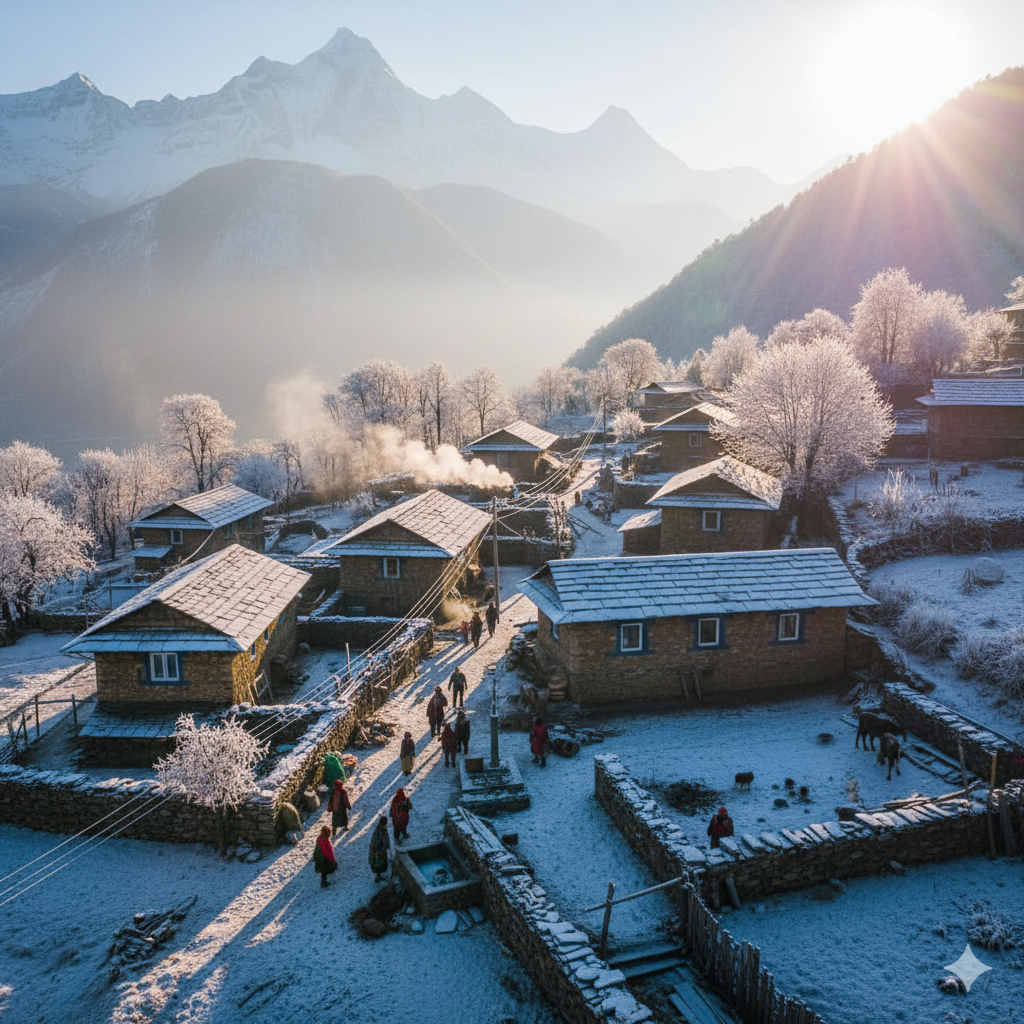
The Himalayas are now entering the most volatile phase of the current weather system: the “Secondary Freeze”following the heavy rain-on-snow event. As the moisture-laden clouds clear, temperatures are plummeting, turning the saturated slush into a solid, unyielding sheet of ice.
-
The Movement: The “Refreeze” is moving upward from the valleys. In Shimla, Manali, and Gangtok, the massive amount of water absorbed by the snow yesterday is now expanding as it turns to ice.
-
The Status: “Mechanical Expansion Warning.” We are entering a critical window for infrastructure. The water that seeped into micro-cracks in roads, retaining walls, and building foundations yesterday is now exerting “Frost Wedging“ pressure, which can split stone and heave pavements overnight.
II. Global Echoes 🌏
The patterns of “Rain-to-Ice” transitions are causing simultaneous disruptions in other high-altitude zones.
-
The Alps (Austria/Switzerland): A similar rapid freeze after a warm rain spell has triggered “Glide-Avalanches.” When water lubricates the ground and then freezes, it creates a “ball-bearing” effect for the snow layer above, leading to sudden, massive movements on steep slopes.
-
The Andes (Chile): High-altitude infrastructure is battling “Cryogenic Stress” on communication towers. The weight of “Rime Ice” (frozen cloud droplets) combined with the heavy saturated snow from previous days is threatening structural collapses.
-
Northern Japan: They are utilising “Geothermal Road Heating” to prevent the exact “Ice-Lock” we are currently facing, a stark reminder of the “Grey-to-Green” infrastructure transition needed in our hills.
III. The Laboratory: The “Frost Wedging” Force 🔬
The Topic: “The 9% Expansion.”
-
The Science: When water turns to ice, its volume increases by approximately 9%. In a confined space—like a crack in a retaining wall or a gap in a concrete pillar—this expansion generates pressures exceeding 200 million Pascals (30,000 psi). This is more than enough force to shatter solid granite or reinforced concrete.
-
The Citizen’s Impact: Walls that looked “fine” during the rain yesterday may suddenly show new, deep fissures tomorrow morning.
-
The Fix: Do not attempt to “seal” wet cracks tonight. If you seal them while they contain water, you are creating a “Pressure Bomb.” Wait for a dry spell before applying seismic-grade sealants.
IV. The Time Machine ⏳
Historical Evidence: 28 January
-
1986 – The Space Shuttle Challenger Disaster (Context): A tragic lesson in “O-Ring Failure” due to cold temperatures.
-
The Lesson: It reminds us that materials have “Thermal Limits.” In Zone VI, our steel, rubber gaskets, and PVC pipes all behave differently in extreme cold. A “safe” system in the sun can become a “fatal” system in the freeze.
-
-
1925 – The Great Race of Mercy (Togo the Sled Dog): The start of the legendary serum run to Nome, Alaska.
-
The Lesson: It proved that in the most extreme freezes, “Biological Resilience” (animal and human) often outperforms machines. When the snow gets too deep for engines, the community’s local knowledge and physical endurance are the only lifelines.
-
V. The Daily Ordinance: The “Black Ice” Shadow Audit 📜
Your 60-second safety hack for the morning commute.
-
The Hack: Identify “Micro-Climates of Ice.”
-
The Observation: Look at areas that stay in the shadow of buildings or trees after 9:00 AM.
-
The Danger: While the “Sun-Lit” roads might be dry, the Shadow Zones will host “Black Ice”—a thin, transparent layer that looks like a wet patch but has zero friction.
-
-
The Action: Test the surface with your toe before committing your full weight. If walking on a slope in a shadow zone, keep your knees slightly bent and your center of gravity forward.
#ShadowAudit #HimalayanSentinel
The tragic thermal betrayals of the 1986 Challenger and the historical isolation of the 1925 Nome freeze warn us that cold is not just a temperature, but a mechanical force. These past events tell us that the most dangerous moment for a structure is not the storm, but the expansion that follows. Our ongoing initiatives in ‘Frost Pressure Monitoring’ and ‘Thermal Resilience’ prove that we are prepared for the ‘Secondary Freeze,’ but history warns us that if we do not respect the ‘Shadow Zones’ on our roads tomorrow, we are ignoring the mountain’s most silent trap. Today tells us the sky is clear and the air is biting; it warns us that water is most powerful when it stops moving.
Leave a Reply