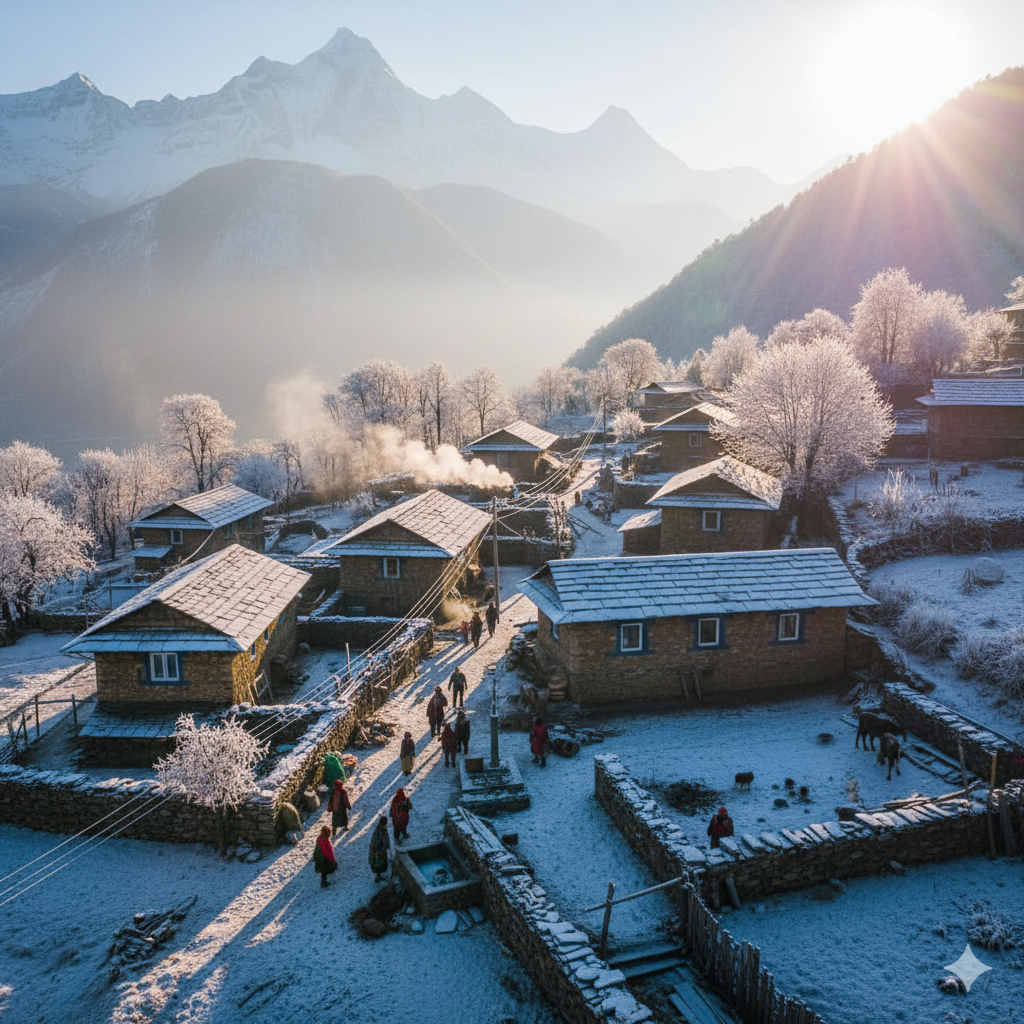
 Himalaya and Other Mountainous Regions
Sri Lanka Landslides and Floods
Cyclonic Storm DITWAH is compounding an already catastrophic situation in Sri Lanka where since the previous week, severe floods and landslides have swept across the country’s central, mountainous regions (Badulla, Nuwara Eliya).
The death toll has tragically risen to at least 31 people, with 14 remaining missing. Many victims were buried alive when rain-soaked mountain slopes collapsed on homes.
Military and police are conducting rescue operations amid submerged roads and blocked mountain routes.
The government has declared a public holiday in affected districts to facilitate the emergency response.
Himalayan Chronic Crisis
While the immediate weather threat is elsewhere, the structural risks in the Himalayas are reaffirmed by new climate studies.
A multi-institutional climate study released today confirms that mountainous regions face accelerated warming and glacier melt. This warming trend surpasses many other Indian zones, increasing the long-term risk of Glacial Lake Outburst Floods (GLOFs) and highly amplified landslides, reinforcing the urgent need to integrate glacier monitoring and risk planning into all development projects.
Major Disasters in Other Areas
Cyclonic Storm DITWAH
The most significant disaster incidence today is the formation and intensification of Cyclonic Storm DITWAH over coastal Sri Lanka and the adjoining Southwest Bay of Bengal.
The system is bringing further heavy rainfall (up to 200 mm in some areas) and strong winds (60-70 km/h, gusting to 80-90 km/h) to the island.
Authorities have issued evacuation red alerts in seven high-risk districts and urged residents in low-lying areas to move to higher ground. The risk of floods has increased further due to the necessary opening of spill gates at all of the reservoirs throughout the island.
Urban Air Pollution Crisis
The Supreme Court is scheduled to take up the plea for continuous monitoring of the “Very Poor” Air Quality Index (AQI) in the Delhi-NCR region on December 3, underscoring the chronic governance challenge and the persistent public health disaster caused by man-made pollution.
DRR & CCA Conferences, Workshops, Reports, Concerns and Incidences
Major Committee Session Conclusion
The Ninth Session of the Committee on Disaster Risk Reduction (CDRR), part of ESCAP Disaster Resilience Week, concludes today in Bangkok.
This intergovernmental legislative forum focused on reviewing the expanding disaster risk landscape in Asia and the Pacific (including intensifying heat and cyclone impacts) and exploring innovations in science and technology to strengthen resilience.
Climate Report Launch
The Post-AR6 Climate Change Update for India was released today, providing region-specific data on accelerating warming trends in the tropical Indian Ocean and reinforcing the need for resilient infrastructure and climate-smart agriculture.
Compound Extremes
The new climate study highlights the critical danger of compound extremes—such as simultaneous heatwaves and droughts, or heavy rainfall immediately following prolonged heat.
These hazards are increasing rapidly and dramatically amplify impacts on agriculture, water supply, and health systems across India.
Global Heat Record
A multi-institutional climate study found that India’s average temperature rose by nearly 0.9o C between 2015 and 2024, with the number of warm days increasing by 5–10 days per decade in many regions. This reflects an accelerating global warming trend affecting both plains and mountainous zones.
Tropical Ocean Warming
The tropical Indian Ocean is warming at about 0.12o C per decade, one of the fastest rates globally.https://en.wikipedia.org/wiki/Illinois
This warming is directly linked to the intensification of pre-monsoon cyclones and the increased frequency of severe coastal hazards.
Adaptation Priority
The necessity for strengthening early-warning systems, building resilient infrastructure, and prioritising climate-smart agriculture is the unified call from recent reports analyzing India’s accelerating climate risks.
Historical Disasters on This Day (November 28)
1879 – Tornado outbreak in US
A rare November tornado outbreak ravaged the American Midwest and South, spawning at least a dozen twisters from Illinois to Louisiana in a “wrenching, spiral” assault that leveled farmsteads, hurled livestock through the air, and claimed dozens of lives in an era before modern warnings, underscoring the Midwest’s long vulnerability to late-season whirlwinds.
1908 – Mine Explosion
A mine explosion in Marianna, Pennsylvania, tragically killed 154 men, leaving only one survivor.
1942 – Cocoanut Grove Fire
The Cocoanut Grove nightclub in Boston, Massachusetts —a glittering haven of wartime escapism—erupted into an inferno of unimaginable horror.
A single match, struck in a crowded basement bar to illuminate a dim corner, ignited artificial palm fronds and flammable decor, transforming the venue into a deathtrap as flames raced up walls and toxic smoke choked the air.
In mere minutes, 492 souls—dancers, soldiers on leave, and locals seeking solace—perished in the crush at locked exits and through shattered windows, marking it as America’s deadliest nightclub fire and spurring nationwide fire safety reforms that saved countless lives in the decades since.
1943 – Tehran Conference
U.S. President Franklin D. Roosevelt, British Prime Minister Winston Churchill, and Soviet Premier Joseph Stalin met in Tehran, Iran, to discuss war strategy (World War II).
1979 – Air New Zealand Flight 901 Crash
The frozen expanse of Antarctica witnessed a modern marvel turned catastrophe: Air New Zealand Flight 901, a sightseeing DC-10 laden with 257 holidaymakers from Auckland, plummeted into the snow-shrouded slopes of Mount Erebus, the world’s southernmost active volcano.
What was billed as a scenic “flightseeing” tour over the icy Ross Ice Shelf ended in a fiery collision at 14,000 feet, erasing all aboard in an instant amid whiteout conditions and navigational errors compounded by a last-minute flight path alteration.
The wreckage, scattered across a glacier, yielded haunting cockpit recordings of a pilot’s final, futile warning—“I don’t like this”—revealing systemic oversights in a probe that rocked New Zealand’s aviation industry and led to global scrutiny of polar operations.
1983 – Nigeria Airways Flight 250’s crash
Nigeria Airways Flight 250’s crash near Enugu Airport during a storm-lashed approach killed 53 of 72 aboard, a stark reminder of aviation’s perilous intersection with tropical weather in West Africa.
2008 – Mumbai Terror Attacks
On this day, the 26/11 terrorist attacks continued in Mumbai (having begun late on November 26).
The siege by Lashkar-e-Taiba terrorists on six sites, including the Taj Mahal Palace Hotel and the Chhatrapati Shivaji Terminus, continued to paralyze the city for 60 hours, resulting in 166 fatalities.
These vignettes from November 28 weave a tapestry of loss—from urban blaze to polar plunge to stormy skies—each a poignant catalyst for safeguards that temper tomorrow’s risks.
Stay vigilant; history whispers warnings.
यह हमारा एक छोटा सा प्रयास हैं, आपको हर दिन आपदा से जुड़ी नवीनतम जानकारियाँ प्रदान करने का –
विशेष रूप से वह आपदायें जो हिमालय व अन्य पहाड़ी क्षेत्रों में घटित हों.
हमारा यह प्रयास आपको कैसा लगा और कैसे हम इसे बेहतर व उपयोगी बना सकते हैं ?
हमेशा की तरह आपके सुझावों का हमें इंतजार रहेगा.
Leave a Reply