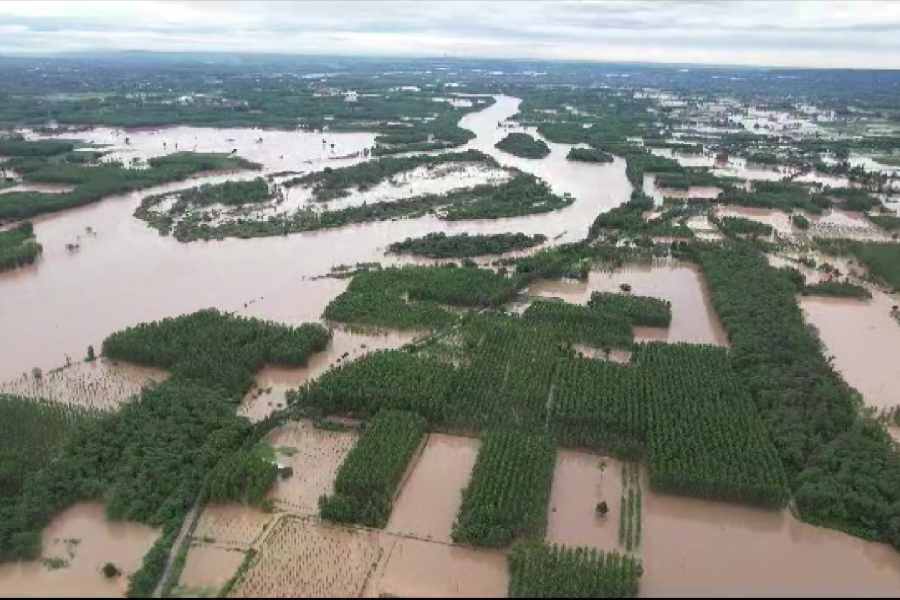
 Global Overview
Intensifying tropical cyclones dominate headlines, with Hurricane Melissa escalating to Category 4 in the Caribbean, posing severe threats to Jamaica and Haiti, while Cyclone Montha brews in the Bay of Bengal, impacting eastern India.
Volcanic activity surges in Indonesia, and ongoing recovery from recent floods and landslides persists in mountainous regions.
No major new seismic events reported today, but atmospheric rivers and heavy rains signal heightened flood risks in parts of Africa and the Americas.
Himalayan and Mountainous Regions
Eastern Himalayas (West Bengal, India)
Recovery from early October landslides in Darjeeling and Kalimpong districts continues, with heavy rains on October 6 claiming at least 18 lives and displacing hundreds.
No new slides today, but soil instability raises alerts for aftershocks from recent cloudbursts. Over 50 landslides reported in the rainy season so far, exacerbating erosion in tea plantation areas.
Western Himalayas (Himachal Pradesh, Uttarakhand)
Flash floods and cloudbursts from July-August 2025 linger in impact, with 58 floods, 30 cloudbursts, and 51 landslides through early August alone.
Current assessments show disrupted infrastructure and heightened GLOF (glacial lake outburst flood) risks; no acute events today but monitoring for monsoon remnants.
Persistent Vulnerability
Reports continue to highlight that the Indian Himalayan Region (IHR) is facing a climate crisis, with 632 fatalities recorded between January and August 2025 alone.
The disasters are attributed to the combination of the Himalayas‘ fragile, young geology, unscientific construction (like the expansion of highways and hydropower projects), and climate-driven extreme rainfall events.
Andes (Mexico)
Torrential rains since October 6 have caused devastating floods and landslides, one of the worst in recent history, with ongoing evacuations in mountainous central areas.
Slow recovery amid mudslides; at least dozens affected.
Rockies and Sierra Nevada (USA)
New Mexico’s Ruidoso village faces renewed flood threats from climate-amplified storms, building on October 1 events; atmospheric rivers forecast for the Pacific Northwest bring wind and rain risks through the weekend.
Alaskan Ranges (USA)
Western Alaska communities remain “completely devastated” by severe storms and remnants of Typhoon Halong through October 13; disaster declaration aids recovery, but isolated mountain villages report persistent flooding.
Indonesian Highlands
Heightened volcanic risks in mountainous zones; see global section for details.
Major Disasters in Other Areas
Delhi Air Quality Crisis
The Air Quality Index (AQI) in New Delhi was recorded at a severe 304 AQIyesterday, indicating a major public health disaster.
While the weather is sunny today, the poor air quality persists, primarily attributed to vehicle emissions and stagnant weather patterns.
Residents have been advised to exercise caution and wear masks during peak hours.
Caribbean and Central America
Hurricane Melissa
Rapidly intensified to Category 4 (winds >140 mph) off Jamaica, with forecasts for Category 5 by evening.
Slow movement (2 mph) amplifies catastrophic flooding risks in Haiti and Jamaica; hurricane watches issued, potential for house-destroying surges up to 20 ft.
Evacuations underway; impacts expected Sunday night.
South Asia
Cyclone Montha (Bay of Bengal)
Depression intensifying into cyclone, bringing heavy rains to Andhra Pradesh, Odisha, and Tamil Nadu starting October 27.
Indian Army on high alert; flash flood warnings for coastal mountains. Telangana expects downpours through October 29.
Southeast Asia
Indonesia (Volcanic Activity)
Mount Ibu (North Maluku) erupted 29 times this week, latest at 07:33 WIT today; ash plumes to 1 km, alerts for nearby villages.
Mount Semeru (Java) erupted again this afternoon, 40 times weekly and 2,680 in 2025—most active globally; evacuation zones expanded in mountainous foothills.
Philippines
24-hour volcano summary shows elevated activity at Kanlaon, Taal, Mayon, and Bulusan; minor quakes (M1.5) in Surigao del Norte, no major damage.
Tsunami alerts from early October earthquake fully lifted.
Africa
Gulf of Guinea and Eastern Africa
Persistent flood risks from heavy seasonal rains; northern areas saw excess precipitation, while southern regions dry out.
Humanitarian aid focuses on displacement in low-lying and foothill communities.
North America (Beyond Mountains)
Tropical Depression forms off Mexico (13.4°N 119.5°W), winds 50 mph; minimal threat but watch for coastal rains.
DRR & CCA Conferences, Workshops, Reports, Concerns and Incidences
Resilient Week concludes
Resilient Week 20-26 October in Zurich concludes today, focusing on strategies for multi-hazard resilience in a complex world.
New Report: Global DRR Status
The UNDRR’s 2025 Global Status of National Disaster Risk Reduction Strategies continues to be a key reference, emphasizing that effective DRR requires integrating climate adaptation plans and addressing new challenges like water security and displacement.
Financing Call
The UN Climate Change chief has urged countries to deliver a rapid surge in climate finance ahead of COP30, warning that developing nations are dangerously short of the resources needed to withstand worsening storms and climate impacts.
Irreversible Tipping Point
Scientific bodies continue to stress that the world has already crossed the first major Earth system tipping point with the widespread death of warm-water coral reefs.
This signals that current global warming levels are already causing irreversible planetary shifts.
Global Warming and Disasters
Climate science and rapid impact attribution studies show that human-caused climate change is responsible for a significant percentage of the damage from major extreme weather events, such as the direct damage to homes and properties caused by Typhoon Ragasa in southern China.
Transport Emissions
The transport sector remains a major contributor to carbon emissions and climate change, emphasizing the necessity of phasing out internal combustion vehicles and investing in low-carbon electricity and charging infrastructure to meet climate goals.
Historical Disasters on This Day (October 21)
1825 – Erie Canal Opens
The Erie Canal in New York opened, creating a crucial commercial water passage from the Hudson River to Lake Erie, fundamentally transforming trade and economic development in the Great Lakes region.
1881 – Gunfight at the O.K. Corral
The famous 30-second shootout between lawmen (the Earp brothers and Doc Holliday) and outlaws (the Clanton and McLaury brothers) took place in Tombstone, Arizona.
1944 – Battle of Leyte Gulf Ends
The Battle of Leyte Gulf in the Philippines concluded with an overwhelming American victory over the Japanese Imperial Navy, marking the end of major Japanese naval capacity in World War II.
1947 – Kashmir Conflict Begins
The Maharaja of Jammu and Kashmir signed the Instrument of Accession with India, formally joining the country.
This act was immediately followed by the Indo-Pakistani War of 1947–1948 and the beginning of the decades-long Kashmir conflict.
1979 – Park Chung Hee Assassinated
South Korean President Park Chung Hee was assassinated by Kim Jae Kyu, the head of the Korean Central Intelligence Agency.
1996 – US Midwest ravaged by tornadoes
In the US Midwest, an outbreak of 26 tornadoes ravaged Illinois, tearing through Chicago suburbs with EF3 winds, claiming 2 lives, injuring dozens, and causing $40 million in damage.
This supercell frenzy highlighted the perils of flatland “tornado alleys” meeting urban sprawl, with funnel clouds twisting for hours in a rare October surge.
1998 – Hurricane Mitch
Hurricane Mitch was the Atlantic’s deadliest in two centuries, peaked around this date as a Category 5 monster, stalling over Central America and dumping 70 inches of rain in Honduras alone.
It triggered mudslides that entombed villages, killing over 11,000 and displacing millions— a slow-motion apocalypse fueled by El Niño, underscoring the Caribbean’s vulnerability to lingering giants.
2010 – Eruption of Mount Merapi
Indonesia’s Mount Merapi unleashed a cataclysmic eruption just a day after a 7.7-magnitude earthquake and tsunami off Sumatra claimed over 400 lives on October 25.
Merapi’s blasts spewed superheated ash clouds up to 1.5 km, killing 353 people, burying villages in pyroclastic flows, and forcing 390,000 evacuations in the densely populated Javanese highlands—a stark reminder of how seismic-volcanic chains can compound devastation in island arcs.
2012 – Hurricane Sandy
Hurricane Sandy’s prelude in 2012 saw the storm’s massive hybrid system barreling toward the US East Coast on October 26, with 74 mph winds already lashing the Carolinas.
By landfall days later, it would claim 233 lives and $70 billion, blending tropical punch with nor’easter chill in a “superstorm” that flooded subways and shredded boardwalks—a harbinger of climate-fueled Frankenstorms.
These events remind us that October 26 often arrives as a pivot—summer’s warmth yielding to autumn’s bite, where a single front or fault line can cascade into catastrophe. From frozen prairies to storm-lashed seas, they underscore the timeless dance between human ambition and elemental power.
Stay vigilant; History whispers warnings.
यह हमारा एक छोटा सा प्रयास हैं, आपको हर दिन आपदा से जुड़ी नवीनतम जानकारियाँ प्रदान करने का – विशेष रूप से वह आपदायें जो हिमालय व अन्य पहाड़ी क्षेत्रों में घटित हों.
हमारा यह प्रयास आपको कैसा लगा और कैसे हम इसे बेहतर व उपयोगी बना सकते हैं ?
हमेशा की तरह आपके सुझावों का हमें इंतजार रहेगा.
Leave a Reply