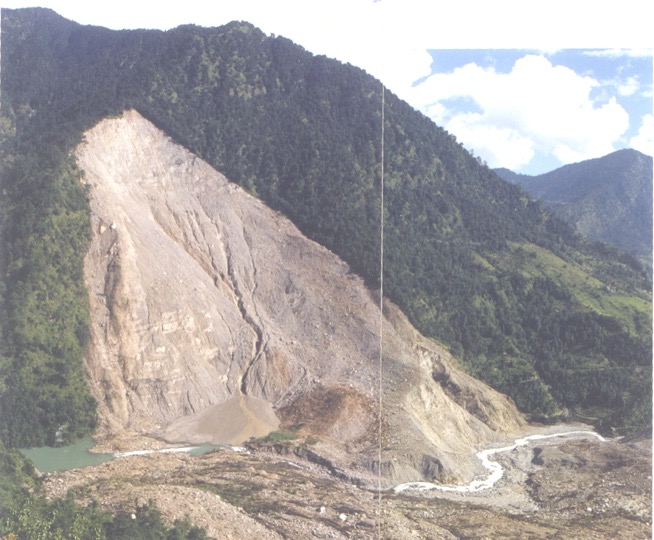
 A week of relentless monsoon rain had finally given way to a bright, sunny morning. The air was clean, but the ground was saturated.
As Santa and Banta were sipping tea on their porch, a low, guttural rumble echoed from the opposite hill.
They watched, transfixed, as a section of the slope, laden with mud and small boulders, slid down into the valley below.
It wasn’t a dramatic explosion of rock, but more like a thick, heavy blanket being pulled downwards.
“Devi Mata!” Santa exclaimed, his eyes wide.
“Did you see that, Banta?”
“A huge piece of the mountain just broke off and fell!”
“The entire mountain must be cracking from the inside.”
“Soon, it will all come down!”
Banta shook his head slowly, taking a thoughtful sip of tea.
“Not quite, my friend.”
“You’re thinking of it like a piece of bread breaking off a loaf.”
“But what we just saw was something different, and far more common.”
“Different how?”
“A landslide is a landslide!” Santa insisted.
“Imagine this,” Banta said, putting down his cup.
“You have a big, slightly tilted plate.”
“For months, you keep adding a spoonful of loose flour onto it every day.”
“The pile grows higher and higher, a mix of old flour and new.”
“The plate itself is strong, not cracked at all.”
“The pile just sits there, looking stable.”
Santa looked puzzled.
“Flour?”
“Just listen,” Banta continued.
“That pile of loose flour is the weathered rock mass and accumulated debris that has been gathering on that slope for centuries.”
“It’s not the solid bedrock.”
“Now, what happens if you take a jug of water and pour it all over that pile of flour?”
A look of understanding dawned on Santa’s face.
“It would all get heavy and sticky, and the whole heap would slide right off the plate!”
“Exactly!” Banta exclaimed.
“The mountain didn’t crack.”
“The mountain just sneezed.”
“The heavy rain was the trigger that saturated the loose, unconsolidated material that was already perched precariously on the slope.”
“The solid mountain underneath is still there.”
“The real danger, Santa, is often not the mountain itself, but the loose blanket it wears.”
संता – बंता की इस जुगलबन्दी से आज हमने क्या सीखा:
समझ / Discover
भू-स्खलन, जैसा कि हमें लगता हैं हमेशा ही पहाड़ो के अचानक टूटने के कारण नहीं होता हैं।
A common misconception is that landslides are always caused by large chunks of solid bedrock breaking off a mountain.
विज्ञान / Science
वैसे देखा जाये तो ज्यादातर भू-स्खलन पहले से ढाल पर पहले से धीरे-धीरे जमा हो रहे मलबे के ढाल पर खिसकने के कारण अस्तित्व में आते है।
A significant number of landslides, especially during monsoons, are triggered by the movement of pre-existing, unconsolidated material (weathered rock and debris) that gets saturated by heavy rainfall, reducing friction and increasing its weight.
चिंतन / Reflect
इस अंतर को समझना जरूरी हैं – अब आप पहाड़ी ढाल की स्थिरता से कहीं ज्यादा अपना ध्यान ढाल पर पड़े मलबे और उसके प्रबन्धन पर केंद्रित करेंगे।
Understanding this distinction is crucial. It means we should be looking at the stability of the surface material on a slope, not just the strength of the mountain itself.
उत्तरदायित्व / Responsibility
हर व्यक्ति का यह अधिकार हैं, कि उसे पता हो कि आखिर उस पर आसन्न जोखिम का स्तर क्या हैं ?
We have a responsibility to be aware that slopes covered in loose soil and debris are inherently more vulnerable to rainfall-induced landslides than solid rock faces.
संता – बंता की यह जुगलबन्दी आपको कैसी लगी, कृपया हमें जरुर बताये
व
इस जुगलबन्दी को बेहतर बनाने के लिये अपने सुझाव अवश्य दें।
हमें हमेशा की तरह आपके सुझावों, प्रतिक्रियाओं व कटाक्षो का बेसब्री से इंतजार रहता हैं और सच मानिये इसी के आधार पर हम अपने आप में, अपनी सोच व रचनात्मकता में सुधार करने को प्रेरित होते हैं।
सो अच्छा – बुरा जैसा आपको महसूस हुवा हो, कमेंट जरुर करते रहें।
Leave a Reply