
The Locked Furnace: Why Padlocked Coaching Exits are Repeat Murders: Santa locks the secondary fire door and seals windows with decorative iron grilles to prevent student fee-dodging. Banta invokes the horrors of the 2019 Surat Takshashila fire and 2023 Mukherjee Nagar tragedy to prove why narrow, wire-choked stairwells turn commercial coaching centers into un-ventilated death chambers during electrical short circuits.
Breaking the Vulnerability Spiral: Why Ending Child Marriage is Essential for Disaster Risk Reduction

Child marriage is far more than a harmful socio-cultural tradition; it is a profound socio-economic vulnerability multiplier that strips adolescent girls of education, physical autonomy, and economic resilience. When climate hazards and geodynamic shocks strike, child brides bear the disproportionate brunt of displacement, economic distress, and post-disaster exploitation. The United Nations General Assembly’s historic resolution declaring November 27 as the International Day for the Elimination of Child, Early and Forced Marriage marks a watershed moment in global development. Grounded in the momentum of grassroots campaigns and co-sponsored by 67 nations, this global mandate reinforces a core tenet of the Sendai Framework: genuine disaster resilience cannot be achieved until the systemic social vulnerabilities of women and children are dismantled at the root.
The ‘Carry-In, Carry-Out’ Whistle and the Self-Help Group Solution

Beyond the Warning Sign: How Self-Help Groups are Solving Mountain Trash: Santa is frustrated because tourists ignore littering fines and warning posters across remote mountain passes. Banta brings in a local women’s cooperative to prove that true environmental enforcement requires replacing plastic carry bags with traditional hemp alternatives at entry gates, turning community pride into our strongest ecological shield.
The Phantom Quake and the Falling Titan
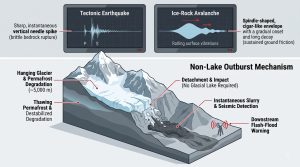
The Phantom Quake: How Falling Mountains Fool the World’s Seismographs: When devastating flash floods tore through Nepal’s Trishuli and Bhote Koshi basins on 26 August 2026, reaching the Indian plains, initial reports blamed an earthquake-triggered GLOF. Banta dissects the seismic waveform to prove how the catastrophic vertical fall of billions of tons of rock and ice generated ground shocks that masqueraded as an earthquake, shattering one of the Himalayas’ most persistent disaster myths.
The Matchbox Mansion and the Vertical Jenga
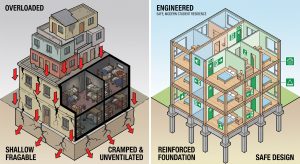
The Satya Niketan Warning: How Overloaded Student Hostels Become Vertical Graveyards: Santa celebrates adding four illegal floors to an old building near Delhi University to cash in on student migration. Banta drops a brutal structural diagnostic, citing the tragic building collapses of Satya Niketan (2022 & 2026) and Lucknow (2024) to prove why loading aged foundations with vertical matchbox rooms is a recipe for catastrophic structural failure.
The Toxic Bonfire and the Sikkim Shield
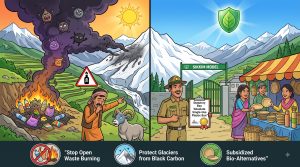
Burning Mountains: The Invisible Toxic Poison of Campsite Garbage: Santa thinks burning a massive pile of tourist plastic bottles and noodle packets is a cheap and effective cleanup strategy. Banta stops the bonfire to reveal the dangerous atmospheric toll of open plastic incineration in the Himalayas, showcasing how Sikkim’s 1998 pioneering plastic ban offers the ultimate blueprint for structural eco-governance.
The Infinite Gorge and the 11-Ton Avalanche
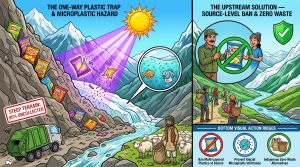
The Microplastic Glacier: The Terrifying Truth Behind Mountain Snack Wrappers: Santa thinks dropping an empty potato chip wrapper into a deep Himalayan valley is harmless convenience. Banta drops a brutal hydrological diagnostic based on The Himalayan Cleanup metrics, revealing how 14,450 tonnes of daily unmanaged waste is fragmenting into microplastics above 5,000 meters, poisoning India’s primary freshwater lifelines.
Santa’s Lazy River Puzzle and Banta’s Underfed Porter Parable
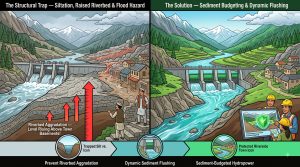
Dams and barrages disrupt natural river dynamics, trapping heavy sediment loads and causing riverbed aggradation that dramatically increases flood risks for upstream and surrounding settlements even during moderate rainfall. Sustainable hydropower planning must mandate comprehensive catchment-wide sediment budget analyses and dynamic flood impact assessments to mitigate dangerous riverbed rising.
The Sugarcane Trap and the Commodity Matrix
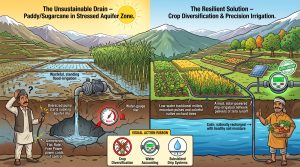
The Sugarcane Trap: Why Free Water is Bankrupting Indian Agriculture: Santa is flooding his fields with free groundwater to cultivate highly water-intensive sugarcane crops. Banta dismantles the short-term cash crop illusion, explaining why agricultural resilience requires strict volumetric water pricing, cropping restrictions in overexploited blocks, and a massive shift toward precision drip irrigation.
The Effluent Pipe and the Diminishing Drop
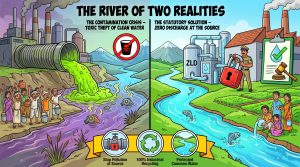
The Purple Rivers: How Industrial Waste is Driving the Next World War: Santa thinks dumping untreated chemical effluents from his factory into the river is smart cost-cutting. Banta drops a terrifying global risk projection showing how freshwater pollution is locking out our remaining drinking reserves, pushing humanity toward catastrophic water-induced wars.