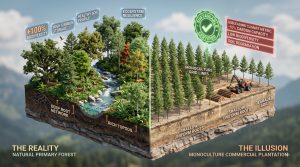
The Monoculture Mirage: Why Certified Green Plantations are an Ecological Lie: Santa is celebrating his high-yielding, ESG-certified palm oil and timber portfolio. Banta tears down the corporate double standard, exposing how 45% of global reforestation pledges are sterile monocultures that destroy local water tables and store a fraction of the carbon found in natural rainforests.
Santa’s “Self-Taught Engineer” Son and Banta’s “Code of Confusion”
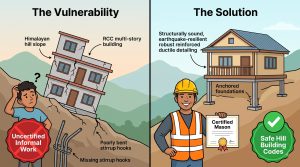
Informal, on-the-job training without institutional certification leaves modern RCC construction vulnerable to critical structural failures. Building disaster-resilient mountain communities requires investing in formal vocational training for local masons, paired with realistic, locally contextualized building codes that are strictly enforced.
The National Security Highway and the Red-Tape Jungle

The Strategic Loophole: How “National Security” Clears Our Forests: Santa is celebrating a record-speed road project that bypassed environmental clearances under a strategic exemption. Banta exposes the dangerous double standard of infrastructure metrics that treat natural carbon sinks and soil stabilizers as obstacles, setting the stage for catastrophic landslide failures.
The Amazonian Cattle Trail and the Foreign Dinner Plate

Appetite for Destruction: How Global Trade Eats the Amazon: Santa is enjoying an imported gourmet meal, celebrating international trade. Banta drops a heavy supply-chain diagnostic exposing how 14% of global tropical forest destruction is driven by consumer demand in wealthy nations, turning critical global carbon buffers into barren agricultural fields.
The World Environment Day Selfie and the Midnight Chainsaw
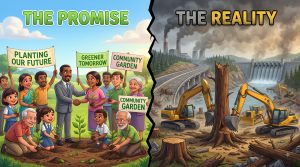
The Green Facade: Why Annual Tree-Planting Selfies are Killing Our Forests: Santa is celebrating his World Environment Day sapling on social media, chasing viral likes. Banta shatters the PR illusion with a brutal reality check on the 10 million hectares of primary forest lost annually, exposing the deep global hypocrisy of replacing complex, native carbon sinks with sterile corporate monocultures.
Santa’s Hunt for a Single Villain vs Banta’s Leaky House Analogy
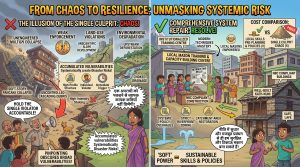
Blaming a single high-profile construction for a disaster ignores the systemic vulnerabilities—from flawed policies to environmental damage—that truly drive catastrophe. Genuine resilience demands fixing the entire governance framework rather than just pointing fingers at the final point of failure.
The ROVER Screening and the Structural Tag Team
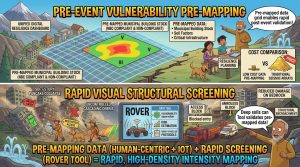
The Digital Structural Shield: Speeding Up Post-Earthquake Audits with ROVER: Santa is trapped in a bureaucratic nightmare of paper forms trying to audit cracked buildings after a tremor. Banta introduces the free mobile tool ROVER to show how automating FEMA and ATC screening protocols allows field teams to tag buildings as safe or unsafe in under five minutes, avoiding aftershock tragedies.
The PAGER Prognosis and the Satellite Proxy
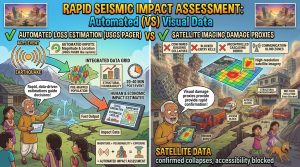
The 30-Minute Disaster Diagnostic: Inside the PAGER Loss Engine: Santa is stunned to see a computer terminal estimate earthquake damage before a single emergency truck arrives on scene. Banta breaks down the science of automated loss estimation models and satellite damage proxies that allow response agencies to map human exposure and infrastructure collapse from space.
Santa’s “Forbidden Stone” and the Mason’s “Cement Confusion”
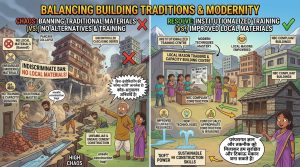
Outlawing traditional building materials without providing viable alternatives forces communities into unfamiliar construction techniques, compromising structural safety. Sustainable housing resilience requires blending time-tested local resources with modern materials, supported by institutional training for regional masons.
Santa’s Tricolor and Banta’s Tectonic Reality Check
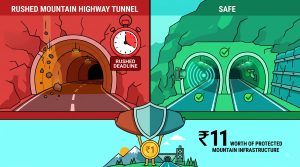
On the eve of August 15th, Santa waves a Tricolor flag outside a cracked Himalayan tunnel portal, claiming infrastructural victory over nature. Banta uses global alpine benchmarks (like Switzerland’s Gotthard Tunnel) and recent Sikkim/Chamoli disaster data to prove why true national independence means freeing India’s hill development from armchair experts, political misadventures, and unscientific shortcuts.