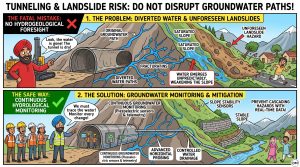
Tunnelling without hydrogeological foresight doesn’t make subsurface water vanish—it merely redirects it, turning once-stable mountain slopes into saturated, high-risk landslide zones. In the deeply interconnected Himalayan terrain, continuous groundwater monitoring during and after excavation is the only way to anticipate and prevent these cascading subterranean hazards.
The Village Alarm and the Muscle-Memory March
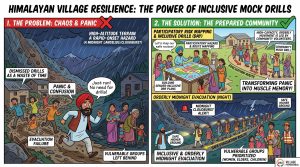
The Mid-Day March: Why Mock Drills are the True Lifesavers of the Himalayas: Santa dismisses a mandatory community evacuation drill as a waste of productive village hours, believing common sense is enough during a crisis. Banta uses behavioral metrics to demonstrate how regular drills and inclusive risk mapping transform panic into survival-ready muscle memory, protecting families during midnight cloudburst disasters.
The Sand-Castles on the Floodplain and the High-Res Sieve
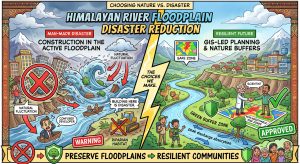
The Floodplain Fallacy: Why Building Near Himalayan Rivers is Financial Suicide: Santa lays out a premium riverside commercial resort right inside an active river flood channel, ignoring municipal restrictions. Banta uses a high-resolution GIS hazard zonation map to expose the geomorphic realities of the 2013 Uttarakhand and 2021 Melamchi disasters, explaining why land-use zoning is our only defense against man-made river tragedies.
The Early Warning Siren and the Automated WhatsApp Alert
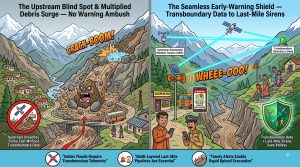
The Velocity of Deception: Why Calm Rivers Hide Impending Flash Floods: Santa ignores an upstream cloudburst advisory because the river outside his dam looks perfectly stable. Banta intercepts the control panel with real-time transboundary sensor data, explaining how cascading hydro-meteorological surges travel with high velocity and why multi-layered early warning systems save lives.
Santa’s Great Wall of Hope vs Banta’s Wise Relocation
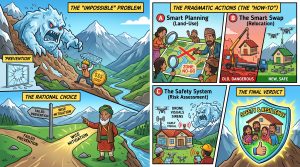
Rigorous feasibility and cost-effectiveness assessments must steer disaster risk reduction decisions, recognizing that engineering total prevention against large-scale geological hazards is often technically unviable and financially impossible. When absolute prevention hits structural and economic limits, pragmatic mitigation strategies—primarily risk-informed land-use zoning and the planned relocation of vulnerable assets—represent the most rational path to safety. Embracing strategic mitigation over futile attempts at hazard elimination is not an institutional defeat, but an evidence-based, mature choice grounded in scientific risk assessment to secure vulnerable mountain populations.
The ‘Mera Pani’ Movement and the Laser Level Solution
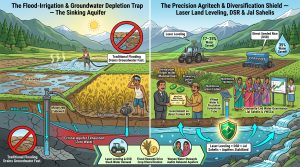
How a Laser Leveler and a Samosa Fund Can Save India’s Aquifers: Santa refuses to give up his water-heavy paddy crop until Banta and the village “Jal Sahelis” bring out a real-time piezometer map. Discover the game-changing demand-side technologies like Direct Seeded Rice (DSR) and Laser Leveling that can restore hydrologic balance to Punjab and Haryana in under 5 years without hurting farmer profits.
The ‘Dhaba’ on the Edge and the Ticking Water Balloon
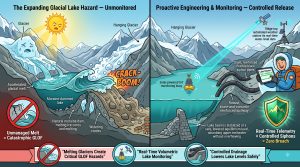
The Sinking Dam: Why Himalayan Glacial Lakes are Ticking Time Bombs: Santa sets up a commercial tea stall directly on a fragile glacial moraine dam, ignoring climate metrics. Banta drops an urgent glaciological reality check based on 388 documented GLOF events, explaining how engineered siphons and controlled drainage are critical to prevent catastrophic outbursts like the South Lhonak and Kedarnath disasters.
The Concrete Carpet and the Mountain That Couldn’t Breathe
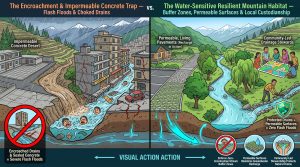
Strict regulatory enforcement of unbuilt buffer zones around natural Himalayan drainage channels is paramount to prevent urban encroachment and eliminate deadly flash-flood bottlenecks. Mandating permeable surfaces—such as interlocking grass pavers and gravel beds—substantially curtails destructive surface runoff while accelerating local groundwater and spring recharge. Embedding local communities directly into the demarcation, protection, and water-sensitive design of these natural conduits fosters deep grassroots ownership and ensures enduring hydrological resilience across mountain settlements.
The Plastic Palace and the Smart-City Sieve
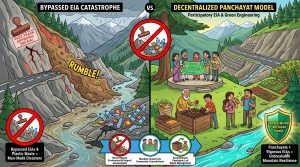
The Fast-Tracked Disaster: Why Bypassing Environmental Laws is Killing the Himalayas: Santa proudly bypasses rigorous Environmental Impact Assessments (EIAs) to set up a commercial tourist square in the hills. Banta dumps a heap of clogged tourist plastic waste onto his desk to prove why omitting local community consultation and carrying-capacity audits constructs a man-made landslide and flood crisis.
The ‘Chadar’ Tracker and the Broken Ice Alarm

The Frozen Trap: Why Satellites Need Ancestral Wisdom to Read Himalayan Ice: Santa attempts to dispatch eighty commercial trekkers onto a frozen river trek based on a clear satellite radar reading. Banta and a local indigenous herder halt the expedition, proving how traditional early warning indicators detect subsurface ice fractures hours before advanced automated software can register the hazard.