
The impact of disasters can be reduced significantly by appropriate action during, and after the disaster incidence. For example practicing Drop Cover and Hold could minimise casualties during an earthquake while prompt, effective and organised response could save human lives. Ensuring these during emergency situations however warrants regular practice and drills. Preparedness generally refers to […]
Search Results for: earthquake
Risk transfer

Infrastructure, assets, and property created by us generally faces risk of various natural, and manmade hazards, and are often devaluated, damaged, and destructed by these. Compensation of these losses would make post-disaster recovery easy, smooth, and hassle free. Risk transfer is a tool for making all this possible in an organised manner. Risk transfer is […]
Traditional landslide management practices of Himalaya
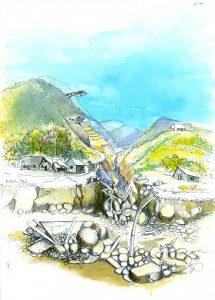
Ignorance of traditional practices under the lure of economic opportunities, comfort, and convenience have aggravated the menace of landslides in the Himalayan region. The Himalayan region has always been prone to a number of hazards that are generally owed to its unique tectonic and geomorphic setup as also evolutionary history, and meteorological conditions. Stabilisation of […]
Mitigation
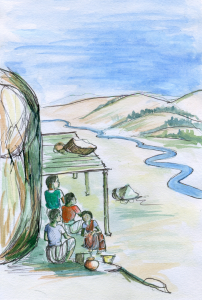
No one wants disasters to cause pain and misery, and erode the gains of growth and development. So we try our best to avoid or rule out the possibility of hazardous incidences, but it is not always possible to do so. Assume that you live in Zone V of Seismic Zonation Map of India, say […]
Hyogo Framework for Action
Building the Resilience of Nations and Communities to Disasters I. Preamble The World Conference on Disaster Reduction was held from 18 to 22 January 2005 in Kobe, Hyogo, Japan, and adopted the present Framework for Action 2005-2015: Building the Resilience of Nations and Communities to Disasters (here after referred to as the “Framework for Action”). […]
Disaster Management
It is important to understand that disasters take place through the interplay of hazard, and vulnerability; there are a number of hazards present in our vicinity or our hazard exposure level is high, and as we are unprepared our vulnerability to these hazards is high. These (hazard and vulnerability) thus create a state of emergency […]
Risk
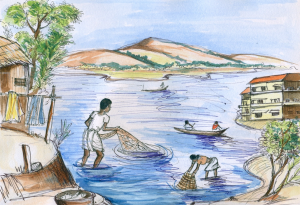
Cambridge English Dictionary defines risk as the possibility of something bad happening or something bad that might happen. Risk refers to expected or anticipated losses from the impact of a given hazard on a given element at risk over a specific period of time. It is important to note that risk is perceived differently by […]
Exposure
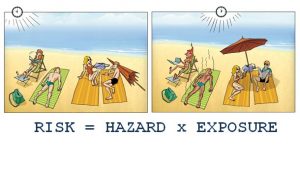
Exposure refers to people, infrastructure, property, housing, production capacities, and other tangible human assets located in a geographical area likely to be affected by hazards. Disaster impact is a direct function of exposure, and if a hazard occurs in an area having no exposure, then there is no risk. In October 2013 a Category 5 […]
Vulnerability

We are all concerned about hazards. We want to understand the processes controlling these. We want to know how, and why these sometimes cause loss of life, property, infrastructure, and assets. All this because we are hard wired to safeguard ourselves, our community and our interests for which better understanding of hazards is a precondition. […]
Hazard

Cambridge English Dictionary defines hazard as something that is dangerous, and likely to cause damage. As reflected by “likely” in this definition, the term hazard suggests possibility of damage, even though actual damage has not been caused. Mere existence of the damage causing potential is thus enough to identify a process, phenomenon, or activity as […]