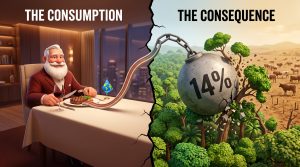
Appetite for Destruction: How Global Trade Eats the Amazon: Santa is enjoying an imported gourmet meal, celebrating international trade. Banta drops a heavy supply-chain diagnostic exposing how 14% of global tropical forest destruction is driven by consumer demand in wealthy nations, turning critical global carbon buffers into barren agricultural fields.
Santa Banta
The World Environment Day Selfie and the Midnight Chainsaw
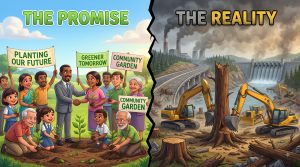
The Green Facade: Why Annual Tree-Planting Selfies are Killing Our Forests: Santa is celebrating his World Environment Day sapling on social media, chasing viral likes. Banta shatters the PR illusion with a brutal reality check on the 10 million hectares of primary forest lost annually, exposing the deep global hypocrisy of replacing complex, native carbon sinks with sterile corporate monocultures.
Santa’s Hunt for a Single Villain vs Banta’s Leaky House Analogy
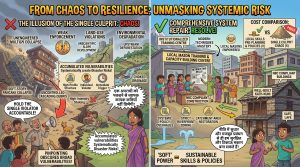
Blaming a single high-profile construction for a disaster ignores the systemic vulnerabilities—from flawed policies to environmental damage—that truly drive catastrophe. Genuine resilience demands fixing the entire governance framework rather than just pointing fingers at the final point of failure.
The ROVER Screening and the Structural Tag Team
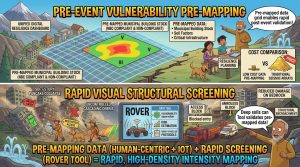
The Digital Structural Shield: Speeding Up Post-Earthquake Audits with ROVER: Santa is trapped in a bureaucratic nightmare of paper forms trying to audit cracked buildings after a tremor. Banta introduces the free mobile tool ROVER to show how automating FEMA and ATC screening protocols allows field teams to tag buildings as safe or unsafe in under five minutes, avoiding aftershock tragedies.
The PAGER Prognosis and the Satellite Proxy
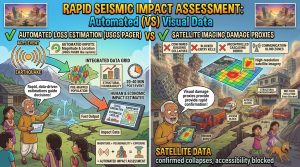
The 30-Minute Disaster Diagnostic: Inside the PAGER Loss Engine: Santa is stunned to see a computer terminal estimate earthquake damage before a single emergency truck arrives on scene. Banta breaks down the science of automated loss estimation models and satellite damage proxies that allow response agencies to map human exposure and infrastructure collapse from space.
Santa’s “Forbidden Stone” and the Mason’s “Cement Confusion”
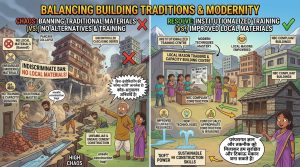
Outlawing traditional building materials without providing viable alternatives forces communities into unfamiliar construction techniques, compromising structural safety. Sustainable housing resilience requires blending time-tested local resources with modern materials, supported by institutional training for regional masons.
The Digital Village Network and the Crowdsourced Lifeline
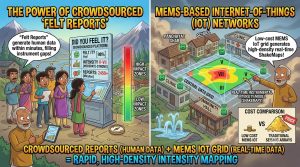
Density Over Luxury: How Smartphone-Grade Sensors Outsmart Earthquakes: Santa wants to spend lakhs on a single high-end imported seismometer for his village. Banta introduces an open-source network of low-cost MEMS sensors and crowdsourced “Did You Feel It?” reporting tools to prove that a community-driven digital network can map disaster damage in under ten minutes.
The ‘Richter’ Illusion and the Samosa Shake Test
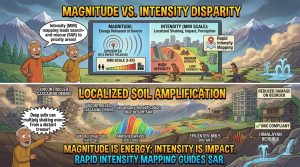
The Richter Scale Fallacy: Why Magnitude Won’t Save You in a Quake: Santa thinks his family is safe from a distant Magnitude 6.2 earthquake, but Banta uses a local sweet shop collapse to expose the dangerous blind spot of ignoring localized Intensity (MMI). Discover why rapid intensity mapping is the ultimate tool for saving lives during the golden hour.
The Shaded Vendor and the Cool Infrastructure Blueprint
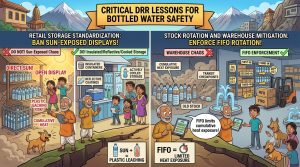
Out of the Sun, Into the Shade: Reforming Highway Water Displays: Santa prioritizes high-visibility sun-exposed display racks for highway water sales, but Banta steps in with an insulated blueprint to revolutionize retail safety. Discover the practical, low-cost modifications—from reflective window films to strict FIFO stock rotation—that roadside eateries must adopt to protect commuters from heat-induced plastic toxins.
The Generous Flood and the Pharaoh’s Feast
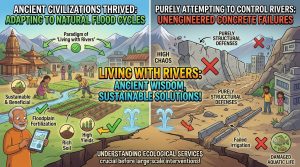
Ancient civilizations thrived by adapting to natural river cycles rather than forcing complete control over them. True flood resilience requires moving beyond concrete defenses to prioritize early warning systems, community preparedness, and ecological harmony.