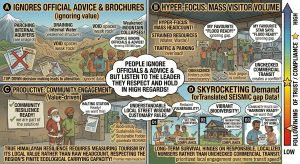
Decoupling Success from Crowds: The Carrying Capacity Crisis: True Himalayan resilience requires measuring tourism by its local value rather than raw headcount, respecting the region’s finite ecological carrying capacity. Prioritizing mass visitor volume over sustainable regulation only invites infrastructure overload and resource degradation, proving that long-term survival hinges on responsible, localized numbers rather than unchecked commercial transit.
The ‘Likes’ Lottery and the Bricks of Doom
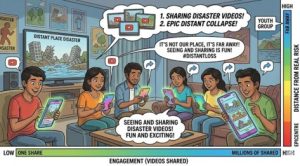
The Price of a Viral Click: Santa is celebrating fifty thousand views on a tragic foreign earthquake video, chasing digital popularity. Banta steps in to expose the hollow morality of “disaster porn” and explains how we must weaponize our social media reach to share actionable seismic safety tips before our own fragile towns become the next viral headline.
The Revenue Recipe and the Moral Compass
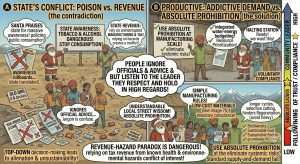
The Poison and the Medicine Strategy: Santa praises the state for its massive anti-tobacco and alcohol awareness billboards. Banta reveals the hidden economic contradiction: why do governments spend public funds policing public consumption while relying on the massive tax revenues generated by the uninterrupted manufacturing of those exact same hazards?
Santa’s Highway of Hope and Banta’s River of Lost Coins
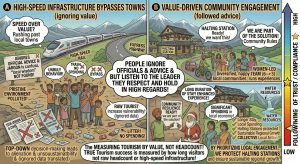
Measuring Tourism by Value, Not Headcount –
True tourism success is measured by how long visitors stay and how much they spend in local communities, not by raw headcounts or high-speed infrastructure that bypasses traditional towns. By prioritizing local engagement over mere transit speed, we protect our halting stations and ensure sustainable regional growth.
The Fast Car and the Speed-Limit Paradox
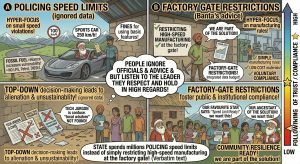
The 250 km/h Speed Limit Paradox: Santa bought a sports car built for extreme speeds, only to find out the highway police will fine him for using its basic features. Banta breaks down the structural contradiction of why the state spends millions policing speed limits instead of simply restricting high-speed manufacturing at the factory gate.
The Squeezed Sponge and the Cloudburst Catalyst
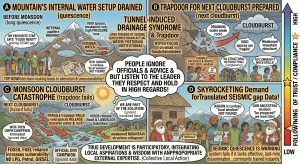
The Squeezed Sponge Crisis: Why are Himalayan mountaintops drying up while tunneling projects happen thousands of feet below? Santa and Banta explore “Tunnel-Induced Drainage Syndrome” and how draining a mountain’s internal water setup prepares a catastrophic trapdoor for the next monsoon cloudburst.
The Muscle Memory Drill and the Voluntary Guard
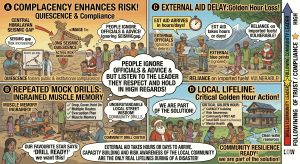
Why Robots Can’t Save Us from Cloudbursts: Santa installed an automated voice system to command his village to evacuate, but everyone ignored it. Banta steps in with a simple whistle to prove that disaster compliance can’t be forced—it has to be practiced until it lives in the community’s muscle memory.
Santa’s “Quick Fodder” Fix vs. Banta’s “Tree’s Lifespan” Logic
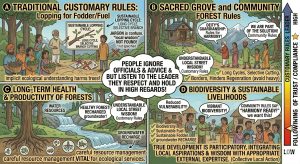
Long before modern environmental governance, traditional mountain communities practiced a highly sophisticated form of resource management. Through customary laws regulating tree lopping for fodder and fuel—especially within sacred groves—they protected their ecosystems from over-exploitation. They intuitively understood that aggressive cutting disrupts forest regeneration, stunts seed production, and degrades the land.
By enforcing selective branch-cutting and resting cycles, these ancestral rules preserved the forest’s long-term health. This wasn’t just about resource conservation; it was a foundational disaster risk reduction strategy. Healthy, un-degraded forests maintain critical ecological services—such as stabilizing slopes, anchoring soil, and facilitating groundwater recharge—creating natural safety nets against climate-induced hazards.
The Silent Fault and the Cloudburst Clamour
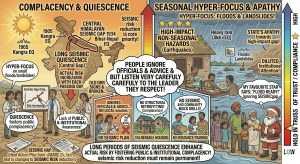
The Danger of Looking the Wrong Way: As climate-change discussions dominate our disaster budgets, Santa is hyper-focused on tracking clouds. Banta reveals why our obsession with weather forecasting has left India completely exposed to the silent, ticking time-bomb of a major Himalayan earthquake.
The Space-Age Siren and the Forgotten Key
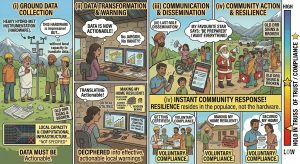
The Multimillion-Dollar Blind Spot: Santa thinks his new satellite-linked river sensors have made his village invincible to climate-driven flash floods. Banta reveals why sophisticated early warning infrastructure is a dangerous illusion if the community has never done a single mock drill.