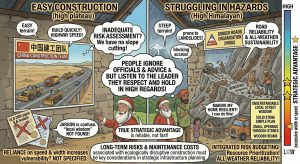
In the rush to build mega-highways through fragile terrains like the Himalayas, we are facing a dangerous paradox: inappropriately designed roads that rely on aggressive slope cutting are actually increasing landslide frequency. Instead of improving connectivity, these corridors are becoming major liabilities—frequently washing out and blocking critical access during monsoons and national security emergencies.
True strategic advantage does not lie in how wide a road is or how fast a vehicle can travel on a clear day; it lies in the reliability and all-weather sustainability of the network when a crisis strikes. Strategic infrastructure planning must shift its focus toward ecological compatibility, ensuring that long-term risks and soaring maintenance costs are factored in before the first excavator touches a fragile slope.
The Crossroads of Risk and the Sovereign Choice
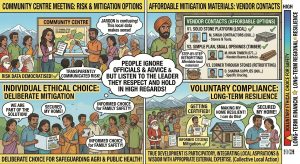
The Threshold of Choice: When the data is simple and the tools are cheap, disaster safety leaves the courtroom and enters the household. Join Santa and Banta as they explore why individual choice and personal accountability are the final, non-negotiable frontiers of disaster risk reduction.
The ‘Affordable’ Shield and the Hardware Store Blueprint
The Myth of the Expensive Shield: Santa is ready to risk an earthquake because an engineer told him safety requires imported luxury technology. Banta proves that real, life-saving structural retrofitting can be built using simple tools from the neighborhood hardware store at a fraction of the cost.
The ‘Blindfolded’ Plot and the Hidden Ledger
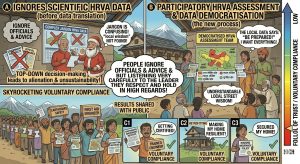
The Cost of Buying Blind: Santa thinks he found a “VIP property deal” until Banta shows up with a simplified state risk map. Discover why locked-away scientific hazard data is a public failure, and how risk-informed decision making can protect your life savings from predictable climate extremes.
Santa’s “Mute Button” Melancholy vs. Banta’s “Echoes of Chipko”
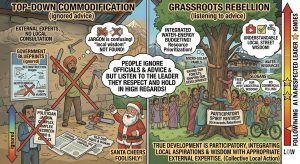
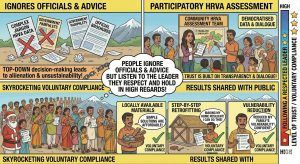
The Grassroots Rebellion against Top-Down Jargon -Santa wants external experts to map our future, blindly trusting top-down plans that ignore the mountain’s soul. Banta stands with the village women to revive our rich history of grassroots movements, proving that true Himalayan resilience is born when local wisdom replaces distant, high-handed political vanity.
The Politician’s Cooler and the Reality Check
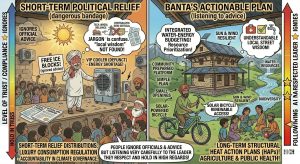
Melting Promises on a 45°C Stage: Santa cheers for a politician promising “free ice blocks,” until Banta pulls the plug on the VIP coolers. Discover why short-term political relief is a dangerous bandage for India’s massive 2026 water-power-fuel crisis, and how public pressure can force real structural change.
The Petrol-Pump Pilgrimage and the Solar Solution
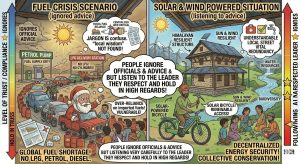
The Fuel Line Mirage: As petrol pumps dry up and the power grid gasps, Santa finds himself stuck in a five-kilometer queue. Banta arrives on a solar-powered bicycle to drop a massive truth bomb on decentralized energy security and why waiting for fossil fuels in 2026 is a losing game.
Santa’s Big Idea at the Panchayat Meeting
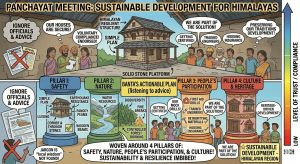
Santa suggests that all infrastructure development in the hills be woven around four fundamental pillars of Safety, Nature, People’s participation and Culture & Heritage and this according to him would imbibe sustainability and resilience which intern would result in sustainable development of the Himalayan region.
The Multi-Crisis Thali and the Hand-Crank Fan
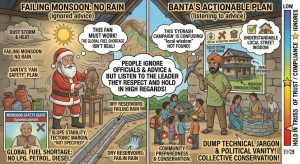
The Tandoor of 2026: Facing the Multi-Crisis Summer: Santa thinks a hand-cranked fan will save him from a below-normal monsoon, dry hydro-dams, and a global fuel shortage. Banta steps in to break down the harsh realities of the impending energy-water crunch in the Indo-Gangetic plains. Discover why collective conservation is our only real shield.
The Chief Minister’s Photo and the Eyewash Calendar
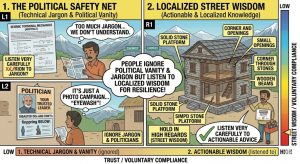
The Myth of the Political Safety Net: Santa thinks a government monsoon safety calendar featuring a giant politician’s photo will protect his village from a landslide. Banta tears down the “eyewash campaign” to show why public safety campaigns must dump technical jargon and political vanity in favor of actionable, localized street wisdom.