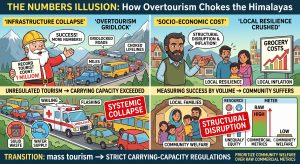
The Numbers Illusion: How Overtourism is Choking the Himalayas: Santa is celebrating record-breaking tourist inflows as economic success, while Banta highlights the gridlocked roads, delayed ambulances, and soaring grocery costs crushing local families in Shimla and Mussoorie. Discover why the Himalayan states must transition from mass tourism to strict, eco-friendly carrying-capacity regulations.
The Failed Design Panic and Banta’s Sacrifice of the Wall
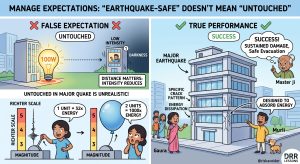
Cracks of Life: Why Damaged Buildings Aren’t Always “Failed” Buildings
After a major earthquake, headlines often display photos of cracked walls and bruised concrete, labeling them as engineering failures. This is a dangerous misconception. When it comes to seismic engineering, an “earthquake-safe” building’s primary mission isn’t to remain untouched—it is to save human lives.
The 39-Second Warning and the Community Shield
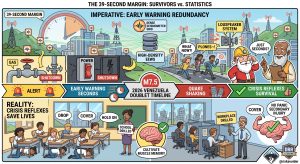
The 39-Second Margin: How Crisis Reflexes Separate Survivors from Statistics: Santa questions the utility of spending public funds on early warning networks that only provide seconds of alert time. Banta utilizes the critical timeline of the 2026 Venezuela doublet to prove how dense seismometer grids and automated “Drop, Cover, Hold On” drills build the vital community muscle memory needed to survive a major Himalayan rupture.
The Sinking Lake Bed and the Amplified Shockwave
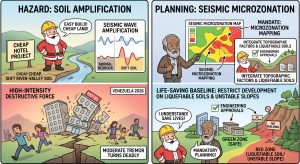
The Seismic Megaphone: How Soft Soil Turns Moderate Tremors Deadly: Santa buys cheap, soft river-valley land for a commercial hotel project, thinking it’s an easy build. Banta drops a profound geomorphological diagnostic from the 2026 Venezuela earthquakes, showing how soft alluvial soils amplify seismic waves and why microzonation mapping is a life-saving baseline for Himalayan development.
The Pancaked Pillar and the Substandard Blueprint
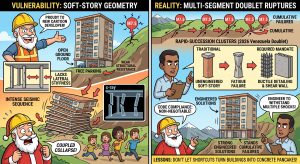
Lessons from the 2026 Venezuela Doublet: Why Free Parking Floors are Structural Deathtraps: Santa builds a lucrative multi-story hill apartment with an open ground floor for parking, ignoring code compliance. Banta delivers a chilling diagnostic based on the devastating June 24, 2026 Venezuela M7.5 doublet tragedy, revealing why “soft-story” shortcuts turn buildings into concrete pancakes during rapid-succession ruptures.
The “Imported Water Pump” that Gathered Dust, and the “Wise Old Spring”
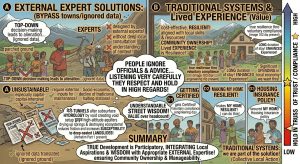
Beyond Capital-Intensive Jargon: The Power of Lived Experience
Top-down, capital-intensive solutions designed by external experts without deep local consultation often prove unsustainable, quickly falling apart when external inputs dry up. True Himalayan resilience depends on the “lived experience” embedded within the local socio-ecological fabric. Traditional systems, developed over generations, are inherently more cost-effective, resilient, and aligned with local skills and resources. Achieving lasting safety requires a deeply participatory approach—one that integrates local knowledge and community aspirations with appropriate modern technologies to ensure true local ownership and manageability.
The Floating Plastic Factory and the Clean-Up Crusade
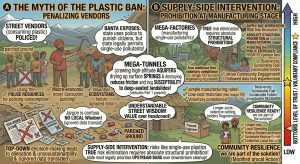
The Myth of the Plastic Ban: Santa is leading a village cleanliness drive, penalizing street vendors for using thin plastic bags. Banta exposes the macro-economic irony: why does the state legally permit mega-factories to manufacture single-use pollutants while using police resources to punish citizens for utilizing them?
The Mountain’s Broken Straw and the Empty Spring
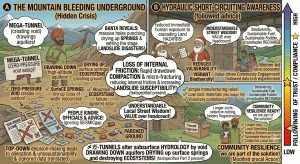
The Mountain Bleeding Underground: Santa thinks a new railway tunnel is pure engineering progress, but Banta reveals a hidden geological crisis. Discover the science of “Hydraulic Short-Circuiting” and why punching massive holes through the Himalayas is drying up surface springs while setting the stage for deep-seated landslide disasters.
The Tilted Layers of Barfi and the Limit of Greed
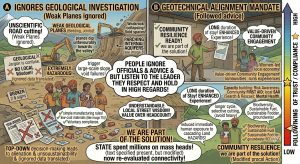
Rushing road alignments through the Himalayas without deep geological and geotechnical investigations invites structural failure, particularly when cutting slopes where weak geological planes dip unfavorably toward the valley. True mountain safety requires us to establish a scientific consensus on non-negotiable “no-go” zones and re-evaluate the assumption that every single settlement must have road connectivity, shifting instead toward a holistic approach that respects strict geographical constraints.
The Staggered Pass and the Lesser-Known Paradise
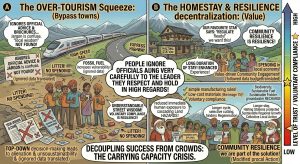
Shattering the Hotspot Habit: How Digital Portals and Homestays Can Save the Himalayas: Santa attempts to pack another massive crowd into saturated, water-scarce Nainital hotels. Banta steps in with an active regulation model, proving why digital entry staggering and diverting crowds to community-led village homestays is the ultimate strategy to decompress high-risk ecosystems.