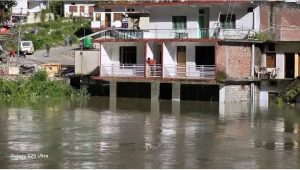
Why Bribes Thrive When Building Codes Confuse: Santa is ready to abandon his home safety because a corrupt inspector brought a manual written in technical riddles. Banta steps in with two mangoes and a piece of string to prove that real disaster resilience doesn’t require complex legal policing—it requires common sense and the power of voluntary compliance.
Search Results for: earthquake
The “Breathable Walls” and the “Pinning” Beams
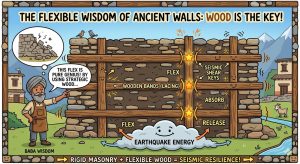
Ever wonder why those ancient wooden-framed buildings still stand after all this time? It’s not just luck; it’s a centuries-old masterclass in disaster resilience, using a simple but powerful tool: wood. Our latest deep dive into seismic performance uncovers the ingenious ways traditional builders turned wood into the backbone of earthquake resistance, a wisdom we ignore at our own peril in modern construction.
The 2026 Disaster Sentinel: The Tectonic-Cryospheric Pulse

As a sharp M 4.0 earthquake jars eastern Nepal’s high-altitude valleys and rescuers battle persistent rains in the Philippines to retrieve victims of the Mindanao megathrust, the Himalayas are navigating an intense pre-monsoon thermal transition. Driven by a 24-year low in seasonal snow persistence, the mountain’s structural foundations are directly exposed to unseasonal heavy rains and crustal stress. From innovative laboratory work mapping how deep blind thrust faults deform our valley floors, we examine the changing physics of mountain survival. Discover why a simple staircase-shaped crack in your external masonry is your most vital early warning of a moving foundation.
The 2026 Disaster Sentinel: The Planetary Harmonic Oscillation

As the planet ‘rings like a bell’ following the devastating M 7.8 megathrust earthquake in the Philippines and an unprecedented M 6.1 shock shatters historical patterns in the Gulf of Mexico, the Himalayas are silently processing these global energy waves. Stripped of their protective snow blankets by a 24-year climate deficit, high-altitude rock faces are facing a dangerous mix of deep meltwater saturation and distant seismic vibrations. Discover why a simple hanging plumb line in your living room can reveal how your home is responding to the deep earth’s latest planetary chords.
Santa’s “Modern Maze” vs. Banta’s “Sensible Rectangle”

Think “plain” and “boxy” means basic? Think again. The simple rectangular plans and balanced proportions of traditional Himalayan houses were actually sophisticated, practical engineering. This inherent symmetry minimized torsional effects during earthquakes, aligning with modern seismic codes that prioritize regular building configurations for maximum resilience.
The 2026 Disaster Sentinel: The Tectonic-Cryospheric Pulse
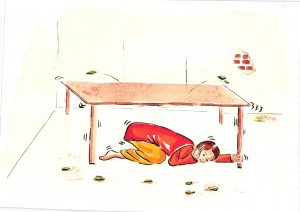
As a historic M 7.8 megathrust earthquake shatters coastal infrastructure in the Philippines and deep oceanic rifts shake the Gulf of Mexico, the Himalayas are fighting a quiet battle against a 24-year low in seasonal snow persistence. Driven by an intense thermal transition, our rivers are burning through ancient fossil ice capital while mountain slopes absorb dangerous solar energy. From innovative laboratory methods tracking how global earthquakes can trigger landslides half a world away, we analyze the shifting rules of mountain defense. Discover why a strange ‘hissing’ sound from your local hillside spring is the ultimate early alert for a moving mountain.
The Mud-Brick Mirage and the Code Compliance Clout
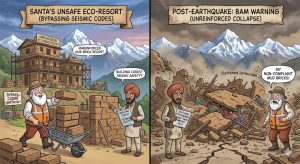
The Mirage of Cheap Construction: Santa tries to build an eco-resort using unreinforced mud bricks to save money and bypass code inspections. Banta brings a chilling warning from the 2003 Bam Earthquake to explain why heavy, non-compliant earthen architecture is a silent killer during seismic events.
The 1892 Bricks and the Time-Bomb Terrace
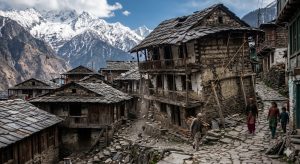
The Fragile Glory of Heritage Buildings: Santa treats his 19th-century brick shop as an unbreakable fortress. Banta brings a lesson from Paso Robles, California, to show why Unreinforced Masonry (URM) is the first thing to shatter when the ground shifts. Learn the critical need for seismic retrofitting.
The Selfie Point Peril and Banta’s Evacuation Drill
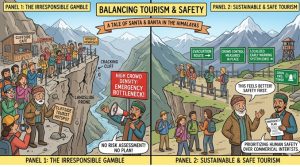
Creating tourist hotspots on cliff edges and landslide zones without rigorous risk assessments is an irresponsible gamble with human lives. High crowd density in these geographically vulnerable areas severely bottlenecks emergency responses, turning manageable incidents into mass tragedies. True sustainable tourism demands that crowd control measures, clear evacuation protocols, and localized early warning systems are integrated into infrastructure before the first ticket is sold—consistently prioritizing human safety over commercial interests.
The 2026 Disaster Sentinel: The Tectonic-Cryospheric Pulse

As a towering 2.5-kilometer ash column from Mount Lewotobi Laki-Laki forces airport closures in Indonesia, and Nepal marks World Environment Day by warning against reckless mountain development, the Himalayas face a hidden structural test. Moving beyond old reactive models, laboratory insights into ‘Hydraulic Short-Circuiting’ are revealing how deep tunneling can strip a mountain of its internal water, drying out surface springs while priming hillsides for catastrophic failures. Discover why a simple gap between your lawn and your home’s foundation wall is the ultimate early diagnostic for a moving hillside.