
The label “green energy” can be misleading if the associated geological and environmental risks to local communities are not fully assessed and mitigated. Comprehensive and transparent environmental and geological impact assessments are non-negotiable before approving large-scale hydropower projects in the Himalayas.
Search Results for: earthquake
Santa’s “Pakka Cement Dream” vs. Banta’s “Wall of Worry”

Blanket condemnation of traditional structures after an earthquake often masks the real culprit: structural incompatibility. Across mountain regions, the rapid, status-driven adoption of cement-concrete has created dangerous structural hybrids, such as placing heavy concrete slabs on top of old stone walls. Discover why true resilience depends on strict engineering compatibility and localized technical guidance, rather than the blind pursuit of a “modern” aesthetic.
The Lazy Mountain and Newton’s Grudge
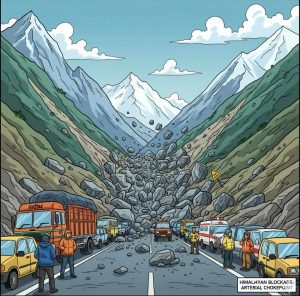
Does the mountain obey Newton? Santa thinks the hills are lazy, but Banta explains the “Law of Inertia” behind landslides. Discover why the “External Trigger” of rain and earthquakes is the only thing standing between a peaceful slope and a deadly disaster.
The 2026 Disaster Sentinel: The High-Altitude Amplification
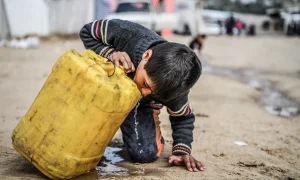
As southern Myanmar recovers from a sharp M 5.2 tectonic shock and global health agencies activate emergency protocols for Central Africa, the Himalayas are fighting an invisible battle against High-Altitude Amplification. From the accelerating thaw of permafrost that acts as the mountain’s internal cement to the 116-year-old warning of the Halley’s Comet panic, we analyze why 2026 is rewriting the physics of mountain safety. Discover why a trickle of dry gravel down an un-rained cliff face is the most critical diagnostic of a mountain un-anchoring itself.
The ‘Resilience Umbrella’
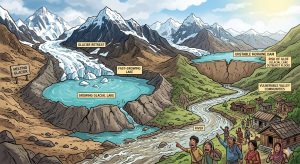
Is your “Earthquake-Proof” house ready for a Cloudburst? Santa wants two separate budgets, but Banta explains why true resilience is like a good khichdi—everything has to be mixed together. A deep dive into why we must factor climate extremes into seismic safety.
The 2026 Disaster Sentinel: The Multi-Hazard Cascade
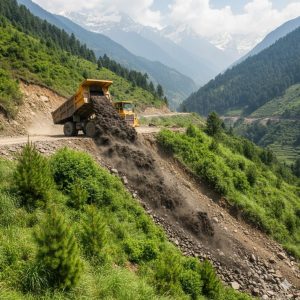
As a M 5.2 earthquake forces the evacuation of thousands in South China and the WHO steps up its global emergency response, ICIMOD’s latest report delivers a reality check: the Himalayas are entering a high-stakes multi-hazard zone. From the internal ‘pore-water’ mechanics that un-anchor our hillsides to the 46-year legacy of the Mount St. Helens collapse, we explore why 2026 demands that we stop treating natural hazards in isolation. Discover why a sudden shift in your local rock spring’s exit point is the ultimate underground diagnostic for a moving mountain.
Santa’s Wish for “Grand Windows” vs. Banta’s “Strengthened Openings”

The survival of centuries-old timber-reinforced structures during major Himalayan tremors warns us that “modern” isn’t always “safer.”
The Giant’s Overflowing Bathtub

Think glacial lakes are just scenic spots? In the shadow of the Himalayas, they are “Giant Bathtubs” waiting for a shake. Santa and Banta explore how earthquakes can trigger catastrophic floods (GLOFs) and why seismic safety is now a water-management issue.
The 2026 Disaster Sentinel: The Tectonic-Cryospheric Pulse

As the WHO faces calls to declare the climate crisis a global public health emergency and Japan rides out a powerful M 6.7 marine earthquake, the Himalayas are silently adjusting to a 24-year low in snow persistence. From the historic ‘Allah Bund’ template showing how earthquakes can instantly rewrite our river maps to the hidden warnings buried inside your local well water, we look at why 2026 demands a total overhaul of mountain safety. Discover why a sudden change in your groundwater’s clarity is the ultimate underground diagnostic for a moving hillside.
The 2026 Disaster Sentinel: The Tectonic-Cryospheric Pulse

As a deep M 4.0 tremor jars the Myanmar border and an avalanche claims lives on Mount Makalu, ICIMOD’s latest analysis delivers a reality check: multi-hazard disasters are altering our vulnerability baseline. From urban flood zones in Assam to the hidden survival network of Himalayan Dharas (springs), we look at why decentralizing our safety parameters is no longer an experiment—it is our primary anchor. Discover why checking your local natural spring’s exit point is the ultimate raw diagnostic for slope movement today.