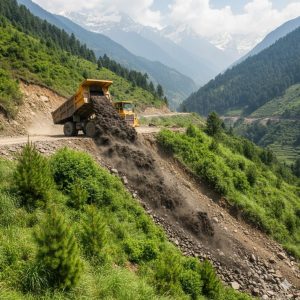
As a M 5.2 earthquake forces the evacuation of thousands in South China and the WHO steps up its global emergency response, ICIMOD’s latest report delivers a reality check: the Himalayas are entering a high-stakes multi-hazard zone. From the internal ‘pore-water’ mechanics that un-anchor our hillsides to the 46-year legacy of the Mount St. Helens collapse, we explore why 2026 demands that we stop treating natural hazards in isolation. Discover why a sudden shift in your local rock spring’s exit point is the ultimate underground diagnostic for a moving mountain.
Santa’s Wish for “Grand Windows” vs. Banta’s “Strengthened Openings”

The survival of centuries-old timber-reinforced structures during major Himalayan tremors warns us that “modern” isn’t always “safer.”
The Giant’s Overflowing Bathtub

Think glacial lakes are just scenic spots? In the shadow of the Himalayas, they are “Giant Bathtubs” waiting for a shake. Santa and Banta explore how earthquakes can trigger catastrophic floods (GLOFs) and why seismic safety is now a water-management issue.
The 2026 Disaster Sentinel: The Tectonic-Cryospheric Pulse

As the WHO faces calls to declare the climate crisis a global public health emergency and Japan rides out a powerful M 6.7 marine earthquake, the Himalayas are silently adjusting to a 24-year low in snow persistence. From the historic ‘Allah Bund’ template showing how earthquakes can instantly rewrite our river maps to the hidden warnings buried inside your local well water, we look at why 2026 demands a total overhaul of mountain safety. Discover why a sudden change in your groundwater’s clarity is the ultimate underground diagnostic for a moving hillside.
The 2026 Disaster Sentinel: The Tectonic-Cryospheric Pulse

As a deep M 4.0 tremor jars the Myanmar border and an avalanche claims lives on Mount Makalu, ICIMOD’s latest analysis delivers a reality check: multi-hazard disasters are altering our vulnerability baseline. From urban flood zones in Assam to the hidden survival network of Himalayan Dharas (springs), we look at why decentralizing our safety parameters is no longer an experiment—it is our primary anchor. Discover why checking your local natural spring’s exit point is the ultimate raw diagnostic for slope movement today.
The ‘Combo Meal’ of Chaos

What’s worse than a Great Earthquake? An earthquake that strikes during a record-breaking monsoon. Discover why Santa thinks disasters have “manners” and why Banta insists that in 2026, we must prepare for the “Combo Meal” of seismic and climatic fury.
The 2026 Disaster Sentinel: The Tectonic-Cryospheric Pulse
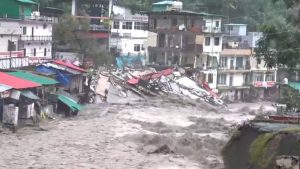
As a M 3.0 tremor shakes Nepal and new NDRF centres rise in the foothills, the ICIMOD Snow Update 2026 confirms a 24-year record low in snow persistence. From the ‘poisonous black rain’ in Tuapse to the ‘Digital Twin’ protocols modeling our headwaters, we explore why 2026 is the year the ‘Water Tower’ truly began to change. Discover why a simple sheet of aluminum foil is your best defense against the approaching May thermal surge.
The 2026 Disaster Sentinel: The Vernal Hydraulic Surge
As a M 4.3 tremor shakes Afghanistan today, scientists at the Khangri glacier have identified a ‘sinking zone’ and a newly formed 16,500-foot proglacial lake. From the geochemical ‘blood work’ of glaciers to the 100 km/h storms in Canada, we explore why 2026 is the year the ‘Water Tower’ truly began to run dry. Discover why your local well-water clarity is the most critical inland sentinel for the spring thaw.
The VIP ‘Thanda-Ghar’ and the Neighborhood Watch

Santa’s “VIP Cooling Lounge” was a disaster until Banta showed him the power of a wet jute bag and a neighborly heart. In the record-breaking heat of 2026, the best cooling technology isn’t a machine—it’s community solidarity.
The 2026 Disaster Sentinel: The Tectonic-Cryospheric Pulse

As a M 3.0 tremor shakes Nepal today, scientists at the Khangri glacier have identified a ‘sinking zone’ and a newly formed 16,500-foot proglacial lake. From the 18-year legacy of the Sichuan quake to the ‘Digital Twin’ models now tracking the Brahmaputra’s headwaters, we explore why 2026 is the year the ‘Water Tower’ truly began to change. Discover why today’s ‘Milky Stream’ is your most critical early warning for a downstream flood.